By Rai Haider
October 21, 2026
Types of Flutes in Corrugated Boxes: A, B, C, E and F Flute Explained
Two boxes can look identical on a shelf and behave very differently in a delivery van. In most cases, the difference sits inside the board: the flute.
The flute decides how thick a box is, how well it cushions a product, how much weight it takes when stacked and how cleanly it prints. Choose the wrong one and you either pay for strength you do not need or watch products arrive damaged.
This guide explains the main types of flutes in corrugated boxes, what each one is used for, how single, double and triple wall board differ, and how to read the specifications a supplier sends you.
Comprehensive Guide to Corrugated Box Flutes and Materials
What is a flute in a corrugated box?
Corrugated board is made from a wavy sheet of paper, called the fluting or medium, glued between flat sheets of paper called liners. Each wave in that middle layer is a flute.
The arched shape is what makes corrugated board so useful. The arches resist pressure from the sides and act as a cushion, while the upright parts of each wave work like small columns that resist crushing when boxes are stacked. The air trapped inside the flutes also gives a degree of insulation.
Flutes are described by two measurements: their height and how many of them fit into a set length of board. Tall flutes with fewer waves give more cushioning. Short flutes with more waves give a flatter, denser surface that resists punctures and prints well. Every box in our range of corrugated shipping boxes is built on one of these trade-offs.
How many types of flutes are there in corrugated boxes?
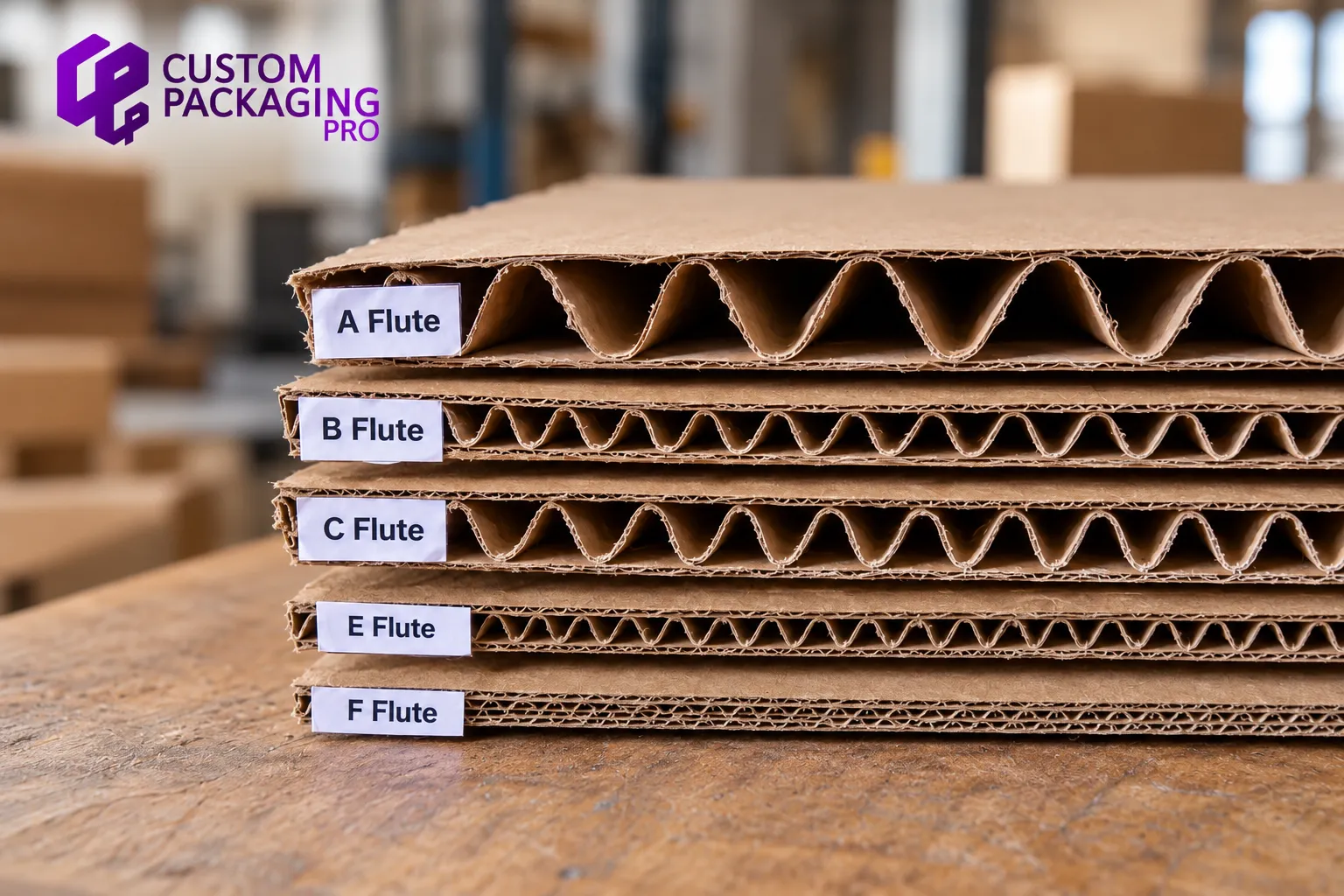
There are five standard flute types in everyday use: A, B, C, E and F. These are the profiles you will find in almost every packaging specification.
Two details often confuse buyers:
- The letters do not follow size. The flutes were named in the order they were introduced, not from largest to smallest. A flute came first, B flute followed for lighter goods, and C flute was developed later as a middle ground between the two.
- There is no standard D flute. Various designs have been suggested over the years, but none became a commercial board.
Smaller "microflutes" such as G, N and O flute also exist. They are used mainly for specialist retail and folding-carton work and are far less common than the five standard types.
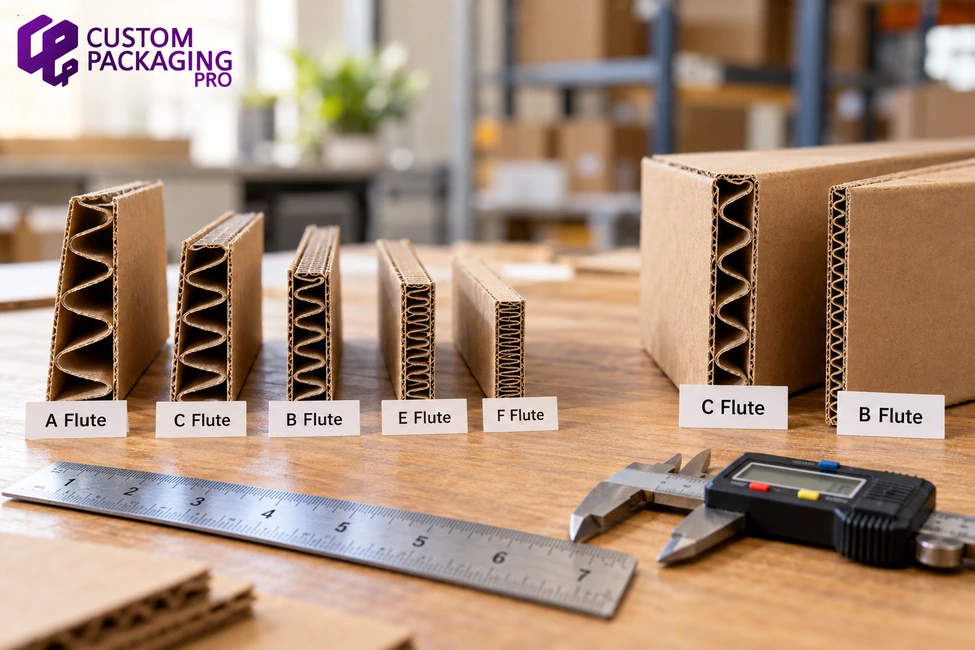
Sorted by thickness, the corrugated flute sizes from largest to smallest are: A, C, B, E, F.
A flute: maximum cushioning
A flute is the tallest standard profile. Its flutes are roughly 4.8mm high (about 3/16 inch), with around 33 flutes per foot.
Because the arches are tall and widely spaced, A flute traps more air than any other single profile. That makes it good at absorbing shocks and gives strong stacking performance for its weight.
Typical uses:
- Fragile items such as glassware and ceramics
- Products that need extra cushioning in transit
- Boxes that will sit at the bottom of a stack
The trade-off is bulk. A flute boxes take up more space flat-packed and in transit, and the tall arches give a less even surface for detailed print. For many UK eCommerce businesses, custom shipping boxes in a thinner profile are a better balance between protection and parcel size, with A flute saved for genuinely fragile goods.
B flute: puncture resistance and a flat print surface
B flute has a flute height of around 3mm (about 1/8 inch) and roughly 47 flutes per foot.
With more waves packed into the same length, B flute forms a stiff, dense board. It resists punctures and crushing well for its thickness, and its flatter surface takes print better than A or C flute.
Typical uses:
- Heavy but robust goods such as canned or jarred products
- Die-cut boxes and inserts
- Internal partitions and dividers
- Printed boxes where the board must stay fairly slim
B flute is also a common choice for postal boxes because it keeps the board compact, which helps keep parcels within carrier size limits.
C flute: the all-round shipping flute
C flute sits between A and B. Its flutes are around 4mm high (roughly 5/32 to 3/16 inch), with about 39 flutes per foot. Some manufacturers produce a slightly tighter version with up to 42 flutes per foot.
C flute is widely regarded as the most common flute for shipping cartons. It gives better cushioning than B flute and better stacking strength than its thickness would suggest, without the bulk of A flute.
Typical uses:
- General shipping cartons
- Storage and removal boxes
- Palletised goods
- Products that need a balance of cushioning and stacking strength
E flute: slim, smooth and print-friendly
E flute is the first of the microflutes. Its flutes are roughly 1.6mm high (about 1/16 inch), with around 90 flutes per foot.
E flute was originally developed as a corrugated alternative to paperboard cartons. It is much thinner than B flute, but the corrugated structure still gives more crush resistance than a plain card of similar thickness. The very flat surface makes it suitable for high-quality printing, including litho-laminated finishes.
Typical uses:
- Retail and display packaging
- Cosmetic and beauty boxes
- Small electronics
- Subscription and eCommerce mailers
For brands that ship lighter products, E flute is often the starting point for custom mailer boxes. It folds neatly, keeps the box slim and gives artwork a crisp finish.
F flute: the thinnest standard flute
F flute is the finest of the five standard profiles. Its flutes are approximately 0.8mm high (about 1/32 inch), with around 125 flutes per foot.
F flute was first developed to replace polystyrene and paperboard containers in the fast food sector. Today it is used where a box needs to feel close to rigid card but keep some of the strength of corrugated board.
Typical uses:
- Small premium retail boxes
- Fragrance, jewellery and speciality items
- Point-of-sale packaging where appearance matters most
F flute offers very little cushioning, so it is chosen for presentation and light protection rather than transit protection for fragile goods.
Corrugated flute size chart
The figures below are typical industry values. Actual measurements vary between manufacturers, and the finished board is always slightly thicker than the flute alone because the liners add to the total.
| Flute |
Approx. flute height |
Flutes per foot (approx.) |
Flutes per metre (approx.) |
Main strength |
Common uses |
| A |
4.8mm (3/16 inch) |
33 |
108 |
Cushioning and stacking |
Fragile goods, heavy-duty cartons |
| C |
4mm (5/32 to 3/16 inch) |
39 |
128 |
All-round balance |
General shipping cartons |
| B |
3mm (1/8 inch) |
47 |
154 |
Puncture resistance, print |
Postal boxes, die-cuts, partitions |
| E |
1.6mm (1/16 inch) |
90 |
295 |
Smooth print surface |
Retail, cosmetics, mailers |
| F |
0.8mm (1/32 inch) |
125 |
410 |
Fine finish, slim profile |
Small premium retail boxes |
Corrugated board thickness chart (finished board)
Finished board thickness depends on the liners as well as the flute. As a general guide:
| Board |
Typical finished thickness |
| E flute single wall |
1.5 to 2mm |
| B flute single wall |
2.5 to 3.5mm |
| C flute single wall |
3.5 to 4.5mm |
| EB double wall |
4.5 to 5.5mm |
| BC double wall |
6 to 7mm |
Always ask for the exact board specification from your supplier before finalising box sizes, especially if you are designing to tight internal dimensions.
Difference between B flute and C flute corrugated boxes
B flute and C flute are the two profiles most buyers compare, as both are common for shipping boxes. The key differences are:
| Feature |
B flute |
C flute |
| Flute height |
About 3mm |
About 4mm |
| Flutes per foot |
About 47 |
About 39 |
| Board thickness |
Thinner |
Thicker |
| Cushioning |
Lower |
Higher |
| Puncture resistance |
Higher for its thickness |
Good |
| Stacking strength |
Good |
Generally higher with the same liners |
| Print quality |
Better |
Fair |
| Best for |
Postal boxes, printed boxes, die-cut designs, heavy but robust goods |
General shipping cartons, storage, goods needing more cushioning |
In short: choose B flute when you want a slimmer, printable box with good puncture resistance. Choose C flute when cushioning and stacking matter more than board thickness.
If branding is a priority, B flute usually gives the cleaner result on custom printed corrugated boxes, while C flute suits plain transit cartons that will spend time in warehouses and on pallets.
Single wall vs double wall vs triple wall cardboard
The number of walls refers to how many fluted layers a board has.
| Construction |
Layers |
Typical use |
| Single wall |
2 liners + 1 fluted layer |
Most retail, postal and eCommerce boxes |
| Double wall |
3 liners + 2 fluted layers |
Heavier goods, long-distance shipping, removals, stacking |
| Triple wall |
4 liners + 3 fluted layers |
Very heavy or bulky goods, industrial and bulk containers |
Single wall board is light, cost-effective and the right choice for most everyday products.
Double wall board adds a second fluted layer and a third liner. It is noticeably stiffer and stronger, but also heavier and thicker. It suits heavy items, fragile goods that need more protection and boxes that will be stacked high.
Triple wall board is used for heavy-duty applications where the box may replace a wooden crate.
Are corrugated boxes double walled? Not always. Most standard shipping and postal boxes are single wall. Double wall is used when weight, fragility or stacking height calls for it. Our guide to corrugated packaging as a material covers how these constructions perform in more detail.
Common double wall flute combinations
- BC flute: a B flute layer bonded to a C flute layer. This is the most common double wall combination for heavy shipping cartons, removals and stacked goods. Finished board is usually around 6 to 7mm thick.
- EB flute: an E flute layer bonded to a B flute layer. The E flute side gives a smooth surface for printing, while the B flute adds strength. It is often used for printed shipping boxes and retail displays, at around 4.5 to 5.5mm thick.
- Triple wall combinations: typically built from A, B and C flutes for maximum strength.
Large bulk containers used for pallet loads are a good example of where double and triple wall board earns its place. Our gaylord boxes buying guide looks at those heavy-duty formats.
How is cardboard thickness measured?
Cardboard thickness is measured as caliper, the total thickness of the finished board from outer liner to inner liner. It is usually given in millimetres in the UK, though some specifications use inches or points.
Caliper is affected by:
- The flute profile (the biggest factor)
- The weight of the liners and fluting paper, measured in grams per square metre (gsm)
- The number of walls
Reading a board grade
Suppliers often describe board with a short code covering the outer liner, flute and inner liner. Liners are commonly either Kraft (K), made from virgin fibre, or Test (T), made from recycled fibre. Kraft is stronger and easier to print on, so it is usually used on the outside.
For example, 125K/B/125T means:
- 125gsm Kraft outer liner
- B flute
- 125gsm Test inner liner
A double wall board might read something like 150K/BC/150T. Heavier liners make a stronger, slightly thicker board. If you prefer a natural brown finish with good strength, kraft corrugated boxes use a Kraft outer liner as standard.
Strength tests
Thickness alone does not tell you how strong a box is. Two common tests are used instead:
- Edge Crush Test (ECT): measures how much force a strip of board can take on its edge before crushing. It is a good guide to stacking strength.
- Burst test: measures how much pressure the board can take before it ruptures. It is a good guide to puncture and rough-handling resistance.
A well-specified single wall board can outperform a poorly specified double wall board, so ask for test values when strength really matters.
Corrugated board vs chipboard and folding carton
Microflutes such as E and F flute sit close to solid board in thickness, which is why buyers sometimes confuse them with chipboard or folding carton.
The difference is structure. Corrugated board has a fluted layer, so it is stronger and more crush resistant for its weight. Chipboard is a single solid sheet of compressed recycled paper. It gives a smooth, rigid feel and is common in cereal-style cartons and rigid gift boxes, but it does not cushion in the same way.
If you are deciding between the two, our article on what chipboard is explains where it works best.
Which flute is best for your product?
The best flute depends on product weight, fragility, how the box will travel and how much the print matters.
| Situation |
Recommended starting point |
| Light retail product, premium print |
E or F flute |
| Cosmetics, small electronics, subscription mailers |
E flute |
| Postal boxes for robust products |
B flute |
| General shipping cartons |
C flute |
| Fragile goods needing extra cushioning |
A flute or double wall |
| Heavy goods or high stacking |
BC double wall |
| Printed shipping box that also needs strength |
EB double wall |
| Very heavy or bulk pallet loads |
Triple wall |
For online retailers, the right flute also affects shipping costs. A slimmer board keeps external dimensions down, which can keep parcels inside a cheaper carrier size band. E-commerce mailer boxes in E or B flute are a common choice for that reason.
How to identify the flute type of a box
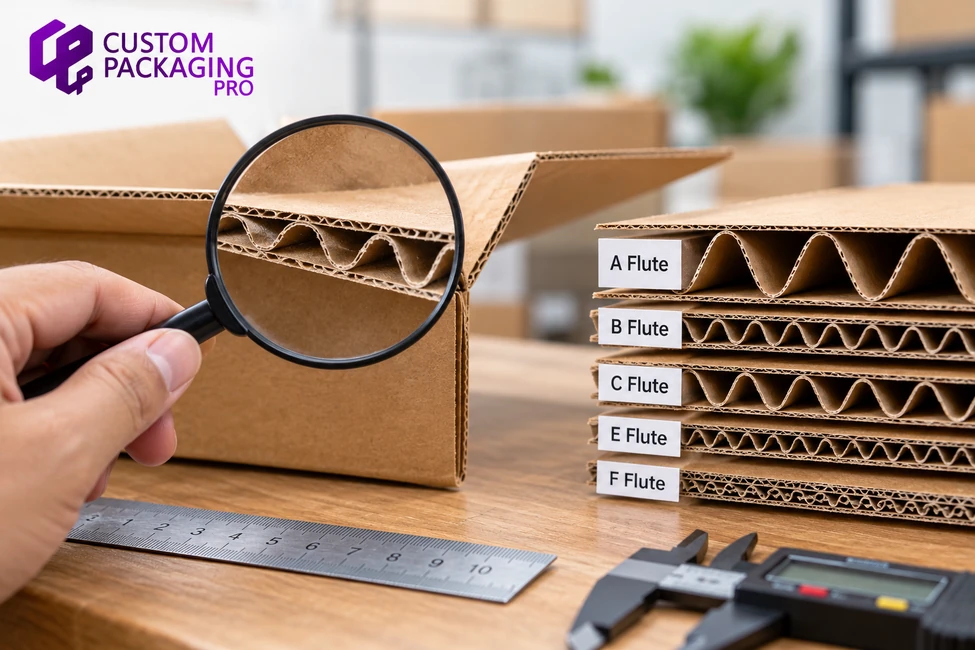
If you have an existing box and want to match it, a few quick checks usually tell you the flute:
- Look at the cut edge. Tall, wide waves point to A or C flute. Tight, shallow waves point to B, E or F flute.
- Measure the thickness. Use a ruler or calipers on the edge, then compare it with the thickness chart above.
- Count the flutes. Count the waves across 30cm (roughly a foot) of board and compare the figure with the flute size chart.
- Check the walls. Two rows of waves mean double wall. Three mean triple wall.
- Look for a stamp. Many shipping cartons carry a manufacturer's certificate or board grade printed on a flap.
For a wider view of how corrugated board compares with other cardboard materials, our cardboard packaging material guide is a useful next read.
Not sure which flute to choose?
Getting the flute right is one of the simplest ways to protect products, control shipping costs and present your brand well. At Custom Packaging Pro, our team can talk you through flute type, wall construction and board grade for your product when you request a quote. Share your product's size, weight and how it will be shipped, and we can recommend a starting specification.
Frequently asked questions
- Which flute is best for a corrugated box?
There is no single best flute. C flute is the usual choice for general shipping cartons, B flute suits postal and printed boxes, E flute suits retail and mailer boxes, and A flute or double wall board suits fragile or heavy goods.
- What are the five types of flutes?
The five standard flute types are A, B, C, E and F flute. A is the tallest and F is the thinnest.
- What is the difference between B flute and C flute corrugated boxes?
B flute is thinner (around 3mm flute height) with more flutes per foot, so it resists punctures and prints well. C flute is thicker (around 4mm) with fewer flutes per foot, so it cushions better and generally stacks better with the same liners.
- What are the different types of flutes?
Standard corrugated flutes are A, B, C, E and F. Microflutes such as G, N and O flute exist for specialist uses. Flutes are also combined into double wall boards such as BC and EB, and into triple wall boards for heavy-duty packaging.
- What are the three types of flutes?
In shipping packaging, the three most common flutes are A, B and C flute. These are the larger profiles used for transit boxes, while E and F are microflutes used mainly for retail and presentation packaging.
- What are the names of all types of flutes?
The standard names are A flute, B flute, C flute, E flute and F flute. Combinations are named by joining the letters, such as BC flute and EB flute. There is no standard D flute.
- What is a very small flute called?
A very small flute is called a microflute. E flute and F flute are the most common microflutes, and even finer profiles such as G, N and O flute are also made.
- How do you identify flute type?
Measure the board thickness, count the flutes across about 30cm of board, check how many fluted layers there are and look for a board grade or manufacturer's stamp on the box.
- What is the most common type of flute?
C flute is widely regarded as the most common flute for shipping cartons. B flute is also very common, particularly for postal boxes, die-cut designs and printed packaging.

 Custom Boxes
 Mailer Boxes
 Shipping Boxes
 Display Boxes
 Product Boxes
 Retail Packaging
 Luxury Packaging
 Sustainable Packaging
 Mylar Bags
 Labels & Stickers
 Inserts & Dividers
 Acrylic Signs
 Mylar and Zipper Bags
 Cosmetic Boxes
 Custom Candle Packaging Boxes
 Food and Beverage
 Display Packaging
 Pharma Packaging
 Custom Blister Packaging
 Stand Up Displays
 Kraft Boxes
 Cereal Packaging Boxes
 Bakery Packaging Boxes
 Eco-Friendly Boxes
 Electronics Packaging Boxes
 Custom Vape Boxes & Packaging
 CBD Packaging Boxes
 Rigid & Luxury Packaging Boxes
 Gift Boxes
 Custom Soap Boxes & Packaging
 Metalized Boxes
 Retail Boxes
 Subscription Boxes
 Invitation Boxes
 Corrugated Shipping Boxes
 Matte Finish
 Gloss Finish
 Soft Touch
 Foil Stamping
 Spot UV
 Embossing
 Debossing
 Window Cutouts