By Rai Haider
October 08, 2026
Gaylord Boxes: Sizes, Uses, Materials & Buying Guide
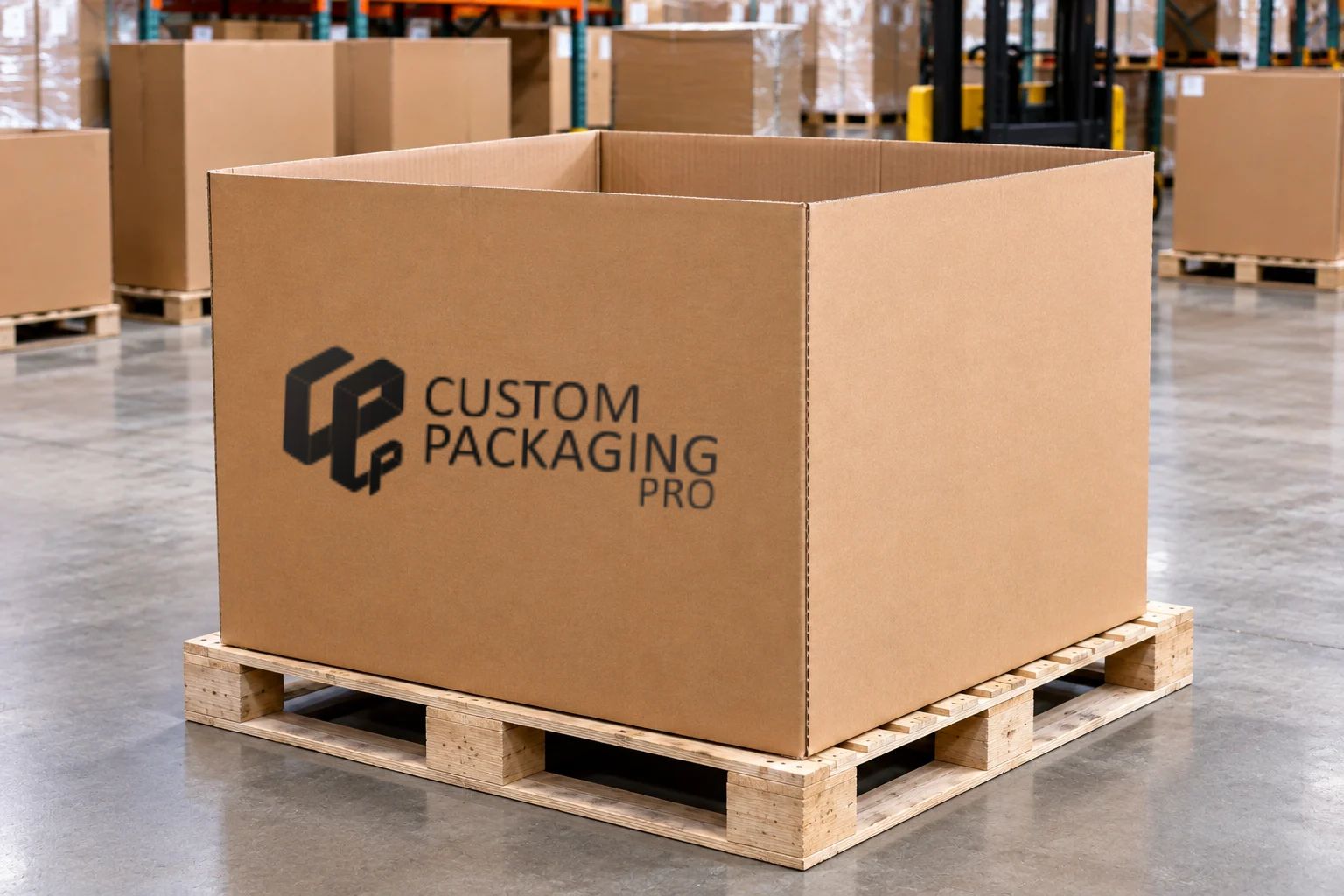
A Gaylord box is a large bulk container designed to hold and move substantial quantities of material as one unit. Unlike a standard shipping carton or shipping box that is usually handled individually, a Gaylord is generally used with a pallet and material-handling equipment such as a forklift or pallet jack.
These large containers are also known by names such as bulk box, bulk bin, pallet box, skid box, tote box, and octabin. In the United States and Canada, the term Gaylord is commonly associated with large corrugated pallet boxes, although the category also includes other constructions.
For warehouses, manufacturers, recyclers, distributors, agricultural operations, and other businesses handling bulk materials, the format can reduce the number of individual cartons required for storage and transportation.
The important thing to understand is that a Gaylord is not defined by one universal dimension. Size, wall construction, board strength, bottom style, cover, liner, and intended load can all vary between models.
What Is a Gaylord Box?
A Gaylord box is a large pallet-sized bulk container used for storing, collecting, transporting, or consolidating products and materials.
A typical corrugated version is made from multiple layers of corrugated fiberboard. Depending on the construction, it may have a separate bottom, flaps, a cover, or reinforced areas designed to improve its performance under load.
These containers can hold materials such as:
- Plastic components
- Agricultural products
- Recyclable materials
- Manufacturing parts
- Packaging materials
- Scrap
- Granular products
- Loose components
- Bagged products
- Waste and debris
The major advantage is scale. Instead of moving many small cartons individually, a facility can consolidate a larger quantity into one palletized container.
What Does Gaylord Box Mean?
The term describes a bulk packaging container rather than one specific box design.
Depending on the supplier or industry, you may see related terminology such as:
- Bulk box
- Bulk bin
- Pallet box
- Skid box
- Gaylord
- Octabin
- Tote box
- Corrugated bulk container
The exact construction can vary significantly.
One supplier may offer a 48 × 40 × 36-inch triple-wall container, while another may offer a different footprint or height. Current commercial listings show many configurations, including rectangular and octagonal designs.
That is why buyers should confirm the actual specifications instead of ordering solely by the word “Gaylord”.
Why Is It Called a Gaylord Box?
The name comes from the Gaylord Container Company, an early manufacturer associated with this type of large bulk container.
The term eventually became widely used as a generic industry description for large palletized bulk boxes. Historical references identify the original Gaylord Container Company with St. Louis and note that it was acquired by Crown Zellerbach in 1955.
The historical trademark record also shows that “GAYLORD BOXES” was used commercially in 1939 and registered in 1964 before the registration expired in 1984.
This history explains why someone can order a Gaylord from many different manufacturers today even though the name originated with a particular company.
How Big Is a Gaylord Box?
There is no single standard Gaylord box size.
The footprint and height can vary according to the intended application, pallet configuration, load requirements, and manufacturing design.
Common commercial configurations include footprints around:
- 48 × 40 inches
- 46 × 38 inches
- Other pallet-compatible dimensions
Heights can vary considerably. Current product listings include examples around 30, 36, 40, 41, 46, and 48 inches, among many other configurations.
Therefore, when someone asks about Gaylord box dimensions, the more useful question is: Which footprint, height, and wall construction do you need?
Gaylord Box Size and Capacity
The physical dimensions are only part of the specification.
Two boxes with similar external dimensions may have different load capabilities because of differences in:
- Wall count
- Board grade
- Edge Crush Test rating
- Bottom construction
- Reinforcement
- Load distribution
- Product density
- Stacking requirements
For example, suppliers can offer double-wall and triple-wall constructions, while industrial catalogs may list several ECT ratings.
The correct box should therefore be selected according to both volume and load requirements.
Gaylord Boxes on Pallets
One of the defining characteristics of a Gaylord is its relationship with the pallet.
A pallet provides a stable base and allows the filled container to be moved using:
- Forklifts
- Pallet jacks
- Warehouse carts
- Other material-handling equipment
A Gaylord itself is not the same thing as a pallet.
The pallet supports and transports the box, while the box contains the material.
Some bulk containers have integrated or specialized bottom constructions, but buyers should still confirm whether the selected model is intended to sit directly on a pallet and what type of handling equipment is appropriate.
Commercial descriptions specifically identify Gaylord containers as pallet-compatible bulk containers designed for movement with forklifts.
Is a Gaylord the Same as a Pallet?
No.
A pallet is a load-bearing platform. A Gaylord is a container placed on or integrated with a palletized handling system.
The two work together:
Product → Gaylord box → pallet → forklift or pallet jack
This arrangement allows large quantities of material to be moved as one handling unit.
For warehouses, this can simplify loading, unloading, staging, and internal transportation.
Corrugated Gaylord Boxes
Corrugated Gaylord boxes are among the most common forms of bulk packaging.
They are often constructed from double-wall or triple-wall corrugated fiberboard. The multiple layers provide greater structural performance than a standard single-wall shipping carton.
Corrugated construction can offer several practical advantages:
- Relatively low weight
- Easy handling
- Recyclability
- Efficient storage when collapsed
- Customizable dimensions
- Multiple wall-strength options
- Compatibility with pallets
Some models also use covers, liners, pads, or additional reinforcement depending on the application.
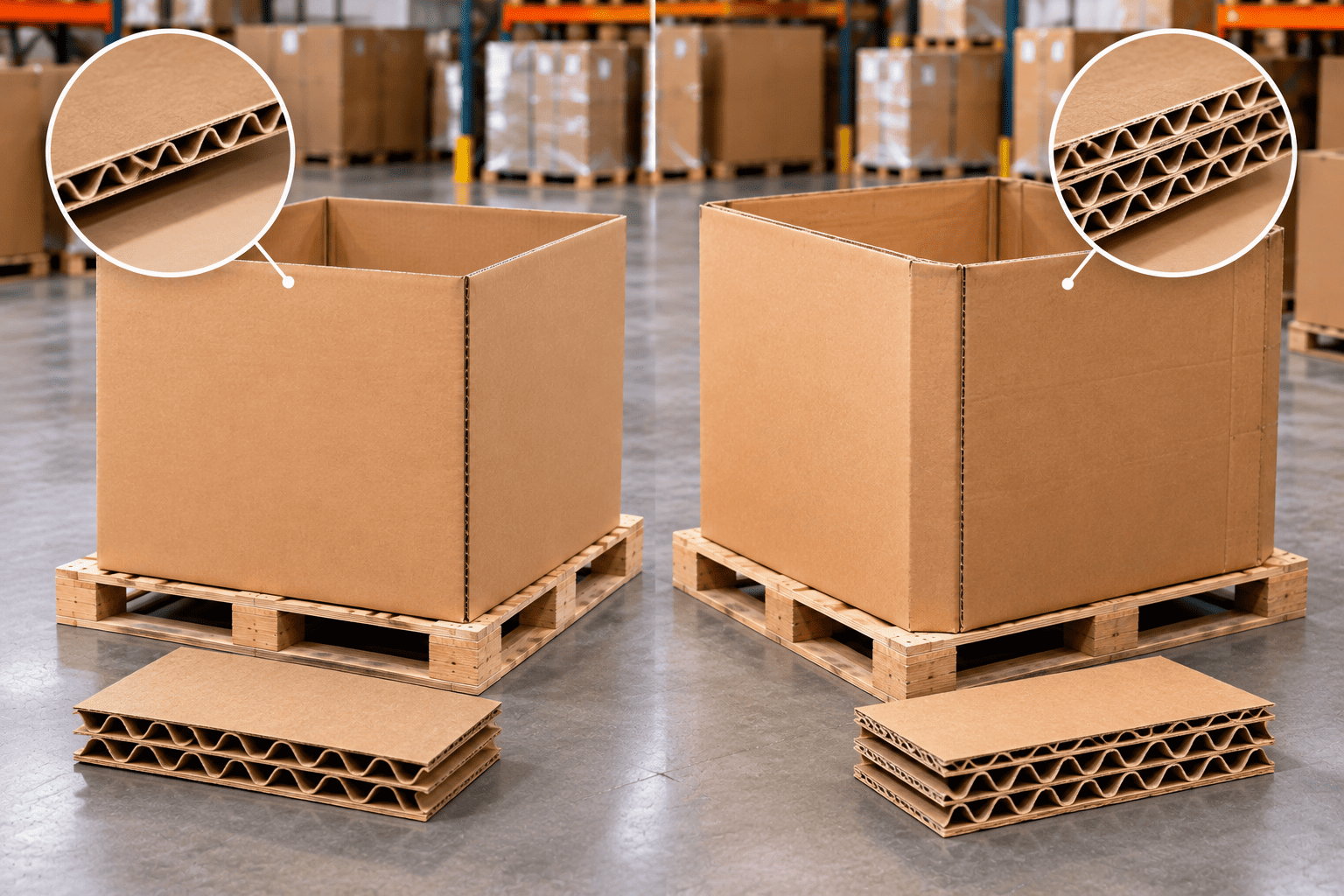
Double-Wall vs. Triple-Wall Gaylord Boxes
The wall construction affects the box's strength and handling characteristics.
Double-Wall
Double-wall construction uses two layers of corrugated board.
It can be appropriate for lighter bulk applications where extreme stacking strength is not required.
Triple-Wall
Triple-wall construction adds another corrugated layer and is commonly used when greater strength is needed.
The appropriate choice depends on the load rather than simply selecting the thickest available box.
Commercial catalogs currently list both double- and triple-wall Gaylord containers along with different board-strength ratings.
What Is an ECT Rating?
ECT stands for Edge Crush Test.
It measures the edge-crush strength of corrugated board and is commonly used to help evaluate stacking performance.
Commercial Gaylord listings can include several ECT ratings, such as 32, 44, 48, 51, and higher ratings depending on the construction.
A higher rating does not automatically mean the box is right for every application.
The final selection should consider the product weight, stacking arrangement, transportation conditions, and expected handling.
Gaylord Box Liners
Some products need an additional barrier between the contents and the corrugated container.
Gaylord box liners can be used for applications where the contents need additional separation or protection from the corrugated walls.
Liners may be useful for:
- Powders
- Granular materials
- Agricultural products
- Certain food-related materials
- Small loose components
- Materials that could leak or create dust
Bulk box liners are available in different dimensions and thicknesses, so the liner should be selected according to the product and box configuration.
Current suppliers offer liners specifically sized for Gaylord and tote applications.
Plastic Gaylord Boxes
Not every Gaylord-style bulk container is made from corrugated fiberboard.
A plastic Gaylord box can provide a reusable alternative for operations that repeatedly move the same type of material through a supply chain.
Plastic bulk containers may be useful when businesses need:
- Repeated reuse
- Moisture resistance
- Easy cleaning
- Durable construction
- Consistent dimensions
- Long-term warehouse use
The tradeoff is that reusable plastic containers generally involve a different purchase cost and handling model from disposable or recyclable corrugated boxes.
Reusable plastic totes are recognized as another form of bulk box construction alongside corrugated fiberboard.
Cardboard Gaylord Boxes vs. Plastic Containers
The choice between corrugated and plastic depends on the operating environment.
| Feature |
Corrugated Gaylord |
Plastic Bulk Container |
| Typical use |
Shipping and bulk handling |
Repeated internal or supply-chain use |
| Weight |
Relatively light |
Usually heavier |
| Moisture resistance |
Limited without additional protection |
Generally stronger |
| Reuse |
Application-dependent |
Designed for repeated use |
| Storage |
Can often be collapsed |
Usually maintains rigid form |
| End of life |
Often recyclable |
Depends on plastic type and recycling system |
| Initial cost |
Often lower |
Often higher |
Neither option is universally better.
A business shipping material one way may favor corrugated construction, while a closed-loop operation may benefit from reusable plastic containers.
What Are Gaylord Boxes Used For?
Gaylord boxes are used across many industries because they can consolidate large quantities of material.
Common applications include:
- Manufacturing: Manufacturers can use them to move components, work-in-process material, parts, and production scrap between facilities or workstations.
- Recycling: Recycling operations can collect paper, plastic, e-waste, and other recyclable materials in large containers.
- Agriculture: Bulk agricultural products can sometimes be collected or transported using palletized containers, with the appropriate liner and material construction where required.
- Distribution: Warehouses can consolidate large quantities of products into fewer handling units.
- Waste Collection: Facilities may use bulk containers to collect production waste, packaging waste, or debris.
Bulk boxes are used for loose parts, granular materials, powders, liquids, recycling materials, and other industrial applications, although special requirements apply to regulated or hazardous contents.
Gaylord Shipping Box Applications
A Gaylord shipping box can be useful when a shipment contains many units that would otherwise require numerous individual cartons.
For example, a manufacturer shipping several hundred lightweight components may be able to consolidate them into a palletized bulk container.
This can simplify:
- Loading
- Unloading
- Warehouse movement
- Inventory staging
- Bulk transportation
- Material collection
However, the box must be appropriate for the product's weight, shape, density, and transportation conditions.
Gaylord Box Dumper and Tipper Systems
Large bulk containers are not always emptied manually.
A Gaylord box dumper or Gaylord box tipper can be used to transfer material from the container into another processing or handling system.
These systems can be useful in operations where workers would otherwise need to repeatedly lift or scoop material from a large container.
Applications may include:
- Manufacturing
- Recycling
- Food processing
- Material handling
- Assembly operations
- Bulk ingredient handling
The equipment should be matched to the container's dimensions, load, and bottom construction.
Empty Gaylord Boxes
Businesses may also search for an empty Gaylord box when they need containers for an upcoming shipment or production process.
Before purchasing empty containers, consider:
- Required footprint
- Height
- Wall count
- Board strength
- Bottom construction
- Cover requirements
- Liner requirements
- Storage space
- Quantity needed
Empty boxes are often easier to store when they can be knocked down or folded.
That can reduce the warehouse space required before the containers enter service.
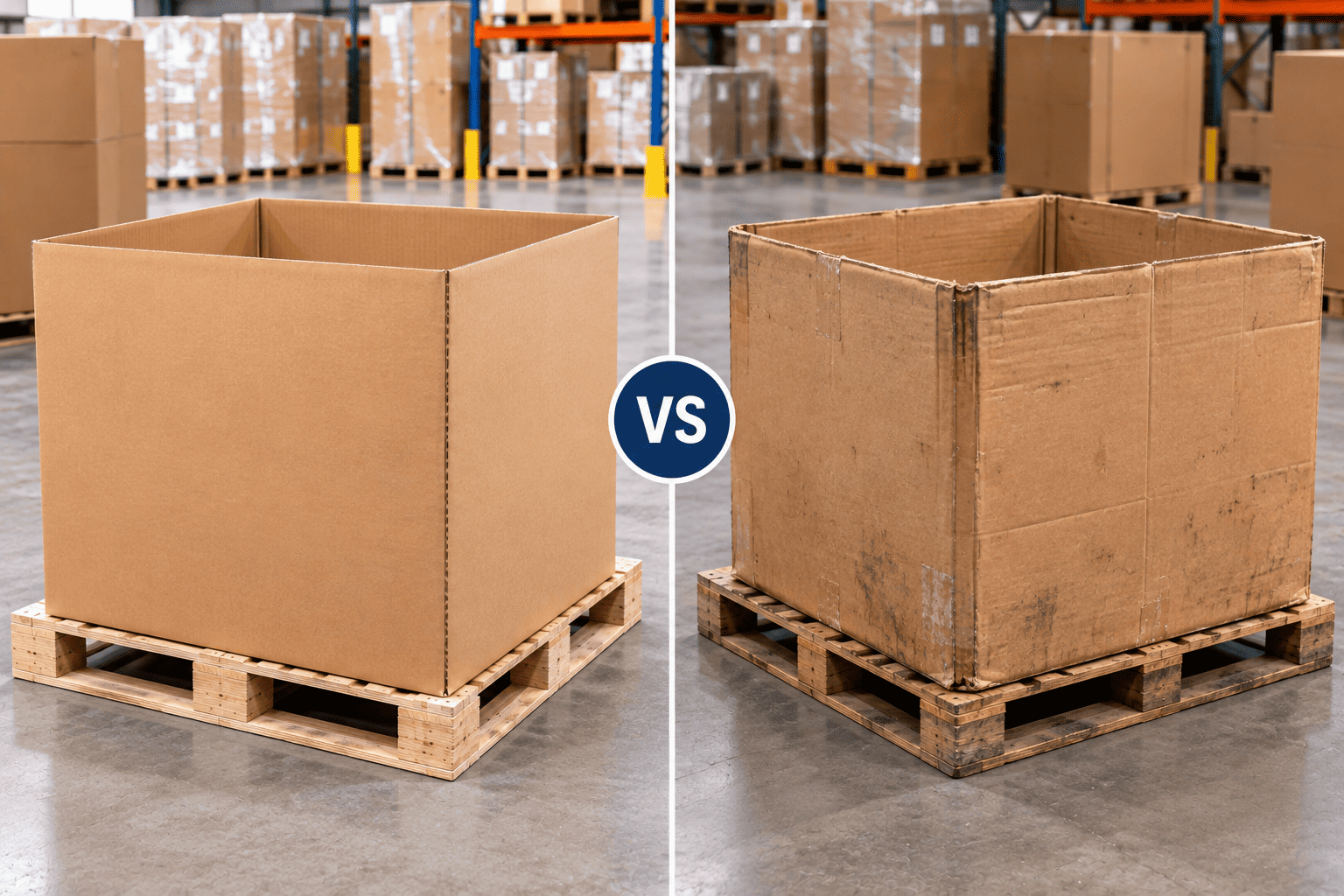
Used Gaylord Boxes
Used Gaylord boxes can be an economical option when appearance is less important than functionality.
Used containers may be suitable for applications such as:
- Recycling
- Scrap collection
- Warehouse storage
- Internal material movement
- Non-sensitive bulk goods
However, condition matters.
Before using a used box, inspect it for:
- Water damage
- Crushed corners
- Torn walls
- Weak bottom panels
- Contamination
- Excessive wear
- Damaged seams
- Deformation
Current suppliers sell used Gaylords in multiple sizes and wall constructions, showing that used inventory can vary significantly from one box to another.
New vs. Used Gaylord Boxes
The decision between new and used containers should be based on the application.
New Boxes
New containers can be preferable when:
- Load requirements are demanding
- Appearance matters
- Cleanliness is important
- Consistency is required
- The boxes will enter a controlled production environment
Used Boxes
Used boxes may make sense when:
- Budget is a major concern
- The application is industrial
- Appearance is not important
- The material is not sensitive
- The boxes will have a short service life
The cheapest box is not necessarily the lowest-cost solution if it fails during handling.
Gaylord Box Exchange and Reuse
Businesses that regularly use large quantities of bulk containers may have opportunities to reuse or exchange them.
A reuse program can reduce the number of new containers required when the boxes remain structurally suitable.
The feasibility depends on:
- Box condition
- Reverse logistics
- Storage
- Cleaning requirements
- Distance between facilities
- Type of material handled
For one-way shipments, corrugated containers may be more practical. For repeat movement between the same facilities, reusable systems can make more sense.
Gaylord Box Covers and Lids
A cover can protect the contents from dust, debris, and other external exposure.
It can also help make the load easier to stack or stage depending on the container design.
Not every Gaylord requires a separate lid. Some designs use flaps or other closure configurations.
Commercial catalogs distinguish between HSC, RSC, and lid-style closures, demonstrating that bulk container closure can vary by design.
How to Choose the Right Gaylord Box
Start with the material rather than the box.
Ask these questions:
- What are you putting inside? Loose parts, powders, scrap, agricultural products, and packaged goods can have very different requirements.
- How much does the load weigh? Weight affects wall construction, bottom strength, and handling requirements.
- Will the box be stacked? If yes, stacking strength becomes especially important.
- Will it be exposed to moisture? If moisture is possible, consider a liner, protective treatment, or another container construction.
- How will it be moved? Forklift, pallet jack, conveyor, and tipping equipment can influence the box configuration.
- Is the box reusable? If it will be used repeatedly, a reusable plastic solution may deserve consideration.
Gaylord Box Dimensions: What Should You Measure?
When ordering a bulk container, don't rely only on a general description.
Confirm:
- Outside length
- Outside width
- Outside height
- Inside length
- Inside width
- Inside height
- Pallet footprint
- Wall thickness
- Bottom style
- Cover dimensions
Commercial catalogs list both inside and outside dimensions because wall construction affects the usable interior space.
This distinction becomes important when the contents have a specific volume requirement.
How Many Books Does a Gaylord Box Hold?
There is no universal answer because books vary greatly in size, weight, binding, and packing arrangement.
A Gaylord filled with lightweight paperback books will hold a different quantity from one filled with large hardcover books.
More importantly, the maximum quantity should not be determined by volume alone.
The combined weight must remain appropriate for the box's construction, bottom strength, pallet, and handling equipment.
For dense materials such as books, weight can become the limiting factor before the available volume is completely filled.
Where Can You Buy Gaylord Boxes?
Businesses can purchase Gaylords from industrial packaging suppliers, box manufacturers, distributors, material-handling suppliers, and companies specializing in used packaging.
When comparing Gaylord boxes for sale, look beyond the headline price.
Check:
- New or used condition
- Dimensions
- Wall construction
- ECT rating
- Bottom design
- Covers
- Liners
- Quantity
- Shipping cost
- Pickup availability
Some suppliers offer local pickup or delivery, while others ship bulk containers to customers.
Gaylord Boxes for Sale Near Me
Searches for Gaylord boxes for sale near me usually indicate that transportation cost and pickup convenience are important.
This makes sense because large empty containers can take up considerable space during delivery.
A local supplier may offer:
- Same-day pickup
- Local delivery
- Lower transportation cost
- Used inventory
- Multiple sizes
- Opportunity to inspect boxes before purchase
Online suppliers may provide a broader selection.
The best option depends on your required quantity, location, dimensions, condition, and deadline.
Gaylord Box Wholesale Buying
For businesses requiring large quantities, Gaylord box wholesale purchasing can provide a more practical procurement method.
Before ordering in bulk, establish:
- Required monthly quantity
- Preferred dimensions
- Wall grade
- New or used condition
- Storage capacity
- Delivery schedule
- Acceptable substitutions
Standardizing one or two preferred sizes can also simplify warehouse operations when the same container is repeatedly used.
Gaylord Boxes in Modern Warehouse Operations
Large bulk containers remain useful because they solve a simple logistics problem: moving a large amount of material without breaking it into many small handling units.
Their usefulness comes from the combination of:
- Large capacity
- Pallet compatibility
- Forklift handling
- Corrugated strength
- Flexible dimensions
- Multiple wall constructions
- Reusable alternatives
The right container can therefore become part of a broader material-handling system rather than functioning as an ordinary shipping carton.
Final Thoughts: Choosing a Bulk Box That Fits the Job
A Gaylord box is best understood as a bulk handling solution, not simply an oversized cardboard box.
The right choice depends on what will go inside, how much it weighs, how it will be moved, whether it will be stacked, and whether the container needs to be reused.
Corrugated Gaylords can provide a practical option for shipping, recycling, manufacturing, agriculture, and warehouse applications. Plastic alternatives may make more sense where repeated reuse, cleaning, or moisture resistance is important.
Dimensions also deserve careful attention. There is no universal Gaylord box size, and commercially available containers vary in footprint, height, wall construction, board strength, closure style, and bottom design.
For buyers comparing new, used, wholesale, or local options, the lowest price should not be the only consideration. A container that matches the load and handling process can provide better value than a cheaper box that is unsuitable for the application.
Frequently Asked Questions About Gaylord Boxes
- Why is a box called a Gaylord?
The term comes from the Gaylord Container Company, an early manufacturer associated with large bulk containers. The company name became widely used as a generic industry term for this type of palletized bulk box. Historical records show commercial use of “GAYLORD BOXES” beginning in 1939.
- How much does a Gaylord box cost?
There is no universal price. Cost depends on dimensions, wall construction, condition, quantity, covers, liners, and delivery. Used boxes can cost considerably less than new heavy-duty containers, while specialized constructions can cost more. Current listings show substantial variation between sizes and wall types.
- What are Gaylord boxes used for?
They are used for bulk storage, shipping, recycling, manufacturing, agriculture, material collection, waste handling, and consolidating large quantities of products or components into palletized loads.
- Is a Gaylord the same as a pallet?
No. A pallet is a load-bearing platform, while a Gaylord is a bulk container that is generally used with a pallet for movement and handling.
- How large is a Gaylord box?
There is no single standard size. Many commercial models use pallet-compatible footprints, with 48 × 40 inches being a common example, but height and other dimensions vary widely.
- Where can you buy Gaylord boxes?
They are available through industrial packaging suppliers, distributors, box manufacturers, material-handling companies, and used-packaging suppliers. Local suppliers may offer pickup or delivery, while online sellers may offer broader selection.
- How much is a Gaylord?
The price depends on the exact specification. A used lightweight box may cost much less than a new triple-wall heavy-duty container. Quantity and freight can also significantly affect the final cost.
- How many books does a Gaylord box hold?
There is no fixed number because book dimensions and weights vary. The practical limit depends on both the available internal volume and the safe weight capacity of the box and pallet system.
- What is the cheapest place to get boxes?
For Gaylords, used packaging suppliers or local industrial sources may offer lower prices than buying new containers, especially when pickup is possible. However, condition, freight, and required strength should be included when comparing the actual cost.

 Custom Boxes
 Mailer Boxes
 Shipping Boxes
 Display Boxes
 Product Boxes
 Retail Packaging
 Luxury Packaging
 Sustainable Packaging
 Mylar Bags
 Labels & Stickers
 Inserts & Dividers
 Acrylic Signs
 Mylar and Zipper Bags
 Cosmetic Boxes
 Custom Candle Packaging Boxes
 Food and Beverage
 Display Packaging
 Pharma Packaging
 Custom Blister Packaging
 Stand Up Displays
 Kraft Boxes
 Cereal Packaging Boxes
 Bakery Packaging Boxes
 Eco-Friendly Boxes
 Electronics Packaging Boxes
 Custom Vape Boxes & Packaging
 CBD Packaging Boxes
 Rigid & Luxury Packaging Boxes
 Gift Boxes
 Custom Soap Boxes & Packaging
 Metalized Boxes
 Retail Boxes
 Subscription Boxes
 Invitation Boxes
 Corrugated Shipping Boxes
 Matte Finish
 Gloss Finish
 Soft Touch
 Foil Stamping
 Spot UV
 Embossing
 Debossing
 Window Cutouts