By Rai Haider
October 16, 2026
How to Reduce Packaging Costs Without Compromising Product Protection
Most packaging budgets get trimmed the same way: someone asks the supplier for a cheaper box. That can work once. The bigger savings usually sit somewhere else, in the space you ship, the board grade you specify, the number of box sizes you stock, and the minutes your team spends packing each order.
This guide covers practical ways to reduce packaging costs for US businesses, with a focus on changes that lower total spend without raising damage rates. If you want to understand how order volume shapes unit pricing, see our guide to MOQ and bulk discounts in custom packaging. Here, the focus is on what you can change.
Where Your Packaging Money Actually Goes
The box price on an invoice is only one line. Total packaging cost includes everything the package touches between your supplier and your customer.
| Cost Area |
What It Includes |
Often Overlooked Because |
| Materials |
Board, paper, film, adhesives, tape |
Over-specified board looks like "quality" |
| Print and finishing |
Ink colors, coatings, foil, embossing, inside print |
Each extra step is small on its own |
| Protective fill and inserts |
Void fill, bubble wrap, paper, foam, dividers |
It is bought separately from the box |
| Packing labor |
Assembly, taping, filling, sealing |
It sits in payroll, not the packaging budget |
| Outbound shipping |
Carrier charges based on actual or dimensional weight |
Box size drives it, not just product weight |
| Inbound freight and storage |
Receiving, pallet space, warehouse cubic footage |
Bulky stock eats space quietly |
| Damage and returns |
Replacement product, reshipping, support time |
It is recorded as a customer service cost |
A cheaper box that adds packing time or raises breakage rarely saves money. Every change below should be judged against all seven lines, not the unit price alone.
Start With a Packaging Cost Audit
Before changing anything, collect a few weeks of real data. You need enough to see patterns, not a perfect model.
- List every box, mailer and insert you use, with dimensions, board grade and annual volume.
- Pull shipping data by box size. Note how often you are billed on dimensional weight instead of actual weight.
- Measure void space. Pack a sample of common orders and estimate how much of each box is air or fill.
- Time the pack station. Record how long assembly, filling and sealing take for your top orders.
- Track damage by SKU and box. Returns and replacement shipments show where protection is too thin.
This audit usually points to one or two areas that account for most of the waste. Fix those first.
1. Right-Size Boxes to Cut Dimensional Weight
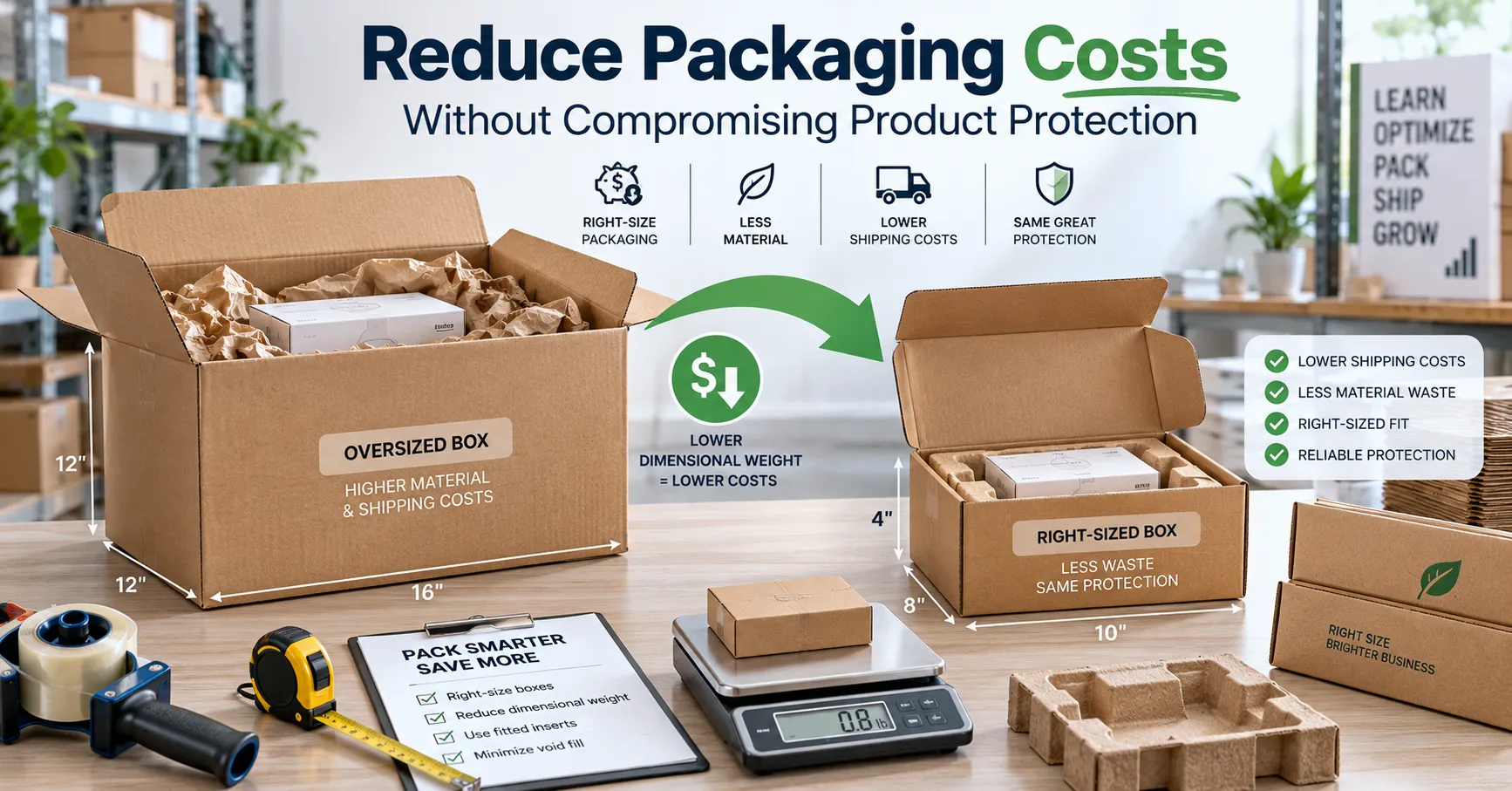
For many e-commerce brands, the largest packaging saving shows up on the shipping bill, not the box invoice. Carriers charge for the space a parcel takes up through dimensional (DIM) weight: length x width x height, divided by a divisor, compared against actual weight. You pay for whichever is higher.
This matters more in 2026 than it did a year ago. On July 12, 2026, USPS lowered its DIM divisor from 166 to 139 for Priority Mail Express, Priority Mail, Ground Advantage and Parcel Select. USPS applies dimensional pricing to parcels larger than one cubic foot (1,728 cubic inches) and now rounds every fractional dimension up to the next whole inch before calculating. UPS daily rates and FedEx already use 139 and apply dimensional weight more broadly, so the old USPS advantage on bulky, light parcels is gone.
What Right-Sizing Does to Billable Weight
Take a light product shipped in an oversized carton, then trimmed to a closer-fitting box:
| Box Size |
Volume |
DIM Weight at 139 |
USPS Treatment |
| 18" x 14" x 10" |
2,520 cu in |
18.13, billed as 19 lb |
Over 1 cu ft, DIM applies |
| 16" x 12" x 8" |
1,536 cu in |
11.05, billed as 12 lb |
Under 1 cu ft, actual weight used |
Same product, roughly 7 fewer billable pounds on UPS or FedEx, and the smaller box drops out of USPS dimensional pricing altogether. Across thousands of orders, that gap is often larger than any discount a supplier can offer on the box itself.
For lighter products, switching from a shipping carton to a closer-fitting mailer is often the simplest fix. Custom mailer boxes and e-commerce mailer boxes can be built to your product's actual dimensions, so you are not paying to ship empty corners.
Measure carefully. Because carriers now round each dimension up, a box measuring 12.1 inches is billed as 13. Shaving a fraction of an inch off a dieline can move a parcel into a lower weight band.
2. Match Board Strength to the Real Job
Many businesses buy heavier board than their products need. It feels safer, but it costs more in material, adds weight, and can increase box size.
Corrugated board strength is commonly specified by Edge Crush Test (ECT), which measures how well the board resists crushing on its edge. Stacking strength depends on that rating, the flute and the box dimensions. Packaging engineers at large manufacturers report that customers can often drop to a lighter grade without losing protection. In one documented case, testing showed the product's primary packaging already carried much of the stacking load, which allowed a move from C flute to the thinner B flute for the outer case.
The point is not to always go lighter. It is to specify board based on product weight, fragility, stacking height and shipping method, rather than habit. For heavier or palletized loads, corrugated shipping boxes can be specified by flute and wall construction to fit the load instead of over-building every carton.
Trade-off: downgrading board without testing is how savings turn into damage claims. Run a drop and stacking test on samples before switching your full volume.
3. Simplify Design, Print and Finishing
Every printing pass and finishing step adds setup and production work. Most brands can keep a premium look while removing steps customers barely notice.
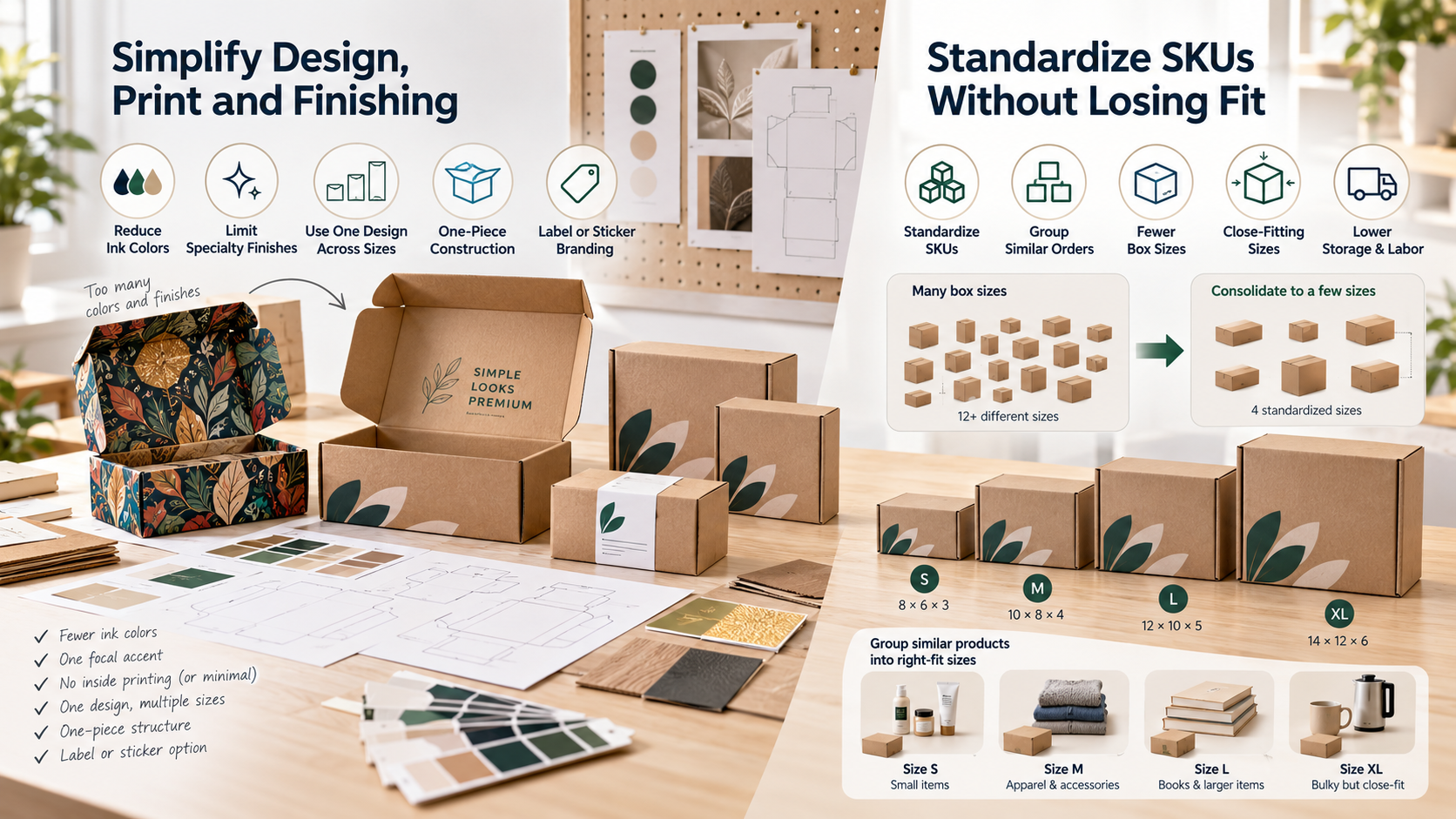
- Reduce ink colors where a design uses several close shades that could be consolidated.
- Limit specialty finishes such as foil, embossing or spot coatings to one focal element instead of the whole box.
- Question inside printing. It works for unboxing-focused brands, but for many products it adds cost no one sees until the box is opened.
- Use one design across sizes where possible, so artwork and plates do not need to be recreated for every box.
- Move from multi-piece to one-piece construction. A tray and separate lid, or a box plus a loose insert, can sometimes become a single folded structure.
Plain or one-color kraft exteriors paired with a printed label or sticker are another option for brands shipping many SKUs. You keep branding while avoiding a separate printed run for each product.
4. Standardize SKUs Without Losing Fit
Stocking 20 box sizes spreads your order volume thin, takes up warehouse space and slows packers down. Cutting to a smaller set usually lowers per-unit cost because each size is ordered in larger runs.
There is a real tension here. Fewer sizes means more products sit in boxes that are slightly too big, which pushes dimensional weight back up. The goal is a small set of sizes that fits most of your orders closely, not one universal box.
A practical approach:
- Sort your order history by the dimensions of what actually ships together.
- Group orders into clusters with similar footprints.
- Assign one box size to each cluster, sized to the larger end of that group.
- Check DIM weight for each size against the carriers you use.
- Keep one or two specialty sizes only for high-volume or fragile products that justify them.
Standardized formats such as mailer cartons work well for this, since one structure can be produced in several sizes with the same design. If you need help mapping your product range to a short list of box sizes, the team at Custom Packaging Pro can review dimensions as part of the quoting process.
5. Cut Void Fill and Loose Inserts
If you are buying a lot of bubble wrap, air pillows or crumpled paper, the box is probably too big. Fill is a recurring cost, and it adds packing time to every order.
Right-sized boxes reduce the need for fill. Where products still need to be held in place, a die-cut paperboard or corrugated insert built into the box is often faster to pack than loose material, and more consistent. The right insert depends on fragility and product shape, so treat this as a case-by-case decision rather than a blanket rule.
6. Reduce Labor at the Pack Station
Labor is one of the most overlooked packaging costs. A box that needs three strips of tape, a separate insert and manual folding can take noticeably longer than one that folds and locks closed.
- Choose self-locking structures such as tuck-front mailers where they suit the product, to reduce or remove taping.
- Combine parts. Fewer components mean fewer picks and fewer steps.
- Pre-assemble where it helps, for example by ordering inserts that drop in rather than fold.
- Standardize the pack process so each box size has one way to be packed.
Automation can cut labor further at high volumes, but it is a capital decision. For most small and mid-sized businesses, design changes to the box itself deliver labor savings first.
7. Buy and Store Packaging More Efficiently
How you order packaging affects cost as much as what you order.
- Consolidate orders. Fewer, larger runs per size usually lower unit cost and reduce setup charges spread across small batches.
- Order boxes shipped flat. Flat-packed stock takes far less storage space than assembled boxes.
- Plan around lead times. Rush orders and emergency air freight erase savings quickly. A simple reorder point per box size prevents that.
- Review inbound freight. For bulk components moving between facilities, bulk bins can reduce handling. Our Gaylord boxes buying guide covers sizes and uses for that kind of bulk movement.
Balance volume against cash flow and storage. Ordering a year of stock to lower unit price only makes sense if you have the space and your design will not change.
8. Protect the Product First, Then Optimize
Every cost reduction has to pass one test: does damage go up? A broken order costs the replacement product, a second shipment, support time and sometimes the customer. A few damaged orders can cancel the savings from a lighter box across a whole month.
Before rolling out any change:
- Test samples with drop and stacking checks that reflect how your parcels are really handled.
- Ship a small pilot batch and track damage against your previous rate.
- Roll out in stages, starting with your highest-volume, least fragile SKUs.
Recognized test procedures, such as those published by the International Safe Transit Association (ISTA), give a structured way to compare packaging options if you need formal results.
Packaging Waste Reduction Lowers Cost Too
Using less material is both a cost lever and a sustainability one. Containers and packaging made up about 82 million tons of US municipal solid waste in 2018, according to the EPA's most recent material data. The recycling picture varies a lot by material: EPA reported that corrugated boxes were recycled at a rate of 96.5 percent in 2018, while the overall recycling rate for plastics was 8.7 percent.
For most brands, the most effective waste reduction strategies are the same as the cost strategies above: smaller boxes, less fill, fewer components, and materials that customers can recycle easily at home.
Cost Reduction Checklist
| Action |
Main Cost Lever |
Watch Out For |
| Right-size boxes and mailers |
Shipping (DIM weight), fill |
Too tight a fit can cause crush damage |
| Re-specify board grade |
Materials, weight |
Test before switching volume |
| Simplify print and finishes |
Production setup, unit cost |
Keep brand recognition intact |
| Standardize box sizes |
Volume pricing, storage, labor |
Too few sizes brings back void space |
| Replace loose fill with fitted inserts |
Fill purchases, labor |
Insert design must match fragility |
| Use self-locking structures |
Packing labor, tape |
Some products still need sealing |
| Consolidate orders and ship flat |
Unit cost, storage |
Cash tied up in inventory |
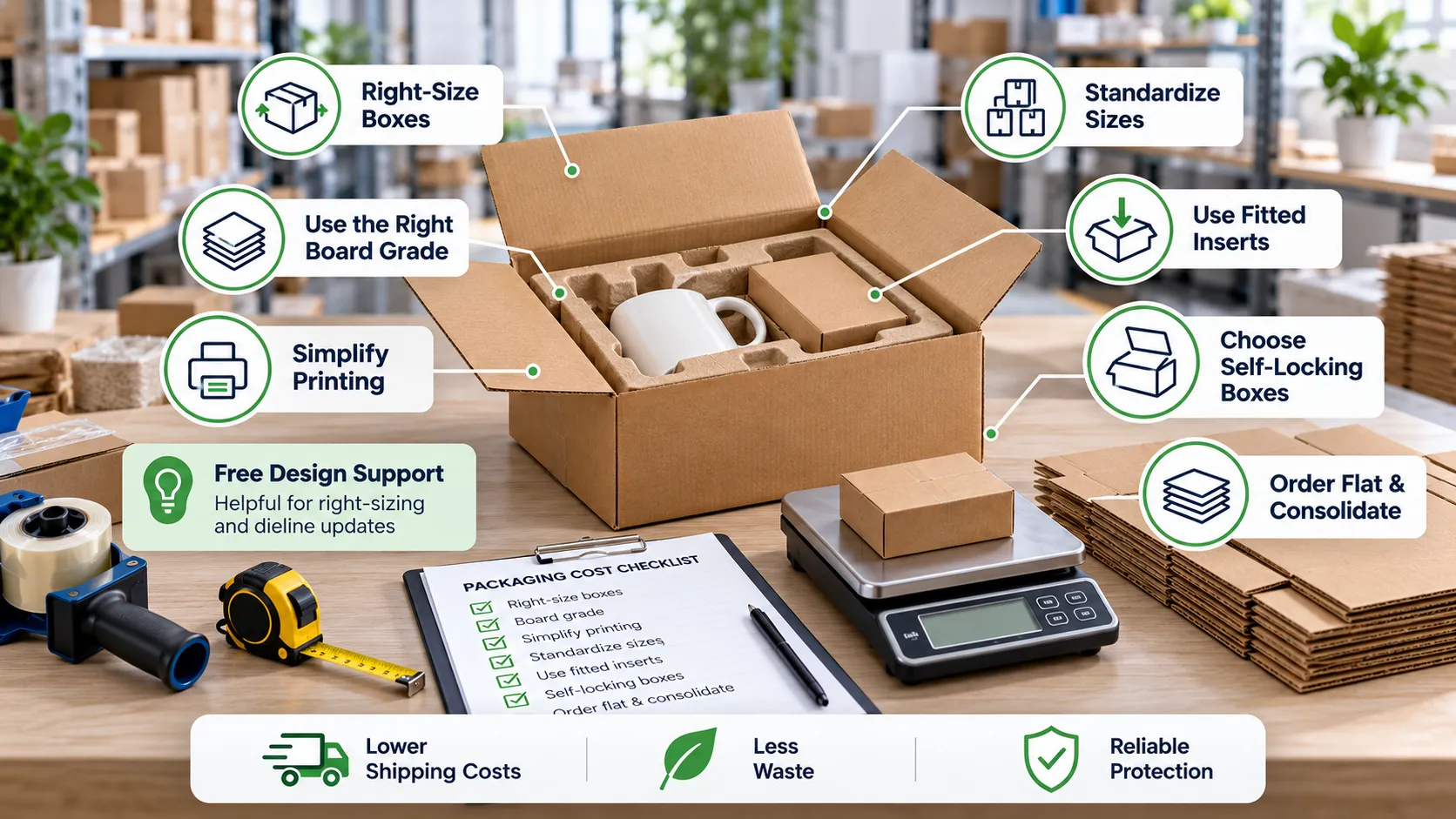
Custom Packaging Pro offers free design support, which helps when right-sizing means reworking dielines or consolidating artwork across several box sizes.
Frequently Asked Questions
- How can a business reduce packaging costs?
Start with an audit of box sizes, shipping charges, fill usage, packing time and damage rates. The biggest savings usually come from right-sizing boxes to lower dimensional weight, matching board strength to the product, simplifying print, and cutting the number of box sizes you stock.
- How do I lower packaging cost per order?
Look at the full cost of each shipped order, not the box price. Smaller boxes reduce shipping charges and fill, self-locking designs reduce labor, and fewer damaged orders reduce replacement costs. Together these usually matter more than the unit price of the box.
- What are the 5 P's of packaging?
There is no single official definition, and different sources list different sets. For cost decisions, a useful framework is Product (what is being shipped), Protection (what it needs to arrive intact), Presentation (how much branding matters), Process (how it is packed), and Price (the total cost, not just the box).
- How can we reduce packaging?
Use the smallest box that protects the product, remove components that do not add protection or value, replace loose fill with fitted inserts where it makes sense, and choose materials that are widely recyclable.
- What are the 7 R's of sustainable packaging?
Lists vary by source. Versions commonly include rethink, refuse, reduce, reuse, repurpose or repair, recycle, and rot (compost). For packaging buyers, reduce and reuse usually deliver the clearest cost savings.
- Is it true that 91% of plastic is never recycled?
That figure comes from a 2017 study in Science Advances, which estimated that of all plastic waste generated globally through 2015, about 9 percent had been recycled, 12 percent incinerated and 79 percent sent to landfills or the environment. In the US, EPA data put the overall plastics recycling rate at 8.7 percent in 2018.
- What is the most sustainable packaging?
It depends on the product and how it is shipped. In general, the most sustainable package is the one that uses the least material while still preventing damage, made from material with an established recycling stream. Corrugated cardboard has one of the highest recycling rates in the US.

 Custom Boxes
 Mailer Boxes
 Shipping Boxes
 Display Boxes
 Product Boxes
 Retail Packaging
 Luxury Packaging
 Sustainable Packaging
 Mylar Bags
 Labels & Stickers
 Inserts & Dividers
 Acrylic Signs
 Mylar and Zipper Bags
 Cosmetic Boxes
 Custom Candle Packaging Boxes
 Food and Beverage
 Display Packaging
 Pharma Packaging
 Custom Blister Packaging
 Stand Up Displays
 Kraft Boxes
 Cereal Packaging Boxes
 Bakery Packaging Boxes
 Eco-Friendly Boxes
 Electronics Packaging Boxes
 Custom Vape Boxes & Packaging
 CBD Packaging Boxes
 Rigid & Luxury Packaging Boxes
 Gift Boxes
 Custom Soap Boxes & Packaging
 Metalized Boxes
 Retail Boxes
 Subscription Boxes
 Invitation Boxes
 Corrugated Shipping Boxes
 Matte Finish
 Gloss Finish
 Soft Touch
 Foil Stamping
 Spot UV
 Embossing
 Debossing
 Window Cutouts