By Rai Haider
October 06, 2026
Custom Raffle Tickets for Fundraisers & Events
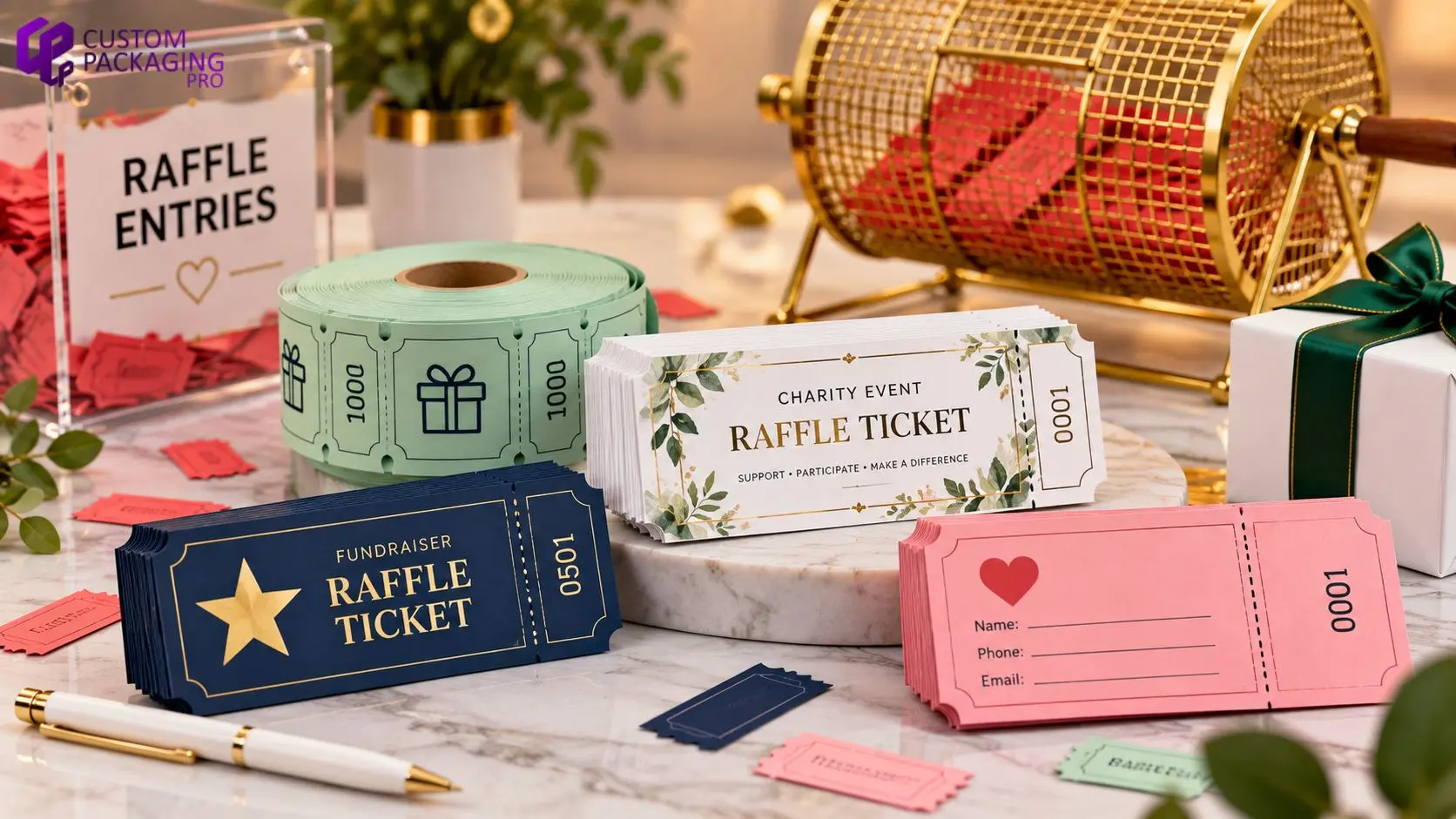
A raffle ticket is a small printed item, but it plays an important role in running a fundraiser, charity campaign, school activity, community event, or promotional drawing. It identifies each entry, gives participants the key details, and gives organizers a simple way to manage the drawing.
Custom raffle tickets give organizations more control than generic ticket stock. The design can include a logo, event name, prize information, ticket number, drawing date, contact details, and participation instructions.
The physical format matters too. Some events work better with individual tickets or sheets, while others need rolls that can be torn off quickly during sales. When organizers need to keep part of each ticket for the drawing, tickets with stubs are the practical choice. Quantity, numbering, perforation, paper stock, size, and the way entries will be collected all deserve attention before printing.
Key Takeaways
- Choose the format based on how tickets will be sold: rolls for fast counter sales, sheets for advance distribution, and stubs when you need a matching half for the drawing.
- Sequential numbering on both the ticket and the stub makes winner verification simple.
- Keep the design focused: event name, prize, drawing date, and ticket number come first.
- Raffle rules are set by each US state, so check yours before printing or selling tickets.
- Order based on realistic demand, not unit price alone, to avoid reprints or unused stock.
Quick answer: High-impact custom raffle tickets for a raffle tickets fundraiser or charity raffle tickets campaign combine clear event details, sequential numbering, and perforated stubs. When planning creating a raffle or evaluating how to design raffle tickets, choosing between pre printed raffle tickets and customized raffle tickets ensures seamless tracking and maximum participation for your fundraiser raffle.
What Are Custom Raffle Tickets?
A custom raffle ticket or custom.raffle tickets entry is a printed ticket created for a specific raffle, raffle fundraiser, prize drawing, or promotional campaign. Unlike generic stock tickets, it is built around the identity and needs of one event. The organizer decides what information appears, how the ticket looks, and whether it needs numbering or a detachable stub.
A ticket may contain:
- Organization name and logo
- Event title
- Ticket number
- Drawing date
- Prize information
- Contact details
- Participation instructions
- Eligibility information
- QR code
- Sponsor information
The amount of information should match the event. A small school fundraiser may need only the basics, while a larger charity campaign may list several prizes, sponsors, rules, and contact details. The goal is a useful ticket that is not overcrowded.
Why Choose Custom Printed Raffle Tickets?
Choosing printed tickets for fundraiser campaigns and printed raffle tickets charity events provides distinct advantages over plain options:
- Event Branding
A logo, colors, typography, and artwork connect the raffle tickets custom design with the organization behind the event.
- Clear Information
Key details are printed on the entry itself instead of relying only on posters or announcements.
- Entry Identification
Sequential numbers give each fundraiser ticket or raffle ticket custom entry a unique identity and make winner verification easier.
- Presentation
A well-designed ticket makes a community ticket fundraiser or promotion feel more polished.
- Flexibility
Organizers can pick the format that suits how entries will be distributed when ordering personalized raffle tickets or customizable raffle tickets.
Raffle Ticket Formats: Stubs, Rolls, and Sheets
Raffle Tickets With Stubs
Raffle tickets with stubs have a detachable section that stays attached until it is torn off. The participant keeps one part and the organizer collects the other for the drawing. Matching numbers on both parts make it easy to verify the winner.
A typical process looks like this:
- The participant buys a ticket.
- The organizer tears off the stub.
- The participant keeps the main portion.
- The stub goes into the drawing container.
- A winning stub is drawn.
- The matching number identifies the winner.
The stub can also have space for the buyer's name, phone number, or email address so the organizer can contact winners who are not present at the drawing.
Raffle Ticket Rolls vs. Sheets
The right choice depends on how the tickets for fundraiser events will be sold or handed out. Rolls are connected tickets wound around a core and torn off one at a time. Sheets are flat and can be cut or perforated into individual tickets.
| Factor |
Ticket Rolls |
Ticket Sheets |
| Best for |
Counter sales and busy events |
Advance sales and batch distribution |
| Speed at the table |
Fast, tear and hand over |
Slower, tickets separated in advance |
| Counting and tracking |
Track by number range on the roll |
Easy to count and assign in groups |
| Design space |
Usually smaller, simpler layouts |
More room for logos, prizes, and sponsors |
| Typical users |
Charity tables, sports events, fairs |
Schools, offices, community groups |
Neither format is automatically better. A busy charity table may benefit from the speed of a roll, while a school sending fundraising tickets home with students will find sheets easier to manage. The same trade-off applies to labels, as explained in our guide to roll vs. sheet formats.
Perforated Raffle Tickets
Perforated raffle tickets have a controlled tear line that lets one section separate cleanly from another. A basic layout looks like this:
Main Ticket | Perforation | Organizer Stub
The main ticket shows the event name, logo, prize, and drawing date. The stub carries the matching number and optional buyer details. Keep text, logos, and QR codes away from the tear line so nothing important is lost when the ticket is separated.
Standard Raffle Ticket Size and Dimensions
When selecting a standard raffle ticket size, organizers typically choose dimensions that balance readable typography with cost-effective printing. Understanding the average size of raffle tickets helps in planning artwork and layout:
- 2.125" x 5.5" (Standard Stub Ticket): The most common size for traditional raffle tickets for fundraiser campaigns, allowing ample space for a detachable 1.5" or 2" stub.
- 3.5" x 8.5" (Large Format): Ideal for high-end events, listing major sponsor logos, full prize lists, and multi-tier drawings.
- 2" x 4" (Compact Ticket): A popular size for simple drawings and quick counter distribution.
How to Number Raffle Tickets
Numbering is one of the most useful features on a raffle ticket. Most events use a simple sequence such as 0001, 0002, 0003, and so on. If the ticket has a stub, the same number is printed on both parts.
Numbering helps organizers:
- Identify the winning entry
- Track which sellers have which tickets
- Match collected stubs
- Account for unsold tickets
- Keep basic sales records
Set the number range before production. An event that needs 1,000 entries could run from 0001 to 1000, and tickets can be grouped in sets of 10 or 25 for each volunteer seller. Professional printers handle sequential numbering and sorting during production, which is closely related to collated printing.
What Information Should a Raffle Ticket Include?
When organizers ask what should a fundraising ticket say on it, good raffle ticket design starts with deciding what the buyer needs to see first. Consider including:
- Event name
- Organization name and logo
- Prize details
- Drawing date and location
- Ticket number
- Participation instructions
- Contact information
- Relevant terms and legal disclaimers
Not every ticket needs every element. A small local fundraiser may only need a logo, prize, date, and number. The most important details should get the strongest visual emphasis, because too many competing elements make a small ticket hard to read.
How to Design Custom Raffle Tickets
Learning how to design raffle tickets or how to design a raffle ticket efficiently ensures your printed material looks professional while staying easy to read.
Logo and Branding
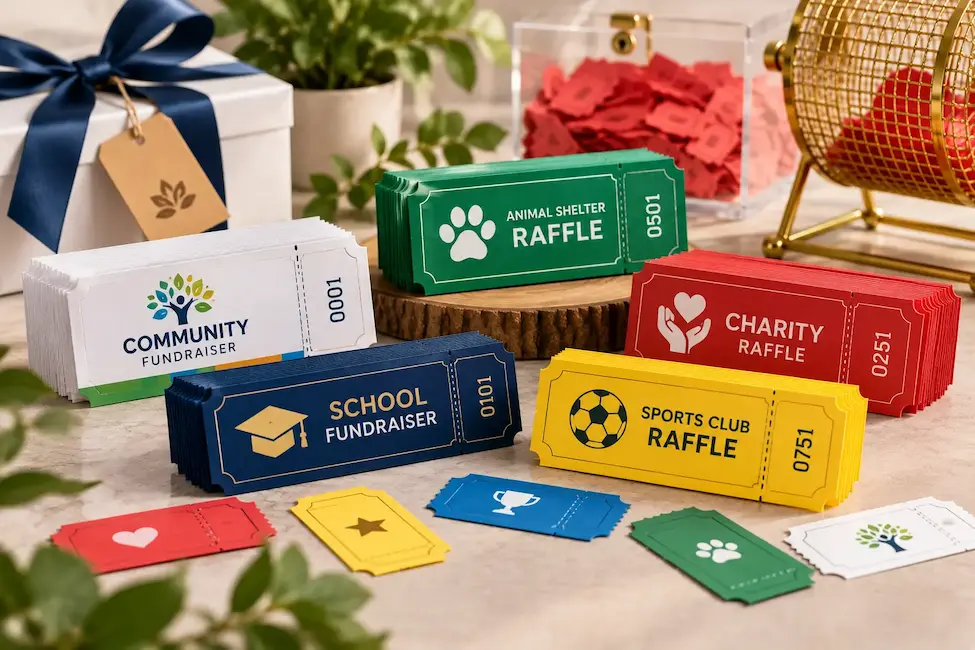
Raffle tickets with a logo connect each entry to the organization running the event. The logo can sit prominently on the front or beside the event title. Other brand elements can include brand colors, typography, photography, illustrations, patterns, and sponsor marks.
Make sure the logo stays recognizable at the final printed size. On a small ticket, heavy artwork competes with the event details. A focused design with clear branding, readable text, and a visible ticket number communicates best. Our design team can set up raffle ticket artwork for free.
Choosing Colors
Color makes tickets easier to tell apart and sets the tone of the campaign:
- Red tickets look bold and energetic.
- Black tickets suit formal or upscale events.
- Blue tickets feel clean and dependable.
- White tickets give a simple, neutral base.
- Yellow tickets stand out and are easy to spot.
If your organization runs several raffles a year, use a different accent color for each event while keeping the logo and typography the same.
Setting the Visual Hierarchy
Before designing, decide what the buyer should notice first. A typical order is:
Organization → Event → Prize → Drawing Date → Ticket Number
The logo does not always need to be the largest element. For many raffle ticket fundraising campaigns, the prize is the main selling point and deserves the most attention. Supporting details can go in smaller text or on the back of the ticket.
Raffle Tickets for Fundraisers and Organizations
If you ask why do a raffle for my event, the answer is simple: fundraising raffle tickets offer one of the highest returns on investment for non-profits and community programs. They generate excitement, encourage participation, and raise essential revenue.
Fundraiser Raffle Tickets and Pricing Strategy
Raffles are a common tool for schools, charities, sports clubs, community groups, and non-profits. When planning an event, deciding what to charge for raffle tickets and setting strategic fundraiser raffle ticket prices is critical for success:
- Single Ticket Pricing: Typically set between $5 and $20 depending on prize value.
- Tiered Pricing Bundles: Offering options like "1 for $10, 3 for $25, or 7 for $50" increases average purchase size.
- High-Value Drawings: For major prizes (such as vehicles or trips), single tickets can range from $50 to $100+.
Prizes vary widely and can include gift baskets, donated merchandise, experiences, event tickets, services, one major prize, or several smaller ones.
The ticket does two jobs: it records the entry and it supports the look of the fundraising campaign. A school might use its colors and logo alongside the event name, prize, drawing date, and ticket number.
50/50 Raffle Tickets and Drawdown Boards
In a 50/50 raffle, the prize is a share of the money collected, usually half, with the rest going to the organization. Tickets often include the event name, a clear 50/50 label, the ticket number, the drawing date, and organization details. For specialized campaigns, utilizing a non-profit drawdown raffle board or digital tracking sheet keeps attendees engaged as numbers are eliminated one by one. Because rules for 50/50 raffles vary by state, confirm what applies to your event before printing.
Raffle Tickets by Organization Type
- Schools
School name, colors, logo, event details, prize, and drawing date.
- Charities
The cause, fundraising goal, prize, and participation details for a fundraiser raffle.
- Sports Clubs
Team colors, mascot or club imagery, and the season or event name.
- Businesses
Promotional drawings for customers, where permitted by state law.
- Community Groups
Simple, readable fundraiser tickets that are easy to distribute.
Check Your State's Raffle Rules Before Printing
In the United States, raffles are regulated at the state level, and the rules vary widely. Many states only allow raffles run by registered non-profit or charitable organizations, and some require a license or permit before tickets are sold. A few states do not allow raffles at all. When exploring digital options or charitable raffle website packages, ensure online sales adhere to state gaming and cross-border distribution laws.
Rules can also affect what must appear on the ticket, such as the organization name, the drawing date, the license number, or the ticket price. Check with your state attorney general's office or gaming commission before you finalize the design, so the printed tickets meet local requirements.
How to Make Raffle Tickets Yourself
Organizers often ask how to make fundraising tickets, how to make tickets for a fundraiser, or how to make fundraiser tickets independently. Small organizations can create their own tickets with a design app or a word processing template. DIY works well when you need:
- A small quantity
- Basic artwork
- Simple handwritten or printed numbers
- Standard office paper or cardstock
Professional printing is the better choice when you need:
- Larger quantities
- Full-color printing
- Sequential numbering
- Perforated stubs
- Clean, consistent trimming
- Heavier cardstock
- Roll formats
Printable Raffle Ticket Files
A file that looks right on screen can still print badly. Before printing at home or in the office, check:
- Correct ticket dimensions
- Your printer's printable area and margins
- Bleed, if artwork runs to the edge
- Numbering on every ticket
- Cut lines and paper stock
When you need professional numbering and perforation, outsourcing is usually simpler and more reliable. See our overview of printing options for how different methods compare.
How Many Raffle Tickets Should You Order?
The right quantity depends on expected participation and how the tickets will be sold. As a rough guide:
- Around 100 tickets for a small event
- 250 to 500 for a medium campaign
- 1,000 for a larger fundraiser
- More for major or multi-week campaigns
Estimate demand rather than choosing a quantity based on unit price. Ordering too few means a second print run, while ordering far too many leaves unused stock.
How to Order Custom Raffle Tickets
Before placing an order online or with a local printer, confirm:
- Finished ticket size
- Quantity
- One-sided or two-sided printing
- Colors
- Numbering range
- Stub and perforation requirements
- Roll or sheet format
- Artwork
- Deadline and shipping address
Check your artwork at actual size, because text that looks fine on a large monitor can become hard to read on a small ticket. When you receive a proof, check the event name, date, numbers, spelling, and colors before approving production.
Pre-Printed vs. Fully Custom Raffle Tickets
Pre-printed stock tickets are a quick option when you only need basic numbered tickets. Fully custom options allow you to customize raffle tickets or customize raffle ticket layouts with total control over branding, layout, event details, numbering, stub design, color, and finishing. Stock tickets suit simple or recurring events, while custom tickets make sense when the ticket should reflect a specific campaign, sponsor, or theme.
Questions to Ask Your Printer
When comparing suppliers, look past the starting price and ask:
- Is sequential numbering included?
- Are stubs and perforation available?
- Can I use my own artwork, or do you offer design help?
- Is two-sided printing available?
- What paper stocks do you offer?
- Will I receive a proof before production?
- What are the production time and shipping options?
A low starting price may leave out features your event needs, while premium finishing may add little value for a simple community fundraiser. Aim for the specification that fits the event.
Local Printing vs. Online Ordering
A local printer can help when the deadline is very short, pickup matters, or you prefer to discuss the job in person. Online ordering usually offers more formats, paper stocks, and finishing options. The better choice depends on your deadline, quantity, level of customization, and delivery needs.
Raffle Tickets and Other Event Printing
Raffle tickets are usually one part of a bigger event. Organizers often also need posters, flyers, brochures, prize cards, table signs, and envelopes. Using the same logo, colors, and typography across every piece makes the campaign look organized.
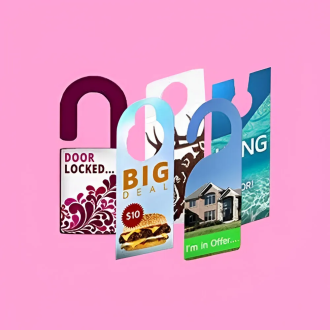
- Door hangers are an effective way to promote a neighborhood fundraiser before the event.
- Acrylic signs work well on the raffle table for prize details and ticket prices.
- Custom labels can brand donation jars, raffle buckets, and prize baskets.
Order Custom Raffle Tickets From Custom Packaging Pro
At Custom Packaging Pro, we print custom raffle tickets using the same card stock and printing we use for our custom printed tags. You can choose the size, paper stock, colors, numbering, and stub layout, and our design team will prepare the artwork and a proof for free. Share your event details and quantity, and request a quote to get started.
Final Thoughts
A raffle ticket is small, but it shapes how smoothly an event runs and how professional the campaign looks. Choose the format based on how tickets will be sold, keep the design focused on the details buyers need, number every ticket, check your state's rules, and order a realistic quantity. The best raffle ticket is the one that fits the way your event actually works. Yes, taking the time to plan your tickets properly makes a measurable difference in your fundraising totals.
Frequently Asked Questions About Custom Raffle Tickets
What are custom raffle tickets?
Custom raffle tickets are printed entries made for a specific raffle, fundraiser, or promotional drawing. They can include your logo, artwork, ticket numbers, event details, and prize information.
Can I order raffle tickets with stubs?
Yes. Personalised raffle tickets and custom tickets can be printed with a perforated stub. The same number appears on both parts, so the organizer keeps the stub for the drawing and the buyer keeps the ticket.
How do you number raffle tickets?
Most raffles use a sequential range such as 0001 to 1000, printed on both the ticket and the stub. Professional printers add numbering during production, so every ticket is unique and in order.
What is the difference between raffle ticket rolls and sheets?
Rolls are connected tickets wound on a core and torn off one at a time, which suits fast counter sales. Sheets are flat and better for advance sales or handing tickets out in batches.
What information should be printed on a raffle ticket?
Common details include the organization name, event title, logo, ticket number, prize, drawing date, contact details, and participation instructions. Your state may also require specific details, such as a license number.
Are raffles legal in every state?
No. Raffle rules are set by each state. Many states only allow raffles run by non-profit organizations and may require a license, and a few states do not allow raffles at all. Check your state's rules before selling tickets.
How many raffle tickets should I order?
It depends on expected participation. Small events may need around 100 tickets, while larger fundraisers often need 500, 1,000, or more.
Can I make raffle tickets myself?
Yes. DIY tickets work for small events with simple designs. Professional printing is better when you need sequential numbering, perforated stubs, larger quantities, heavier cardstock, or consistent quality.
How much do custom raffle tickets cost?
Cost depends on quantity, size, paper stock, printing, numbering, perforation, and shipping. Compare the full specification rather than the starting price to see the real cost.

 Custom Boxes
 Mailer Boxes
 Shipping Boxes
 Display Boxes
 Product Boxes
 Retail Packaging
 Luxury Packaging
 Sustainable Packaging
 Mylar Bags
 Labels & Stickers
 Inserts & Dividers
 Acrylic Signs
 Mylar and Zipper Bags
 Cosmetic Boxes
 Custom Candle Packaging Boxes
 Food and Beverage
 Display Packaging
 Pharma Packaging
 Custom Blister Packaging
 Stand Up Displays
 Kraft Boxes
 Cereal Packaging Boxes
 Bakery Packaging Boxes
 Eco-Friendly Boxes
 Electronics Packaging Boxes
 Custom Vape Boxes & Packaging
 CBD Packaging Boxes
 Rigid & Luxury Packaging Boxes
 Gift Boxes
 Custom Soap Boxes & Packaging
 Metalized Boxes
 Retail Boxes
 Subscription Boxes
 Invitation Boxes
 Corrugated Shipping Boxes
 Custom Apparel Boxes