By Rai Haider
November 20, 2026
USPS Shipping Rates Rise in 2027: What It Costs Your Business
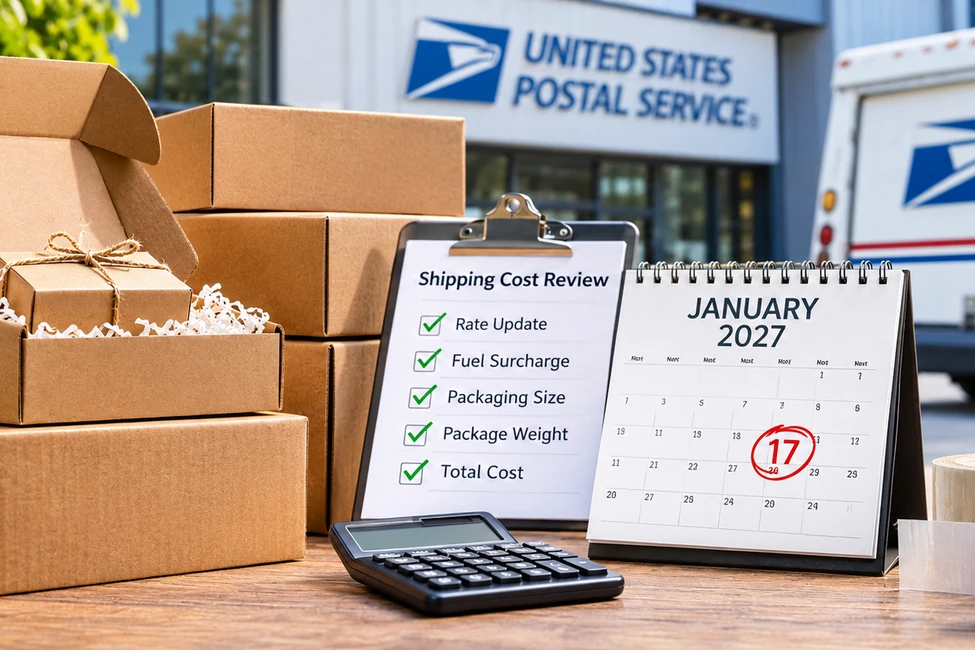
USPS filed its 2027 shipping prices on November 12, 2026. Domestic rates rise 5.9 percent on average, international rates rise 7.9 percent, and a new 11 percent fuel surcharge applies to domestic parcels from January 17, 2027, pending review by the Postal Regulatory Commission. Stamp prices do not change.
For any business that ships orders, returns or samples, this is not a small adjustment. The new base prices and the fuel surcharge arrive together, on the same day the holiday prices end, so there is no drop back to autumn costs in January.
What you pay will depend on your service, your shipping zone and your billable weight, which is not always the weight on your scale. What you can control before January 17 is your packaging: the size, weight and strength of the custom packaging boxes you ship in decide which price band, nonstandard fee and dimensional weight you fall into.
At a glance: File the date now: January 17, 2027. UPS moves first on December 21, 2026 and FedEx follows on January 4, 2027, both at 5.9 percent on average. By mid January every major US carrier will be on 2027 prices.
Key facts at a glance
| Change |
Products affected |
Amount |
| Domestic base price rise |
Priority Mail, Priority Mail Express, USPS Ground Advantage, Parcel Select |
5.9% on average |
| Fuel surcharge |
Same four domestic services |
11% on base postage |
| International rise |
Priority Mail Express International, Priority Mail International, First-Class Package International Service, International Priority Airmail |
7.9% on average |
| Stamps |
First-Class Mail stamps |
No change |
| Market dominant mail |
First-Class Mail, Marketing Mail, Periodicals |
No January increase |
| Competitive PO Boxes |
Competitive PO Box prices |
No change in January |
| Effective date |
All changes above, if approved |
January 17, 2027 |
| Review |
Fuel surcharge reevaluated |
July 2027 |
Source: US Postal Service announcement, November 12, 2026, Competitive Products filing, Docket No. CP2027-1. The filing was approved by the USPS Board of Governors and is now under review by the Postal Regulatory Commission (PRC). Price tables are published on USPS Postal Explorer.
Domestic shipping prices rise 5.9 percent on average
USPS is proposing an average increase of 5.9 percent across its four main domestic shipping services: Priority Mail, Priority Mail Express, USPS Ground Advantage and Parcel Select. USPS published one average for all four services and did not publish a separate figure for each one.
That single average matters. Your own increase will be higher or lower than 5.9 percent depending on the weights you ship, the zones you ship to, and whether you pay retail prices at the Post Office counter or commercial prices through shipping software. On a carrier rate card, zone is a distance band, so a light local parcel and a heavy cross country parcel do not move by the same amount. E-commerce sellers and marketplace sellers feel that spread first, because so many online orders travel well beyond the local zones.
Shipping prices work differently from mail prices. In its November 12 release USPS noted that mailing services price increases are based on the consumer price index, while shipping services prices are primarily adjusted according to market conditions. That is why this filing covers competitive package products, not everyday letters.
The figure also matches its rivals. Both UPS and FedEx announced average increases of 5.9 percent for 2027, which means switching carrier alone does not remove the increase. The comparison that matters is your total delivered cost per order, including base postage, surcharges, accessorial fees and packaging, on the shipping lanes you actually use. For most shippers the answer is a carrier mix, not a single carrier, because the cheapest service changes with weight, zone and delivery address.
The 11 percent fuel surcharge, explained clearly
The biggest structural change is the fuel surcharge. In April 2026 USPS added a temporary transportation related increase of 8 percent to the same four domestic services. That increase was due to end on January 17, 2027. Instead of letting it expire, USPS will convert it into a permanent fuel surcharge.
From January 17 the surcharge will be 11 percent in total: the original 8 percent made permanent, plus an additional 3 percent that USPS attributes to a further elevation in fuel prices. USPS reported that its transportation expenses rose by $225 million in the 12 months ending September 30 because of higher fuel costs, as reported by Reuters and cited by USA TODAY.
How the surcharge is charged matters for your math:
- It is a percentage of base postage only. It is not charged on extra services or nonstandard fees, such as oversized package fees.
- It applies to retail and commercial labels alike.
- Priority Mail and Priority Mail Express are linked to jet fuel prices. USPS Ground Advantage and Parcel Select are linked to diesel prices.
- It applies to domestic products only at this stage. International products are not affected by the surcharge for now.
- The January rate is fixed at 11 percent. The price tables USPS filed set the surcharge at 11 percent at every fuel price level for both diesel and jet fuel.
Later in 2027 USPS intends to move to a weekly fuel surcharge, updated from diesel and jet fuel prices published by the US Energy Information Administration, in the same way FedEx and UPS already update theirs against a published fuel index. USPS said in its PRC filing that customers can begin making programming changes now to handle a dynamic surcharge, and that it intends to authorize the rate and classification changes for that system later in 2027. For January, plan on a fixed 11 percent, and reevaluate in July 2027 when USPS reviews the surcharge against fuel prices from the first half of the year.
International shipping rises 7.9 percent, with new services
International shippers face a larger average rise. USPS proposes an increase of 7.9 percent on average for Priority Mail Express International, Priority Mail International, First-Class Package International Service and International Priority Airmail.
Two service changes sit inside the same proposal. USPS plans to introduce an optional Outbound Proof of Delivery service for Priority Mail International, and to expand USPS Delivered Duty Paid (DDP) service to International Priority Airmail. With DDP, the sender can pay applicable duties at mailing or at a later time, which reduces surprise charges for the buyer on delivery.
USPS is also changing its international country rate group structure and country assignments. If you ship the same product to the same country every week, check its new group before January, because a country move can change your price by more than the 7.9 percent average.
Separately, USPS will adjust prices on some competitive special services and introduce new fees that it says better align with the industry. The services named in the announcement include address enhancement services, premium forwarding services and several competitive ancillary services. If you pay for forwarding, address correction or premium handling, price those fees into your January costs as well.
What does not change in January
Not everything goes up. There is no change to the price of stamps, and USPS describes First-Class Mail as one of the best mailing bargains in the world. There is also no January increase for market dominant mail, which covers First-Class Mail, Marketing Mail and Periodicals, and no change to competitive PO Box prices in January.
That split creates two different January stories. A business sending catalogs, magazines or direct mail letters sees no January postage increase on those products. A business sending parcels on competitive shipping services should budget for higher costs from January 17. Many small brands do both, so separate your mail budget from your parcel budget before you set 2027 prices.
What common labels will cost from January 17
Averages hide the real cost. The table below uses worked examples from the proposed January 2027 price file, with the 11 percent surcharge added to the proposed base price. The before and current columns come from USPS Notice 123 and the holiday price tables. Treat January figures as accurate to about a cent, because USPS has not published how it rounds the surcharge on a single label.
| Package (commercial unless stated) |
Before Oct 4 |
Now (holiday) |
From Jan 17 |
Change from now |
| Ground Advantage, under 1 lb, Zone 1 |
$6.93 |
$7.33 |
$7.66 |
+$0.33 |
| Ground Advantage, under 1 lb, Zone 5 |
$7.69 |
$8.24 |
$8.45 |
+$0.21 |
| Ground Advantage, under 1 lb, Zone 8 |
$8.40 |
$8.95 |
$9.18 |
+$0.23 |
| Ground Advantage, 1 lb, Zone 5 |
$8.74 |
$9.29 |
$9.73 |
+$0.44 |
| Ground Advantage, 5 lb, Zone 5 |
$13.48 |
$14.53 |
$14.69 |
+$0.16 |
| Ground Advantage, retail, 4 to 8 oz, Zone 1 |
$7.90 |
$8.40 |
$8.60 |
+$0.20 |
| Ground Advantage, retail, 4 to 8 oz, Zone 5 |
$8.60 |
$9.35 |
$9.38 |
+$0.03 |
| Priority Mail Flat Rate Envelope |
$11.12 |
$11.97 |
$12.11 |
+$0.14 |
| Priority Mail Medium Flat Rate Box |
$21.17 |
$22.02 |
$23.05 |
+$1.03 |
Read the pattern, not just the rows. Against holiday prices, January labels cost 3 cents to $1.03 more. Against prices before October 4, the same labels cost about 8.9 percent to 11.3 percent more. A few heavier Priority Mail labels come out slightly below the holiday price, which is why you must reprice your own most common weight and zone—and review your packaging cost strategy—instead of applying 5.9 percent across the board.
The monthly math adds up fast. A store shipping 1,000 orders a month as 1 lb commercial Ground Advantage to Zone 5 paid $8.74 per label before the holidays. From January 17 it pays about $9.73, which is $0.99 more per order, or $990 more per month. On a $60 average order value, that one label takes shipping from 14.6 percent to 16.2 percent of revenue, before cardboard packaging, pick and pack labor or returns. If the order ships free, the extra $990 comes straight out of profit margin.
Why 5.9 percent is not your increase
Three layers stack on January 17. The holiday increase ends, base prices change by an average of 5.9 percent, and the 11 percent fuel surcharge is then applied to the new base price. Because the surcharge sits in its own table, the prices in the January price file are shown before the 11 percent is added.
That also explains why some January base prices look lower than what you pay today. The 8 percent that is built into current prices moves out of the base price and into the surcharge. A simple illustration shows the effect: a label with a $10.00 base price before April 2026 cost $10.80 with the 8 percent added. If the base rises to $10.59 and 11 percent fuel is added, the label costs about $11.75, which is 8.8 percent more than the September label. This is an illustration, not a USPS figure, but it shows why comparing January with September, not with December, gives you the honest increase.
If you set your checkout shipping rates, your flat rate shipping charge or your free shipping threshold in early autumn, reprice against those autumn costs. Comparing only with December holiday prices will understate what changes for your margin in 2027.
The model you sell under decides who pays. Calculated shipping passes the new postage to the customer at checkout. Flat rate and free shipping absorb it in your margin until you reprice, which is why the two models need different January decisions.
Four USPS price changes in a year, and the full carrier calendar
January 2027 is not a one off rise. It is the fourth USPS shipping change in twelve months, and it lands in a six week window when every major carrier resets its prices.
| Date |
Change |
| January 18, 2026 |
Annual increase: about 7.8% for Ground Advantage, 6.6% for Priority Mail, 5.1% for Priority Mail Express, 6.0% for Parcel Select |
| April 26, 2026 to Jan 17, 2027 |
Temporary 8% transportation related increase on base postage, retail and commercial |
| October 4, 2026 to Jan 17, 2027 |
Holiday prices: flat dollar amount per package by weight and zone |
| December 21, 2026 |
UPS Daily Rates rise by an average net 5.9% for Ground, Air and International services |
| January 4, 2027 |
FedEx standard list rates rise by an average 5.9% for US, export and import services |
| January 17, 2027 (proposed) |
USPS base prices rise 5.9% on average and the 11% fuel surcharge begins |
| July 2027 |
USPS reevaluates the fuel surcharge on first half fuel prices |
| Later in 2027 |
USPS plans to move to a weekly fuel surcharge |
One advantage USPS still holds in last mile delivery: it does not charge a residential surcharge. FedEx and UPS do, on top of the peak season demand surcharges both carriers add per package over the holidays, and their fuel surcharges are far higher as percentages, at around 29 percent to 30 percent for ground services in early November 2026, although each carrier applies its percentage to a different base. For light packages delivered to homes, Ground Advantage can remain competitive even after the January rise, provided the package itself is sized and packed efficiently.
Oversized fees and dimensional weight: the packaging trap
The headline rates are only part of the filing. Fees for long packages rise as well, and the fuel surcharge is not charged on those fees, so they hit your cost in full.
| Ground Advantage oversized fee |
Today |
From Jan 17 (proposed) |
| Longer than 22 inches, up to 30 inches |
$4.50 |
$5.25 |
| Longer than 30 inches |
$10.00 |
$12.00 |
A box that is one inch over a threshold now costs more on every single shipment. If you ship posters, rugs, lamps, gift sets or any long product, measure the packed box, not the product. The packed length includes padding, inserts and any bulge in the carton.
Larger boxes are also priced by dimensional weight, often shortened to DIM weight. The carrier multiplies length by width by height to get the cubic size, divides by a set divisor, and bills the higher of that DIM weight and the actual weight. In its July 2026 price change USPS said it would align its dimensional weight divisors with industry standards. In plain terms, a big light box can be billed as if it were heavier than it is. Air inside the box is not free anymore. Right sizing is the direct answer: a box made to fit the product, with protection built into the structure, keeps the billable weight close to the actual weight and avoids paying postage on empty space.
Why USPS is raising prices now
USPS links the filing to financial sustainability and to its ongoing modernization plan. The agency reported a net loss of $6.5 billion for fiscal year 2026, ended September 30, compared with $9.0 billion the year before. Shipping and packages revenue rose 5.1 percent year over year in 2026 even as volume fell 5.3 percent, which shows how much of the improvement came from price rather than from more parcels.
Postmaster General and CEO David Steiner said in remarks at the Board of Governors meeting: "Of course, our revenue picture is tied to our improved service performance and effective pricing, and so, as service and pricing strategies improve further, we hope to achieve commensurate revenue gains."
In the fiscal 2026 results release, David Steiner also said: "While the Postal Service continues to face systemic challenges associated with the business model and regulatory framework established by Congress, the results we are reporting for the year demonstrate solid improvements in revenue generation, cost control and service performance."
USPS has also asked Congress for support and has warned about its cash position, with more than $120 billion in net losses recorded since 2007, as reported by USA TODAY and the New York Post. The governors, in the November 12 announcement, said they believe the new rates will keep the Postal Service competitive while providing much needed revenue. For shippers, the reason matters less than the direction: USPS itself says the pricing actions are part of a balanced approach under its modernization plan aimed at financial sustainability, and it plans to keep delivering mail and packages at least six days a week nationwide.
What this means for your packaging
You cannot set USPS prices. You can set the box those prices are applied to. When postage rises by 5.9 percent plus an 11 percent surcharge, every gram and every inch you remove from a parcel saves money on every order, not just once. This is where custom packaging boxes stop being a branding choice and become a cost control.
Right size the box to the product
Oversized stock boxes force you to pay for void fill, dimensional weight and, past 22 inches, an oversized fee. Corrugated shipping boxes made to your product dimensions remove that waste. Single wall, double wall and triple wall options let you match strength to weight instead of over specifying every order. Carriers measure the outer dimensions of the finished carton, so board thickness and bulging sides count toward the bill as well.
Use mailer boxes where they fit
For apparel, cosmetics, candles, bakery goods and smaller electronics, a fitted e-commerce mailer box often ships lighter and flatter than a shipping carton inside another carton. A self sealing mailer protects, presents and posts as one unit, which cuts both material cost and postage weight, and removes the box in a box that pushes many small orders into a higher billable weight.
Protect subscription and repeat orders
Subscription brands feel a rate rise every month on the same box. Custom subscription boxes built on corrugated E flute and B flute stock keep the unboxing experience while holding a consistent size and weight, so your January repricing stays predictable across the whole subscriber base.
Keep protection, cut waste
Thinner does not mean weaker. Custom inserts, corrugated dividers and a flute matched to the product weight protect as well as loose fill in a larger box, with less material and less movement in transit. Fewer damaged goods also means fewer reshipments, and a reshipment in 2027 costs the new rate plus the surcharge all over again.
Returns deserve the same attention. Holiday returns shipped back in January will travel at the new January rates, not at the rates in place when the order was sold. Reverse logistics is easy to overlook in a rate rise, because the return label is often created weeks after the sale. A box with a tear strip and a resealable closure lets the customer reuse the original packaging for a return, which saves a second box and keeps the return parcel in the smallest possible size band.
Get weights, dimensions and labels right
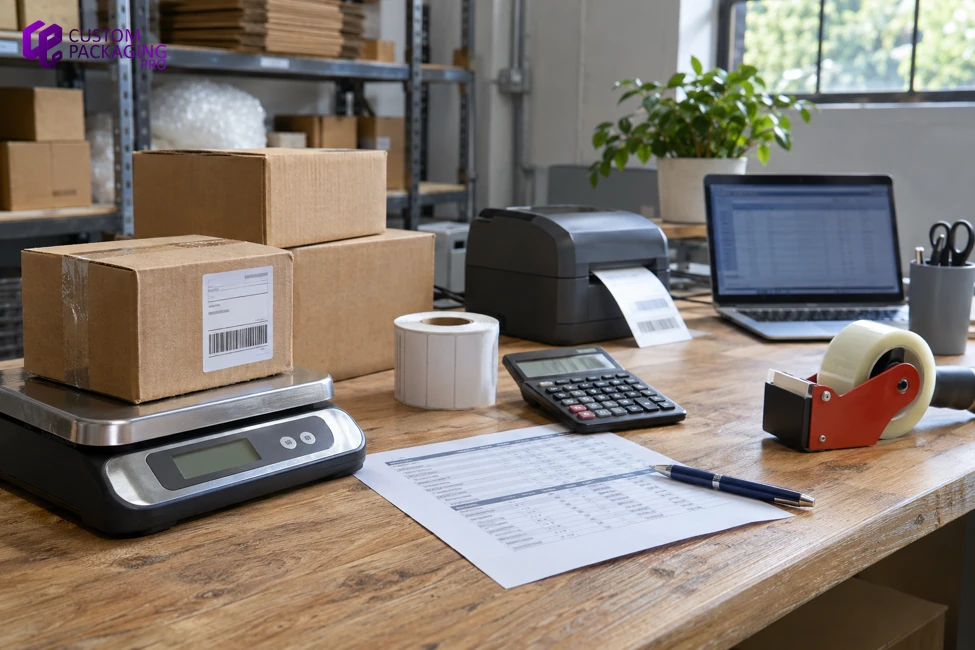
Accurate data is now part of packaging too. USPS checks parcels after they enter the network with Automated Package Verification, comparing the weight and dimensions measured in sorting against the weight and dimensions declared on the shipping manifest when the label was bought. Where the two do not match, the postage is corrected after the parcel has shipped. The same filing that raises base prices also introduces new fees that USPS says better align with the industry, so a guessed weight, a default box size left in your shipping software, or a barcode the sorting equipment cannot read can each add cost on top of the January rates. Weigh and measure the finished parcel, with its box, inserts and fill in place, and save those figures as presets for each product.
Seven things to do before January 17
- Pull your last 90 days of USPS labels by service, weight and zone, and reprice your top 20 parcels with the proposed January price file on Postal Explorer, adding 11 percent to the base price.
- Compare January costs with your September costs, not only with December holiday costs, before you decide on checkout rates or free shipping thresholds.
- Check that you are paying commercial prices wherever you can. Retail labels carry higher holiday amounts today and higher base prices in January.
- Re-measure every packed box against the 22 inch and 30 inch thresholds and against dimensional weight, using the outer dimensions of the packed carton. Resize any box that sits just over a threshold, and record the new size against the product so repeat orders use it automatically.
- Test any free shipping threshold change on a small share of traffic first. Raising a threshold can cost more in lost orders than it saves in postage.
- Ask your shipping platform how discounted USPS rates will change and how the 11 percent surcharge will appear on labels, invoices and customer tracking emails.
- Compare USPS, UPS and FedEx again for your top lanes in the week of January 17, when all three carriers are on 2027 prices, including residential and fuel charges.
About Custom Packaging Pro
Custom Packaging Pro USA is not just another company for packaging, but a provider of solutions committed to challenging the standard of packaging. It was founded with the intention to make packaging an asset of strategic importance for companies. We have always striven to meet or exceed customer expectations and provide unforgettable brand experiences.
The world of packaging has shifted dramatically, adapting to evolving trends in consumer tastes and demands for sustainability. In this ever changing environment, a single firm stands out as a source of reliability and innovation.
If the January rise has exposed boxes that are too big, too heavy or too weak for the job, talk to Custom Packaging Pro about custom packaging boxes sized to your product, from corrugated shipping boxes and mailer boxes to subscription boxes, candle boxes, bakery boxes and cosmetic packaging. Right sized packaging is the one packaging solution a small business fully controls in a general rate increase: it will not stop a carrier rate rise, but it decides how much of that rise you actually pay on every order.

Frequently asked questions
How much is the USPS price increase in January 2027?
USPS has filed an average increase of 5.9 percent for Priority Mail, Priority Mail Express, USPS Ground Advantage and Parcel Select, plus an 11 percent fuel surcharge on base postage for domestic parcels. International services rise by an average of 7.9 percent. The changes are proposed for January 17, 2027, pending PRC review.
When do the new USPS rates take effect?
The proposed date is January 17, 2027. That is the same day the holiday prices and the temporary 8 percent increase end. The Postal Regulatory Commission reviews the filing before the prices can take effect.
Are stamps going up in January 2027?
No. The November 12, 2026 announcement says no changes are made to the price of stamps. There is also no January increase for market dominant mail such as First-Class Mail, Marketing Mail and Periodicals, and no change to competitive PO Box prices in January.
What is the USPS 11 percent fuel surcharge?
It is the temporary 8 percent transportation related increase from April 2026 converted into a permanent fuel surcharge, plus an additional 3 percent linked to further fuel price rises. It is charged as a percentage of base postage, applies to domestic parcels only for now, and will be reevaluated in July 2027.
Will USPS prices drop after the holidays?
No, not on the labels in the worked examples. Holiday prices end on January 17, but the new base prices plus the 11 percent surcharge replace them. In the examples published from the proposed price file, January labels cost 3 cents to $1.03 more than holiday prices and about 9 percent to 11 percent more than prices before October 4.
Does the fuel surcharge apply to international shipping?
Not at this time. USPS says the surcharge will not impact international products for now. International prices still rise by an average of 7.9 percent, and country rate groups and assignments also change.
How can a small business offset the USPS increase?
Reprice your most common weight and zone, pay commercial prices where you can, and right size your packaging. A fitted box can lower billable weight by cutting dimensional weight, avoid the higher fees for boxes over 22 and 30 inches, and reduce damage and reshipments. Then reset checkout rates and free shipping thresholds against September costs, not December costs.
How does USPS compare with UPS and FedEx in 2027?
All three carriers announced an average rise of 5.9 percent. UPS takes effect on December 21, 2026, FedEx on January 4, 2027 and USPS on January 17, 2027. USPS does not charge a residential surcharge, which helps on light home deliveries, but each carrier applies fuel and other surcharges differently, so compare total cost per order on your own lanes.

 Custom Boxes
 Mailer Boxes
 Shipping Boxes
 Display Boxes
 Product Boxes
 Retail Packaging
 Luxury Packaging
 Sustainable Packaging
 Mylar Bags
 Labels & Stickers
 Inserts & Dividers
 Acrylic Signs
 Mylar and Zipper Bags
 Cosmetic Boxes
 Custom Candle Packaging Boxes
 Food and Beverage
 Display Packaging
 Pharma Packaging
 Custom Blister Packaging
 Stand Up Displays
 Kraft Boxes
 Cereal Packaging Boxes
 Bakery Packaging Boxes
 Eco-Friendly Boxes
 Electronics Packaging Boxes
 Custom Vape Boxes & Packaging
 CBD Packaging Boxes
 Rigid & Luxury Packaging Boxes
 Gift Boxes
 Custom Soap Boxes & Packaging
 Metalized Boxes
 Retail Boxes
 Subscription Boxes
 Invitation Boxes
 Corrugated Shipping Boxes
 Custom Apparel Boxes