By Rai Haider
September 21, 2026
Mason Jar Sizes Guide: Standard Sizes, Dimensions, Lids, and Uses
Mason jars come in many sizes, and choosing the right one is not always as simple as picking a capacity in ounces. A small jar may be perfect for jam or honey, while a larger jar may be more practical for pickles, vegetables, beverages, sauces, or pantry storage.
When comparing mason jar sizes, you should look at capacity, jar dimensions, mouth style, lid compatibility, intended use, and packaging requirements. Two jars may both hold 16 ounces but have different heights, widths, and openings, which can affect filling, labeling, storing, and shipping.
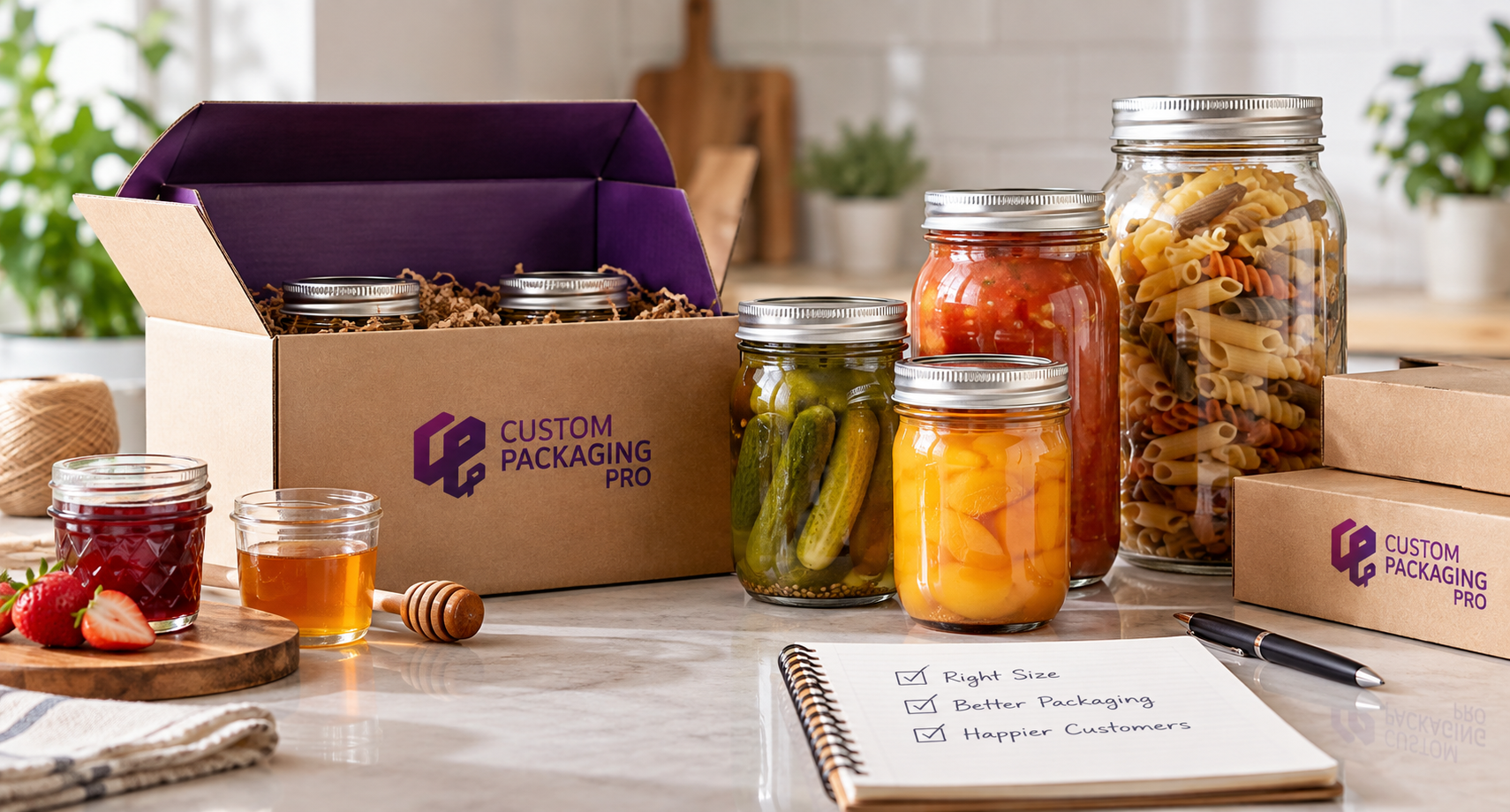
For businesses, this becomes even more important. The jar itself is only one part of the final product. Labels, inserts, cartons, shipping protection, and custom packaging must all fit the exact jar being used.
This guide explains the most common sizes of mason jars, their uses, dimensions, lid types, and packaging considerations so you can choose the right format with confidence.
Mason Jar Sizes at a Glance
There is no single standard size mason jar. Mason jars are available in several capacities, from small sample-size containers to larger half-gallon jars.
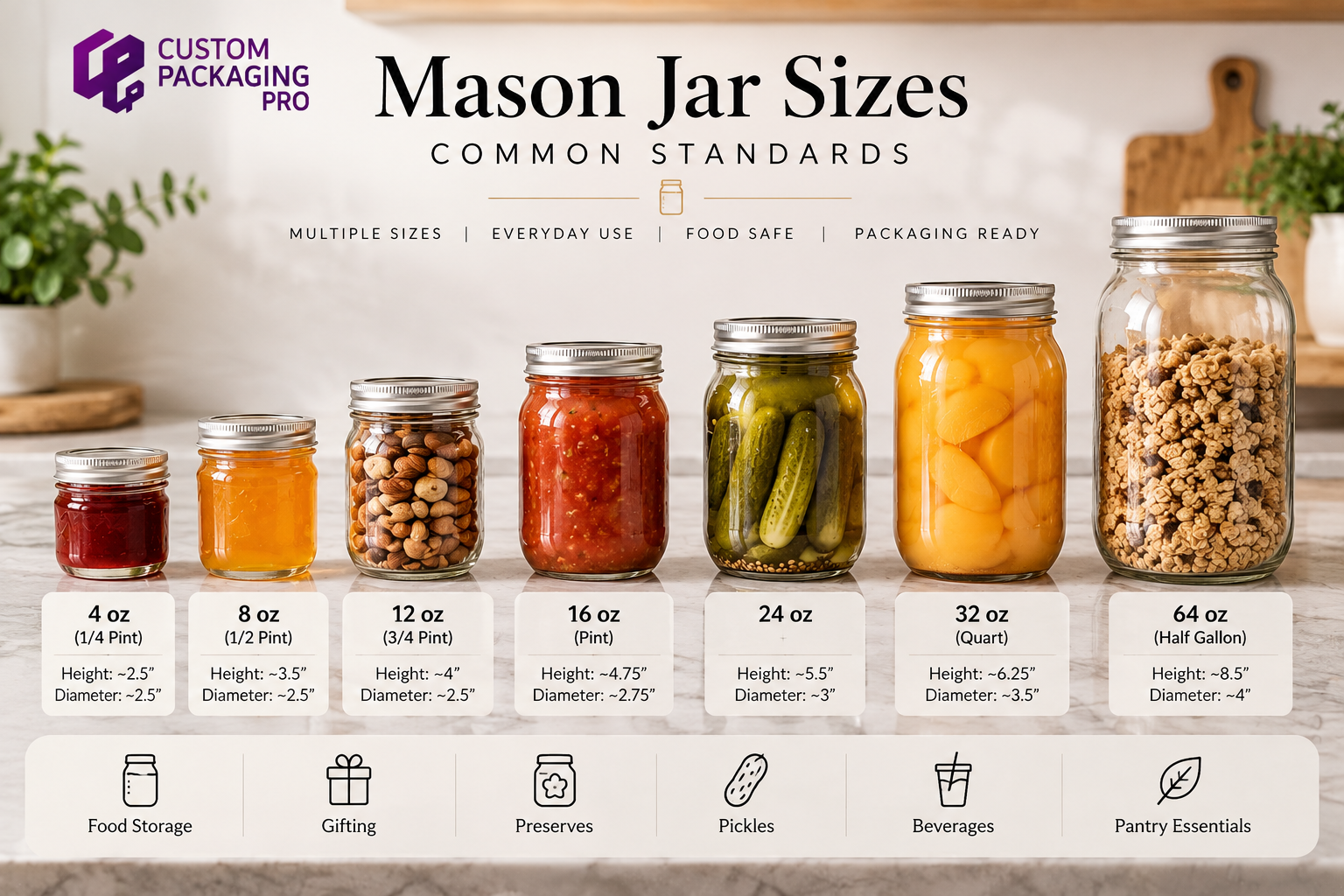
Here is a practical mason jar sizes chart:
| Mason Jar Size |
Common Name |
Approx. Cup Capacity |
Typical Uses |
| 4 oz |
Quarter pint |
1/2 cup |
Jam, jelly, spices, samples |
| 8 oz |
Half pint |
1 cup |
Preserves, honey, sauces |
| 12 oz |
Three-quarter pint |
1 1/2 cups |
Marmalade, spreads, specialty foods |
| 16 oz |
Pint |
2 cups |
Salsa, sauces, pickles, beverages |
| 24 oz |
Pint and a half |
3 cups |
Pickle spears, vegetables, soups |
| 32 oz |
Quart |
4 cups |
Tomatoes, pickles, juice, sauces |
| 64 oz |
Half gallon |
8 cups |
Bulk storage and certain juices |
This chart is useful for understanding capacity, but it should not be treated as a universal dimensions chart. Jar shape can vary between brands and product lines.
What Are the Sizes of Mason Jars?
If you are wondering what are the sizes of mason jars, the most common options usually range from 4 oz to 64 oz. Smaller jars, such as 4 oz and 8 oz containers, are useful for products that are consumed in small portions. Jam, honey, sauces, spices, and product samples fit naturally into these sizes. The 16 oz pint jar sits in the middle. It offers enough capacity for many everyday foods without becoming too large or heavy. This makes it popular for salsa, sauces, relishes, beverages, and preserved foods.
Larger 24 oz and 32 oz jars provide more space for vegetables, pickles, soups, tomatoes, and larger product portions. A 64 oz jar offers even more capacity, although larger jars are not automatically suitable for every home-canning process. The best jar size is therefore determined by the product, not just by how much glass you want to use.
Why Mason Jar Dimensions Matter
Mason jar dimensions are especially important for retailers, food manufacturers, and packaging designers. Capacity tells you how much a jar holds. Dimensions tell you whether it fits into a box, shipping divider, display tray, or retail shelf. Important mason jar specifications include:
- Overall height
- Body diameter
- Base diameter
- Mouth diameter
- Lid size
- Label area
A short, wide 16 oz jar may require a different box than a tall, narrow 16 oz jar. The capacity may be the same, but the packaging requirements can be completely different. Businesses should always measure the actual production jar or request manufacturer specifications before ordering custom printed boxes, inserts, or labels in bulk.
Regular Mouth vs Wide Mouth Mason Jars
Mouth style is another major difference between different size mason jars. Regular-mouth jars have a narrower opening, while mason jar wide mouth styles provide more space at the top. The larger opening can make a noticeable difference when filling or removing foods.
Regular-Mouth Jars
Regular-mouth jars work well for foods that can easily be poured or spooned into the container.
They are commonly used for:
- Jam
- Jelly
- Sauces
- Syrups
- Relishes
- Fruit spreads
Their smaller opening can also make pouring certain liquids easier.
Wide-Mouth Jars
Wide-mouth jars are useful when the contents include larger pieces. Pickles, whole vegetables, fruit pieces, chunky sauces, and dry ingredients are easier to place inside a wider opening. The additional space also makes it easier to reach the bottom of the jar when cleaning.
For businesses, mouth size also affects lid diameter, neck profile, label placement, and packaging clearance.
4 oz Mason Jars
4 oz mason jars, also known as 4 ounce mason jars or 4oz mason jars, are small containers designed for compact portions. They are commonly used for jam, jelly, honey, mustard, spices, samples, and gift products. Their small size makes them particularly useful for premium products where customers only need a limited amount.
For retailers, 4 oz jars also work well in multi-flavor sets. Instead of selling one large jar, a brand can package several small varieties together inside a single gift or retail carton.
This is where packaging matters. When several glass jars are packed together, inserts or dividers can help prevent direct glass-to-glass contact.
8oz Mason Jars
8oz mason jars are usually referred to as half-pint jars.
They offer a practical balance between compact size and useful capacity. An 8 oz jar can hold enough product for regular use while remaining convenient for storage, display, and shipping.
Common applications include preserves, honey, chutney, dessert sauces, salsa, and specialty condiments.
For small businesses, 8 oz jam jars are also attractive because they provide enough label space for branding, ingredients, and product details without creating an oversized package.
12 oz Mason Jars
A 12 oz jar sits between a half-pint and pint.
It is useful when 8 oz does not provide enough product but 16 oz feels excessive. Marmalade, spreads, sauces, and specialty food products can all work well in this format.
For retail packaging, 12 oz containers can create a distinct shelf profile compared with more common 8 oz and 16 oz jars. However, exact measurements should always be confirmed before designing fitted packaging.
16 oz Canning Jars
16 oz canning jars hold one pint, which is approximately two US cups.
The pint size is one of the most versatile options because it works for a wide range of products without becoming difficult to handle.
Common uses include salsa, sauces, relishes, pickled foods, beverages, fruit, and pantry ingredients.
From a packaging perspective, a 16 oz jar provides enough label area for strong branding while still fitting comfortably inside many types of retail packaging.
For ecommerce, filled weight should also be considered. A jar may look compact on a shelf but become much heavier once filled with sauce, vegetables, or liquid.
24 oz Mason Jars
24 oz mason jars hold approximately three cups.
They are often taller than standard pint jars, which makes them useful for pickle spears, asparagus, vegetables, soups, and larger food portions.
This taller profile is one reason businesses should never design packaging based only on ounces. A 24 oz jar may require a taller box, different divider dimensions, and additional support compared with a 16 oz container.
Its shape can also provide more vertical space for branding, which may be useful for premium food products.
32 oz Canning Jars and Quart Jars
A quart jar holds 32 fluid ounces, or approximately four cups. 32 oz canning jars are often used for pickles, tomatoes, vegetables, fruit, juice, sauces, and larger food quantities. Because quart jars hold more product, they can become relatively heavy. This has a direct effect on shipping and food packaging boxes.
A business packing several quart jars together may need stronger corrugated material, fitted partitions, cushioning, and careful control of empty space. Good packaging should stop the jars from moving and prevent impact between glass surfaces.
64 oz and Larger Mason Jars
A 64 oz Mason jar holds half a gallon.
These larger containers can be useful for bulk pantry storage, juices, dry ingredients, pasta, beans, rice, or decorative organization.
A massive mason jar may look convenient, but bigger does not always mean better for canning. Larger containers should only be used when their intended use and processing guidance support that application.
For non-canning storage, however, 64 oz jars provide plenty of capacity and can reduce the number of smaller containers needed.
Is a 1 Gallon Glass Jar a Mason Jar?
A 1 gallon glass jar holds 128 fluid ounces. Large gallon containers are often used for pantry storage, fermentation, beverages, bulk ingredients, and decorative purposes. They should not automatically be treated as standard home-canning jars.
The same applies to glass gallon jugs and a traditional glass jug. These containers may have narrower necks, different closures, and different glass construction compared with Mason-type jars. The intended use from the manufacturer matters more than the general appearance.
How Many Ounces in a Mason Jar?
There is no single answer to how many ounces or mililiters in a mason jar because Mason jars are produced in multiple capacities. The most useful conversions are:
- 4 oz = quarter pint
- 8 oz = half pint
- 16 oz = pint
- 24 oz = pint and a half
- 32 oz = quart
- 64 oz = half gallon
These conversions make it easier to compare recipes, serving sizes, product portions, and packaging formats.
Mason Jar Lids
Mason jar lids are usually connected to the jar's mouth style. Traditional home-canning jars commonly use a flat sealing lid together with a separate screw band. The lid creates the seal, while the band holds it in place during processing.
Regular-mouth and wide-mouth jars use different lid sizes, so they are not interchangeable. For businesses, lid selection also influences the overall product experience. The closure may affect tamper evidence, labeling, storage, shelf appearance, and how easily the customer opens the product.
Ball Mason Jar Sizes
Ball mason jar sizes are frequently used as a reference because Ball is one of the most recognized names in canning and preserving.
Common Ball formats include quarter-pint, half-pint, pint, quart, and other specialty sizes. Different lines may also include smooth-sided jars, quilted jars, regular-mouth jars, and wide-mouth jars.
You may also see older blue Ball jars, which are popular with collectors and decorators. Vintage jars, however, should not automatically be treated the same as modern Ball mason preserving jars intended for current canning practices.
Canning Jars vs Ordinary Glass Jars
Not every jar with glass construction is suitable for canning. There are many types of jars, including decorative jars, cosmetic jars, food storage jars, spice jars, preserving jars, and beverage containers.
A container may look similar to a Mason jar but have a different sealing surface, closure system, or glass specification. If the jar will be used for canning, confirm that it is intended for that purpose rather than choosing based only on appearance. This is especially important when searching broad terms such as just jars or jar mason, which may return products made for completely different applications.
Jam Jars vs Pickling Jars
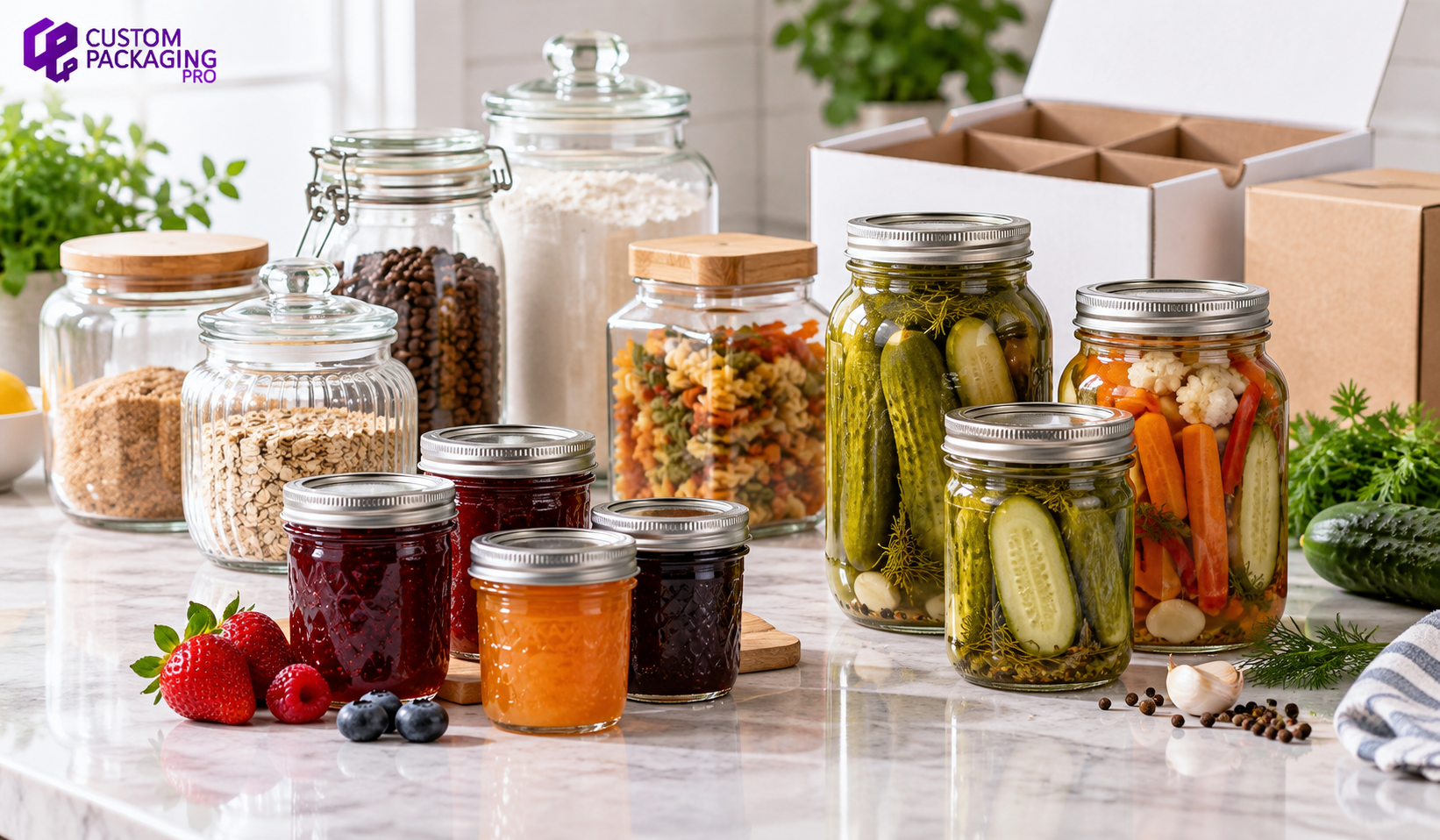
Jam jars are usually smaller because jams and preserves are consumed in modest portions. Sizes such as 4 oz, 8 oz, and 12 oz work well for these products. Pickling jars are often larger because cucumbers and vegetables require more internal space. Pint, 24 oz, and quart jars are commonly chosen.
Wide-mouth jars are particularly practical for pickled vegetables because larger pieces are easier to arrange and remove. For retailers, these differences also affect packaging design. A compact jam jar may work well in a gift box, while a tall pickle jar may need stronger and deeper product packaging.
Small Glass Jars and 2 oz Bottles
Small glass jars and tiny Ball jars are useful for samples, spices, honey, mini preserves, gift products, and specialty foods.
A 2 oz bottle, on the other hand, is generally more suitable for liquid products such as extracts, oils, flavorings, and concentrated samples.
The distinction is important because bottles and jars require different closures and different packaging inserts.
Mason Jar With Handle
A mason jar with handle is normally used as drinkware rather than for preserving food.
These jars are popular for lemonade, iced tea, smoothies, restaurant beverages, and party drinks.
Even though they resemble Mason jars, they should not automatically be used for heat processing unless the manufacturer specifically approves that use.
Clear Glass vs Amber Glass
Clear glass is common for Mason jars because it allows the contents to remain visible.
Amber glass, by comparison, creates a darker appearance and is often used for products where light exposure is a concern.
Amber containers are common in cosmetics, pharmaceuticals, essential oils, and specialty liquids.
For brands, the decision between clear and amber glass can affect both product protection and visual presentation.
How to Sterilize Jars
People often search how to sterilize jars before canning. The exact preparation depends on the processing method and processing time. Jars should always be cleaned before use, but separate pre-sterilization is not required for every canning process. For safe food preservation, always follow a current tested recipe and its instructions for jar size, preparation, and processing time.
The important point is that sterilization should be based on the actual canning method, not on a general assumption that every jar requires exactly the same preparation.
Buying Canning Jars in Bulk
Businesses buying canning jars bulk should consider much more than the cost per jar.
Before ordering large quantities, check:
- Jar dimensions
- Closure availability
- Weight
- Label area
- Case quantity
- Breakage risk
- Shipping requirements
Testing a smaller quantity first can help identify packaging or labeling problems before they affect hundreds or thousands of units.
Choosing Mason Jars for Product Packaging
For a business, a Mason jar becomes part of the overall brand presentation.
A small preserve jar can communicate premium, handcrafted, or gift-focused positioning. A 16 oz pint feels more practical for everyday use. A 24 oz or 32 oz jar creates a stronger shelf presence and communicates a larger product portion.
The outer packaging solutions should support that positioning.
A complete packaging system may include the jar, lid, label, tamper feature, insert, divider, retail carton, and shipping box. Designing all of these elements together helps create a more professional and secure final product.
How to Choose the Right Mason Jar Size
Start by thinking about the product instead of choosing a jar first.
Ask yourself:
- How much product should the customer receive?
- Is the product liquid, spreadable, chunky, or dry?
- Does it need a wide opening?
- Will the jar be used for canning or storage?
- How much label space is needed?
- Will the jar be sold individually or in a multipack?
- Does it need protective shipping packaging?
Once these questions are answered, it becomes much easier to narrow down the right jar size.
Final Thoughts
Understanding mason jar sizes means looking at more than ounces.
Capacity, dimensions, mouth style, lid compatibility, intended use, and packaging requirements all affect which jar will work best.
Small 4 oz and 8 oz jars are useful for samples, jams, honey, spices, and specialty foods. A 16 oz pint offers a flexible middle size, while 24 oz and 32 oz jars provide more room for pickles, vegetables, sauces, and larger portions.
For businesses, accurate mason jar specifications are also essential for labels, dividers, custom packaging, and shipping cartons. Choosing the right jar from the beginning can make the entire packaging process easier and help create a finished product that looks professional and arrives safely.
Frequently Asked Questions About Mason Jar Sizes
- What is the standard size mason jar?
There is no single standard Mason jar capacity. Pint and quart jars are common, but smaller and larger formats are also widely available.
- What are the most common mason jar sizes?
Common sizes include 4 oz, 8 oz, 12 oz, 16 oz, 24 oz, 32 oz, and 64 oz.
- How many ounces are in a pint Mason jar?
A pint Mason jar holds 16 fluid ounces.
- How many ounces are in a quart jar?
A quart jar holds 32 fluid ounces.
- Is a 64 oz Mason jar one gallon?
No. A 64 oz jar is half a gallon. One US gallon equals 128 fluid ounces.
- What Mason jar size is good for jam?
4 oz, 8 oz, and 12 oz jars are practical choices for jams, jellies, and preserves.
- What size jar works well for pickles?
16 oz, 24 oz, and 32 oz jars are commonly used. Wide-mouth jars can make larger pickles easier to pack.
- Are mason jar lids all the same size?
No. Regular-mouth and wide-mouth jars use different lid sizes.
- Can every glass jar be used for canning?
No. Use containers specifically intended for canning and follow tested preservation instructions.
- Are Mason jar dimensions the same across brands?
No. Capacity can be the same while jar height, diameter, shape, and label area differ.
- Can Mason jars be used for beverages?
Yes, many Mason-style jars are used for drinks. A mason jar with handle is especially common for beverage service, although it should not automatically be treated as a canning jar.

 Custom Boxes
 Mailer Boxes
 Shipping Boxes
 Display Boxes
 Product Boxes
 Retail Packaging
 Luxury Packaging
 Sustainable Packaging
 Mylar Bags
 Labels & Stickers
 Inserts & Dividers
 Acrylic Signs
 Mylar and Zipper Bags
 Cosmetic Boxes
 Custom Candle Packaging Boxes
 Food and Beverage
 Display Packaging
 Pharma Packaging
 Custom Blister Packaging
 Stand Up Displays
 Kraft Boxes
 Cereal Packaging Boxes
 Bakery Packaging Boxes
 Eco-Friendly Boxes
 Electronics Packaging Boxes
 Custom Vape Boxes & Packaging
 CBD Packaging Boxes
 Rigid & Luxury Packaging Boxes
 Gift Boxes
 Custom Soap Boxes & Packaging
 Metalized Boxes
 Retail Boxes
 Subscription Boxes
 Invitation Boxes
 Corrugated Shipping Boxes
 Matte Finish
 Gloss Finish
 Soft Touch
 Foil Stamping
 Spot UV
 Embossing
 Debossing
 Window Cutouts