By Rai Haider
October 12, 2026
Can You Microwave Styrofoam? Safety, Risks & Alternatives
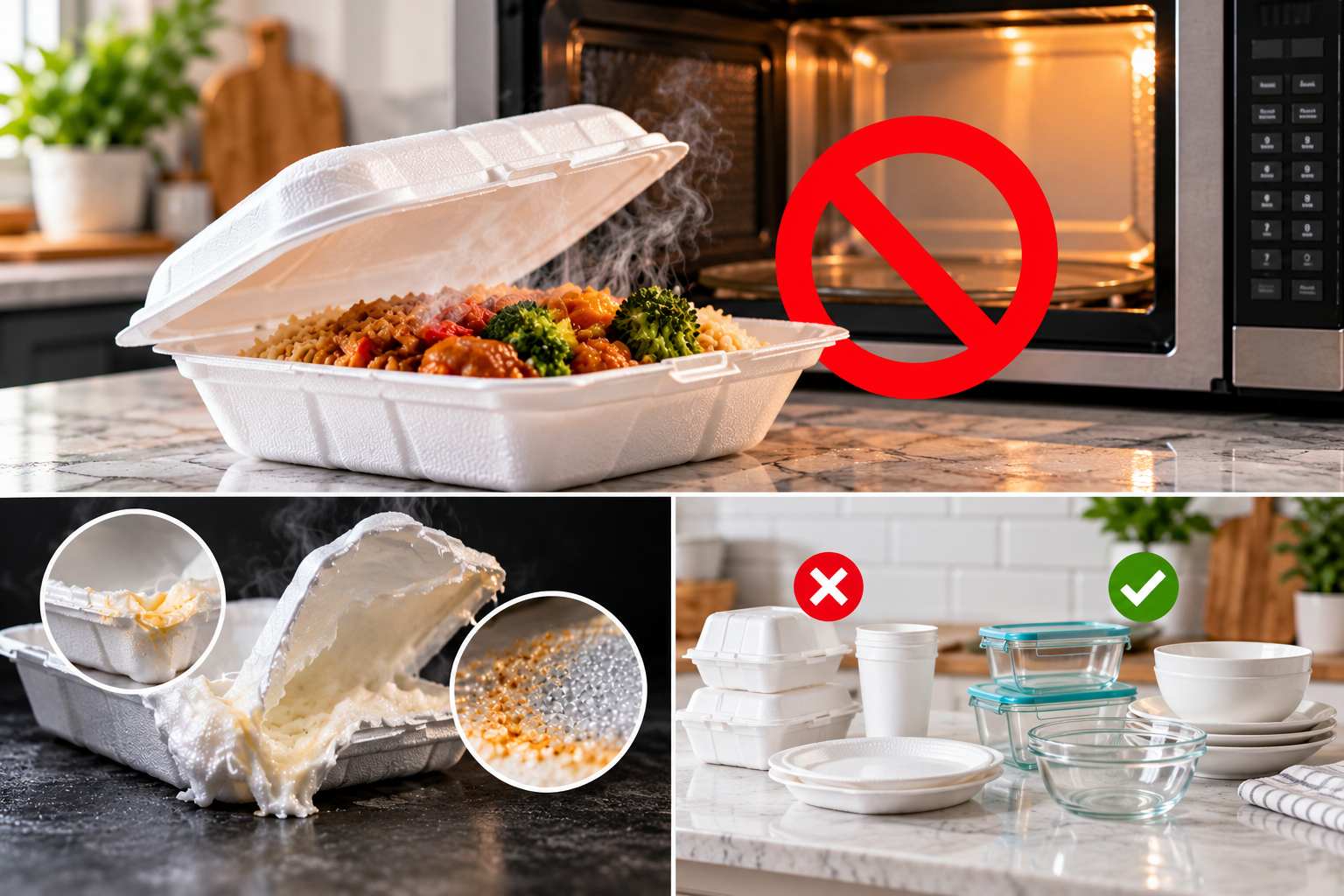
No, not unless the container is clearly labeled microwave safe. Most foam takeout boxes, cups, plates, and meat trays are built for one-time use at serving temperature, not for reheating. USDA food safety guidance lists take-out containers among the one-time-use containers that should stay out of the microwave because they can warp or melt and let chemicals move into food (USDA FSIS).
This guide explains what happens when foam heats up, which foam items cause the most trouble, how to read a container's markings, and what to use instead. If you run a restaurant, cafe, or food brand, the last sections cover packaging your customers can reheat without guessing.
Is Styrofoam Microwave Safe?
In most cases, no. The answer starts with what the material actually is.
"Styrofoam" is a DuPont trademark for blue extruded polystyrene (XPS) foam used as building insulation. DuPont itself points out that it isn't used to make cups or food containers (DuPont). The white cups, clamshells, and trays most Americans call Styrofoam are expanded polystyrene (EPS) foam, marked with resin code 6 or "PS."
Polystyrene starts to soften at around 212°F (100°C), roughly the boiling point of water. That's fine for holding hot coffee or a fresh plate of fries. A microwave is different: it heats food unevenly, and spots with fat, oil, or sugar can climb well past 212°F. Those hot spots sit directly against the foam.
Some foam products are made for microwave use, and those are the exception. Polystyrene that touches food is regulated by the FDA (21 CFR 177.1640), and manufacturers have to make sure a food-contact material suits how it will be used. If a foam container is meant to go in the microwave, it should say so on the item or its packaging. No label means no microwave.
| Foam item |
Usually made of |
Microwave it? |
| Takeout clamshell or to-go box |
EPS (#6) |
No, unless labeled microwave safe |
| Coffee or soup cup |
EPS (#6) |
No, unless labeled microwave safe |
| Plate or bowl |
EPS (#6) |
No, unless labeled microwave safe |
| Meat or poultry tray |
EPS (#6) |
No, not even on defrost |
| Older-style instant noodle cup |
EPS (#6) |
Add boiled water only, per package directions |
| Blue insulation board (actual Styrofoam brand) |
XPS |
Never used for food |
What Happens If You Microwave Styrofoam?
Three things can go wrong, and they don't always happen together.
- The container breaks down. Foam softens, bends, or caves in where the hottest food touches it. Thin rims and hinges go first. A sagging clamshell full of hot soup or chili is a real burn risk when you lift it out.
- Chemicals can move into the food. Heat speeds up the migration of styrene and other substances from polystyrene into whatever it holds. Research on polystyrene food packaging shows migration rises with higher temperatures, longer contact time, and fattier foods (Guazzotti et al., 2022). Old, scratched, or cracked containers make it worse.
- You may smell or see it. A plastic odor, a warped bottom, or foam stuck to the food are clear signs the container got too hot.
Can microwaving styrofoam make you sick?
A single accidental reheat is unlikely to make you ill right away. The concern is styrene exposure over time. The U.S. National Toxicology Program lists styrene as "reasonably anticipated to be a human carcinogen" (NTP Report on Carcinogens), and the International Agency for Research on Cancer moved it to Group 2A, "probably carcinogenic to humans," in 2018 (review in PMC).
That evidence mostly comes from workers with heavy, long-term exposure in plastics and rubber plants, not from people eating reheated leftovers. Still, reheating food in foam several times a week is an exposure you can cut to zero by grabbing a plate.
If you already microwaved a foam container:
- Throw the food out if the foam melted, warped into the food, or left a plastic taste or smell.
- If the container looks unchanged, there's no need to panic, but switch to a different container next time.
- Air out the kitchen if you notice fumes, and wipe any melted residue from the microwave once it cools.
Can You Microwave Styrofoam Food Containers?
Only the ones that say so. Foam food containers are chosen by restaurants and grocers because they're light, cheap, and hold heat well. Reheating isn't part of the design brief, so most carry no microwave marking at all.
USDA's Food Safety and Inspection Service groups take-out containers with margarine tubs and whipped topping bowls: one-time-use containers that shouldn't go in the microwave (USDA FSIS).
Can You Microwave Styrofoam Takeout Boxes?
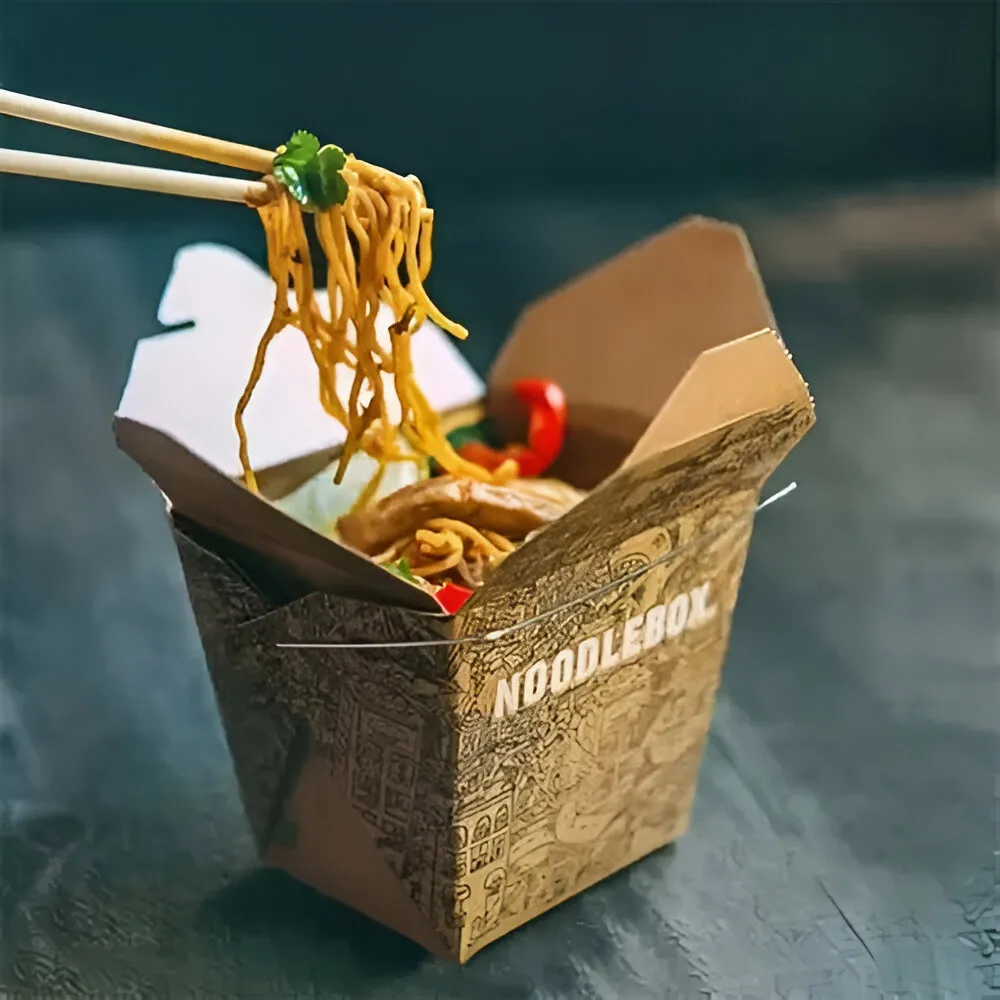
The hinged foam clamshell is the container people microwave most, and it's one of the worst candidates. The lid traps steam, the hinge is the thinnest part of the box, and saucy or oily dishes like lo mein, wings, or curry put the hottest food right against the foam.
For takeout leftovers, the safer routine takes about 30 extra seconds:
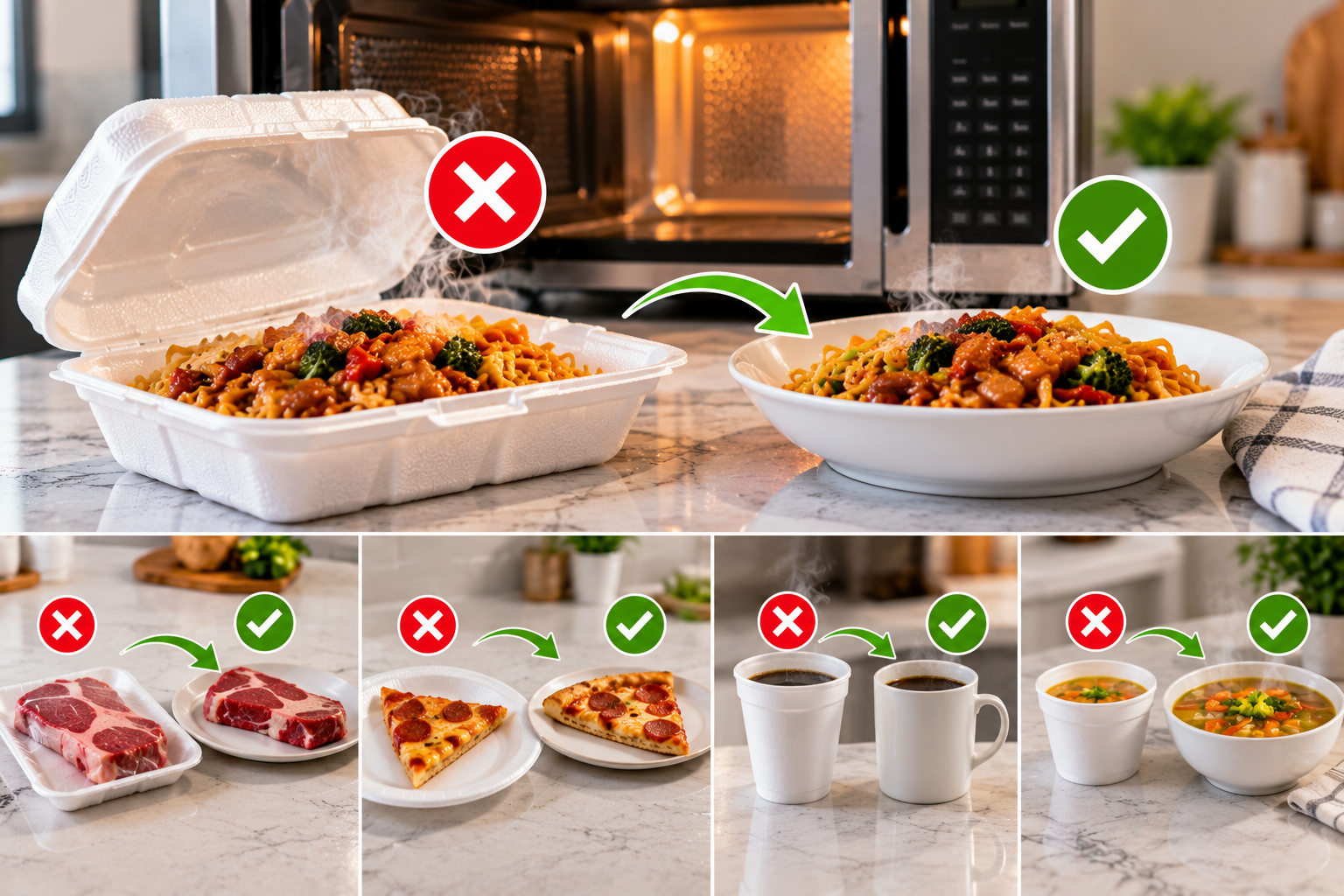
- Move the food to a glass or ceramic plate or bowl.
- Cover it loosely with a microwave-safe lid, wax paper, or a white paper towel.
- Heat in short bursts, stirring or rotating between them.
- Check that leftovers reach 165°F (74°C) in the center, the temperature USDA recommends for reheating.
Can you microwave the styrofoam meat comes in?
No. Foam meat and poultry trays are packaging for the store shelf and the fridge. USDA advises taking meat out of its packaging before defrosting, because foam trays and plastic wraps aren't heat-stable. Defrost on a plate instead, and toss the tray along with the absorbent pad underneath.
Can You Microwave Styrofoam Plates, Cups, and Bowls?
The same rule applies: check for a microwave-safe label, and assume there isn't one. Each shape fails a little differently.
- Plates. Foam plates are thin and flat, so a greasy slice of pizza or a buttered side dish heats the foam directly. Party-pack foam plates almost never carry a microwave marking. Reheat on a ceramic plate and serve on foam if you like.
- Cups and coffee cups. Coffee, tea, and soup reheated in the microwave can get close to boiling, which is right around the point where polystyrene softens. A Printed Paper Cup may be a better packaging option when it is specifically designed and labeled for the intended use. Lids can also add steam pressure. For reheating, transfer the drink to a microwave-safe ceramic mug first.
- Bowls and soup cups. Deli soup cups and foam bowls hold liquid with fat floating on top, which is exactly the kind of food that can increase contact with polystyrene. Pour the soup into a microwave-safe bowl before reheating.
- White vs. black foam. Color doesn't change the answer. White and black foam trays are typically both polystyrene. Some black takeout bases are made of polypropylene (#5) instead, a plastic commonly used for microwavable containers, but they are only safe to heat if they carry a microwave-safe label. Read the code and the label, not the color.
How Long Can You Microwave Styrofoam?
For foam without a microwave-safe label, there is no safe time limit. How hot the container gets depends on the food, the amount, and your microwave's wattage, which commonly ranges from about 600 to 1,200 watts in home models. The same 45 seconds can be harmless in one kitchen and enough to warp a cup in another.
For foam that is labeled microwave safe, follow the time and power level printed on the package, vent or lift the lid, and stop if the container starts to bend.
Is 30 Seconds or 1 Minute Safe?
A 30-second warm-up often leaves no visible damage, which is why many people think it's fine. Looking undamaged isn't the same as staying cool. Oily sauce, cheese, or sugary glaze can reach high temperatures in seconds and heat the foam right where it touches.
One minute raises the odds of softening, especially with fatty food or a small portion.
A few related questions come up often:
- Low power or defrost setting: Lower power heats more slowly, but it also runs longer, so the foam still spends time in contact with warm food. USDA specifically advises against defrosting on foam trays.
- Foam with water in it: Water tops out at about 212°F, close to the temperature where polystyrene softens. Boiling water in a foam cup in the microwave is a good way to get a soft, leaky cup. Heat the water in a mug or kettle instead.
How to Identify Microwave-Safe Styrofoam Containers
Flip the container over and check the bottom, then the outer packaging if there is any.
- Look for words first. "Microwave safe" or "microwavable" printed on the item is the clearest signal. There's no single required symbol design in the U.S., so text beats guessing at an icon.
- Find the microwave icon. A small microwave or dish with wavy lines usually means the maker intends it for microwave use. A microwave with a line through it means the opposite.
- Don't read the recycling number as permission. The number 6 inside the arrows (or "PS") only tells you the material is polystyrene. It says nothing about heat.
- Check the condition. Skip containers that are cracked, scratched, already warped, or reused many times, even if they're labeled.
- When in doubt, transfer. If you can't find a marking, treat the container as not microwave safe.
| What you see |
What it tells you |
Microwave it? |
| "Microwave safe" text or wavy-lines icon |
Maker intends microwave use |
Yes, following package directions |
| Microwave icon with a line through it |
Not made for the microwave |
No |
| #6 or "PS" only |
Polystyrene, nothing about heat |
No |
| #5 or "PP" only |
Polypropylene, nothing about heat |
Only if also labeled microwave safe |
| No marking at all |
Unknown material and use |
No |
Can You Microwave Styrofoam Ramen Cups?
Not the foam ones. Foam instant noodle cups were designed for one step: pour in boiling water, close the lid, and wait. The microwave was never part of the instructions.
That's changing at the shelf. Nissin Foods USA replaced the polystyrene Cup Noodles cup with a paper cup in early 2024, made with 40% recycled fiber, and the new cup can go in the microwave (ProFood World). Older stock and other brands may still use foam, so read the cup you're holding.
For a foam ramen or soup cup:
- Peel the lid back and remove any seasoning packets.
- Boil water in a kettle or a microwave-safe mug.
- Pour it to the fill line and let the noodles sit for the time listed, usually about 3 minutes.
- If you want the noodles hotter or softer, tip them into a ceramic bowl and microwave there.
The Cup Noodles switch is a useful example for food brands too: the packaging decides whether customers can use the microwave at all.
Safer Alternatives for Reheating Food
At home, the fix is simple: reheat in glass or ceramic, or in plastic that's labeled microwave safe. Cover the food loosely to hold in steam, stir halfway through, and let it stand for a minute before checking the temperature. Fried foods, pizza, and anything crispy usually reheat better in an oven or air fryer anyway, on a metal or oven-safe tray rather than the original box.
| Material |
Microwave use |
Notes |
| Glass and ceramic (no metal trim) |
Yes |
Best everyday choice for reheating |
| Polypropylene (#5) labeled microwave safe |
Yes, per label |
Common in reusable and deli containers |
| Paperboard with a food-safe lining |
Only if labeled |
Depends on the coating, glue, and inks |
| Aluminum foil trays |
Avoid |
Only if your microwave maker allows it |
| EPS foam (#6) |
Only if labeled |
Most foam food packaging isn't |
| Takeout pails with wire handles |
No |
Metal handles can spark |
What this means for food businesses
Customers reheat leftovers. If the box they carried home can't go in the microwave, they either move the food themselves or microwave the foam anyway. Neither reflects well on the restaurant.
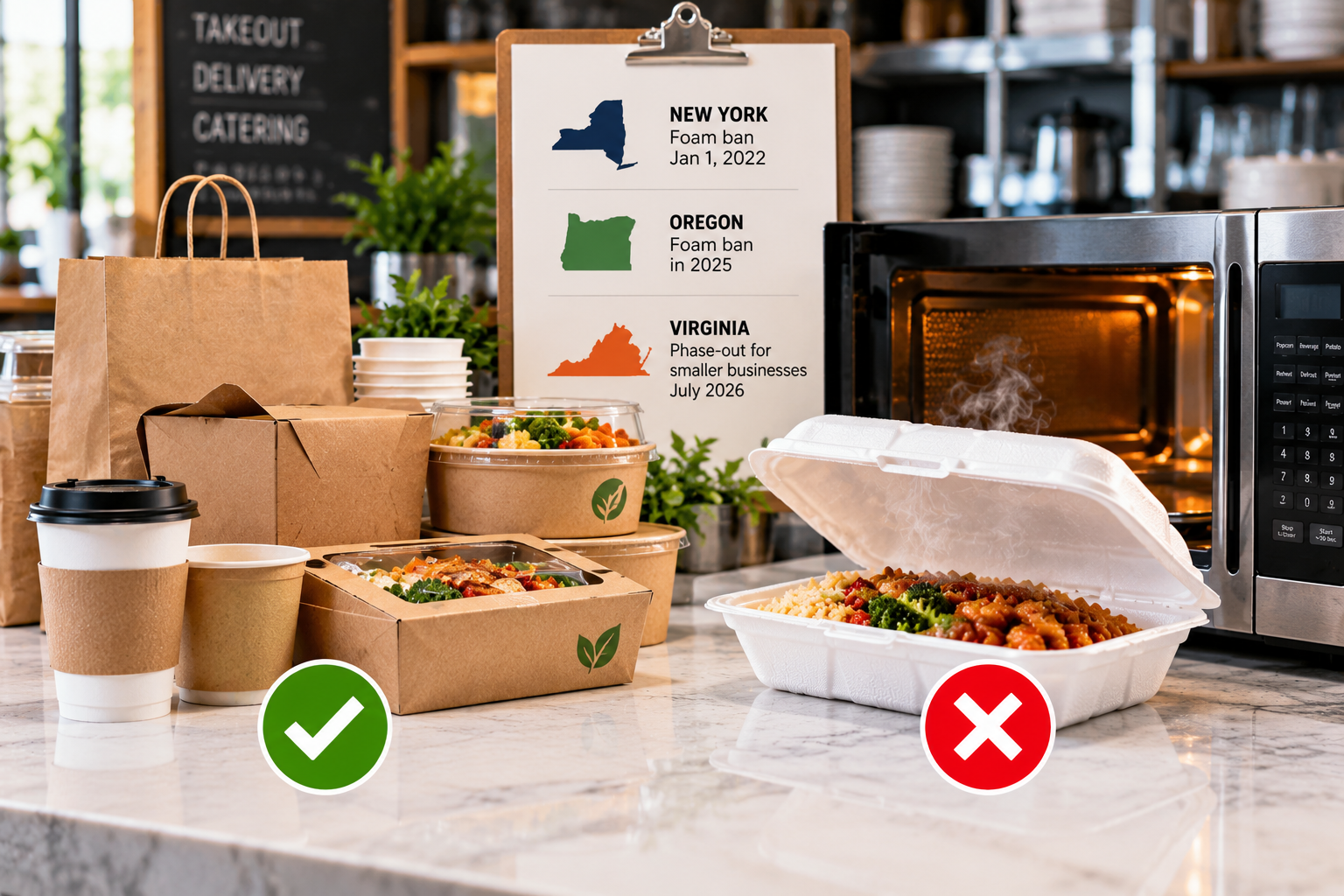
Foam is also getting harder to use legally. New York banned foam food service containers on January 1, 2022 (NY DEC), Oregon's ban took effect in 2025 (Grist), and Virginia's phase-out reached smaller businesses in July 2026 (Wikipedia summary). Check your state and city rules before reordering foam.
Paper-based packaging gives brands more room: it can be printed edge to edge, sized to the menu, and specified with the linings your food needs. Custom Packaging Pro produces custom food packaging for U.S. restaurants and food brands, including Chinese takeout boxes, food tray packaging, custom printed paper cups, and eco-friendly packaging. If reheating matters for your menu, tell us when you request a quote so the material, lining, and closure style (no wire handles, for example) are chosen with the microwave in mind. Every order comes with free design support.
For more material options, see our guide to eco-friendly packaging materials for food and beverage brands.
Final Thoughts
Foam is good at keeping food warm on the trip home. It isn't built to heat food back up. Unless the container clearly says microwave safe, move your food to glass or ceramic before reheating, and skip foam entirely for defrosting and boiling water. For businesses, packaging that customers can reheat with confidence is a small detail that keeps the meal, and your brand, intact after it leaves the counter.
Frequently Asked Questions
Why can't you microwave styrofoam if it holds hot coffee?
Hot coffee is usually served around 160 to 185°F, below the point where polystyrene softens. A microwave can push food and drinks past 212°F, and fatty or sugary spots get hotter still, right against the foam.
Can you put styrofoam in the microwave on defrost?
No. Defrost runs at low power for a long time, and parts of the food start cooking while the rest thaws. USDA recommends removing food from foam trays and plastic wrap before defrosting.
Can you microwave styrofoam on low?
Low power slows the heating but doesn't make unlabeled foam safe. The container still sits against warm food for longer.
Is a container marked number 6 microwave safe?
Not by itself. The 6 identifies polystyrene for recycling. Only a separate "microwave safe" label or icon tells you the container was made for microwave heating.
Can you microwave white styrofoam or black styrofoam?
The color doesn't matter. Both are usually polystyrene. Look for the microwave-safe marking on the bottom of the container.
Can styrofoam go in the oven or air fryer?
No. Oven and air fryer temperatures run far above what polystyrene can handle, and the foam will melt. Use an oven-safe dish or tray.

 Custom Boxes
 Mailer Boxes
 Shipping Boxes
 Display Boxes
 Product Boxes
 Retail Packaging
 Luxury Packaging
 Sustainable Packaging
 Mylar Bags
 Labels & Stickers
 Inserts & Dividers
 Acrylic Signs
 Mylar and Zipper Bags
 Cosmetic Boxes
 Custom Candle Packaging Boxes
 Food and Beverage
 Display Packaging
 Pharma Packaging
 Custom Blister Packaging
 Stand Up Displays
 Kraft Boxes
 Cereal Packaging Boxes
 Bakery Packaging Boxes
 Eco-Friendly Boxes
 Electronics Packaging Boxes
 Custom Vape Boxes & Packaging
 CBD Packaging Boxes
 Rigid & Luxury Packaging Boxes
 Gift Boxes
 Custom Soap Boxes & Packaging
 Metalized Boxes
 Retail Boxes
 Subscription Boxes
 Invitation Boxes
 Corrugated Shipping Boxes
 Matte Finish
 Gloss Finish
 Soft Touch
 Foil Stamping
 Spot UV
 Embossing
 Debossing
 Window Cutouts