By Rai Haider
November 10, 2026
Biodegradable Packing Chips: What They Are, How They Work and When to Use Them
If you ship fragile products, you already know that the box is only half the job. The space around the product matters just as much. For years that space was filled with white foam peanuts. Now more US shippers are switching to biodegradable packing chips, partly because customers prefer them and partly because several states no longer allow foam loose fill to be sold.
This guide explains what biodegradable loose fill is made of, how it protects a shipment, where it works well, where it falls short, and what to check before you buy it in bulk.
What Are Biodegradable Packing Chips?
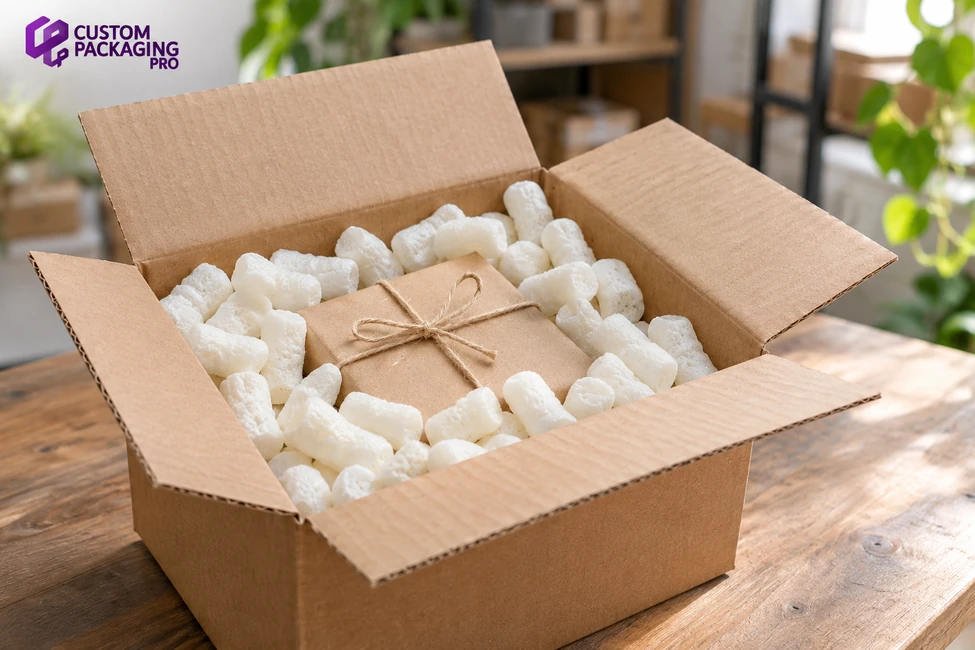
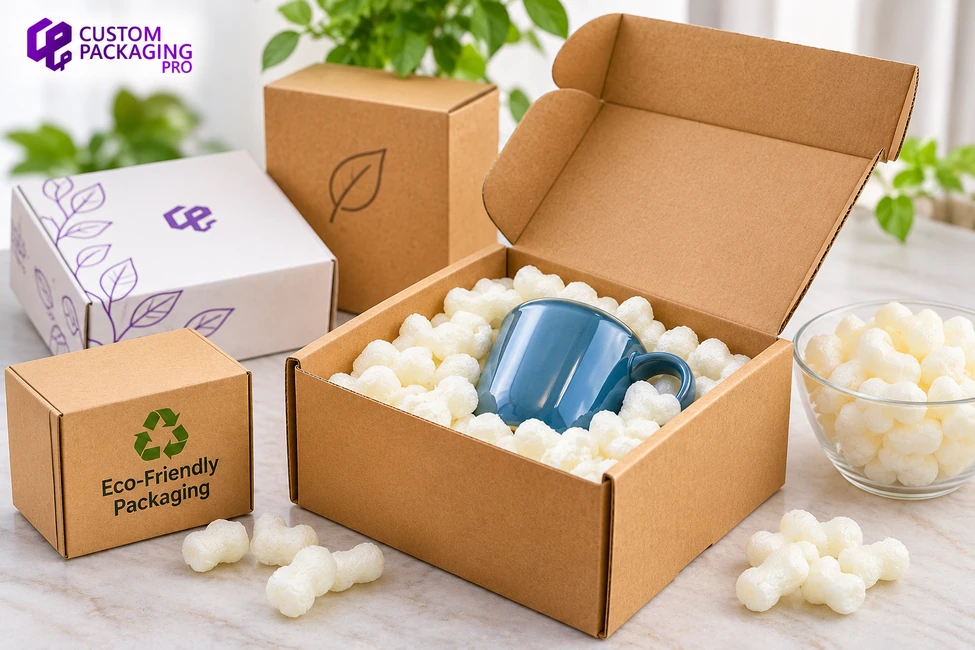
Biodegradable packing chips are loose fill cushioning pieces made mainly from plant starch instead of expanded polystyrene (EPS) foam. You will also see them called biodegradable packing peanuts, starch loose fill, loose fill packing chips or simply loosefill packaging. They all describe the same basic product: small, lightweight pieces poured into a box to fill empty space and absorb shock.
Most starch chips are made from corn, potato, wheat or tapioca starch. The starch is mixed with water, heated and pushed through an extruder. As it exits, the moisture flashes into steam and the material puffs up into a light, airy foam. That trapped air is what gives each chip its cushioning ability.
Because the base material is starch, the chips break down when they get wet and can be digested by microorganisms in compost. That is the key difference from foam peanuts, which are a petroleum-based plastic.
A Quick Note on "Chip Packaging"
Some searches for biodegradable packing chips are really about compostable bags for snack chips. That is a different product category. Flexible snack bags use films and laminates, not loose fill. If that is what you need, look at food and beverage packaging or mylar and zipper bags instead. The rest of this guide focuses on protective loose fill for shipping.
How Biodegradable Loose Fill Works
Protection Inside the Box
Loose fill does two jobs. First, it fills voids so the product cannot slide around and hit the box walls. Second, it absorbs some of the energy from drops and bumps during transit.
When you pour starch chips around a product and close the box, the pieces settle and press against each other. That creates a cushioned layer that moves with the item instead of letting it shift. The shape of the chip matters here. S-shaped and figure-eight shapes tend to lock together better than flat or round pieces, which helps them resist settling during long trips.
How the Chips Break Down
Starch chips have two disposal routes.
- Water: Starch softens and disperses quickly in water. A chip dropped in a glass will shrink, turn sticky and fall apart within minutes.
- Compost: In a compost pile, microorganisms digest the starch along with other organic material.
Speed depends on conditions. Heat, moisture and oxygen all help. A chip in a warm, active compost pile will disappear much faster than one buried in a dry landfill.
Biodegradable Packing Chips vs Foam Packing Peanuts
| Feature |
Starch-Based Packing Chips |
EPS Foam Packing Peanuts |
| Main material |
Plant starch (corn, potato, wheat, tapioca) |
Expanded polystyrene (petroleum-based plastic) |
| Reaction to water |
Softens and dissolves |
Floats and stays intact |
| End of life |
Compost or dissolve; trash if neither is available |
Reuse; recycling access is very limited |
| Weight |
Denser and heavier per cubic foot |
Very light |
| Moisture sensitivity |
Can soften or clump in high humidity |
Resists moisture |
| Static cling |
Generally lower |
Prone to static cling |
| Legal status in the US |
No state bans |
Banned from sale in several states |
The weight difference is real. A study by the USDA Agricultural Research Service found that starch-based loose fill was two to three times denser than EPS loose fill. The same study found that while the starch products absorbed more moisture, their mechanical performance held up. In practice, the extra weight is usually small per box, and many parcels are billed by dimensional weight (box size) rather than actual weight. Still, it is worth testing on your heaviest SKUs.
How to Tell if Packing Chips Are Biodegradable
Starch and foam chips can look almost identical, especially when both are white. Here are three easy checks.
- The water test. Drop one chip in a cup of water and stir. Starch chips soften, shrink and start dissolving. Foam chips float and stay exactly the same.
- The feel test. Starch chips usually feel slightly denser and less "squeaky" than foam. They also cling less to your hands and sleeves.
- The iodine test. A drop of iodine solution turns starch dark blue or black. Foam will not change color.
Do not rely on color. Starch chips are commonly sold in white, green and other shades, and foam peanuts come in white, pink, green and more. Color is a dye choice, not a material indicator.
When to Use Biodegradable Loose Fill
Starch packing chips are a good fit when:
- You ship small to medium fragile items such as ceramics, glassware, candles, cosmetics jars and gift sets.
- Your products have odd shapes that are hard to pack with sheets of paper or fitted inserts.
- Your brand positions itself as sustainable, and you want the inside of the box to match the outside.
- Your customers are in states that ban foam loose fill, so you need a compliant alternative.
- You ship lower volumes or many different SKUs, where custom inserts would not be cost-effective.
When to Choose Something Else
Loose fill is not the right answer for every shipment.
- Humid routes or long storage: High humidity can make starch chips soft and tacky. If boxes sit in hot, damp warehouses or travel through wet climates, consider paper fill or molded inserts.
- Heavy products: Very heavy items can push through loose fill and settle against the box bottom. Fitted box inserts or a stronger corrugated build usually work better.
- Sensitive electronics: Starch chips create less static cling than foam, but they are not a substitute for proper anti-static or ESD packaging. Use anti-static bags first, then add fill. For products that need a precise fit, foam inserts inside electronics packaging boxes are often the safer choice.
- Food contact: Starch chips are not intended to touch unwrapped food. Always wrap or bag food items before packing.
US State Laws on Foam Loose Fill
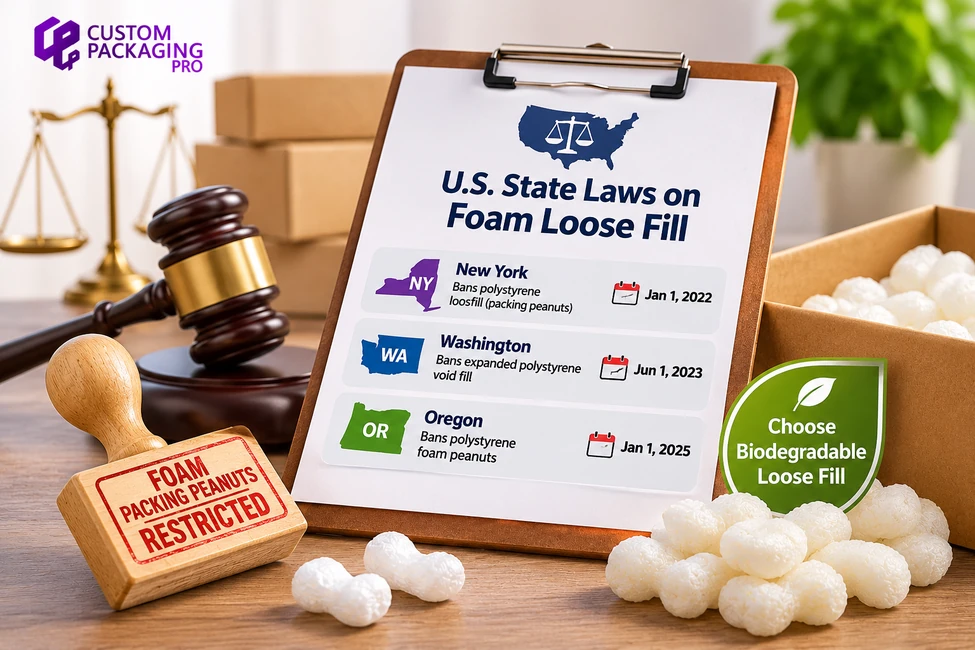
Regulation is one of the biggest reasons businesses are moving to biodegradable loose fill packaging. Several states now prohibit the sale or distribution of foam packing peanuts.
| State |
What Is Banned |
Effective Date |
| New York |
Polystyrene loose fill packaging (packing peanuts) |
January 1, 2022 |
| Washington |
Expanded polystyrene void fill, including packing peanuts |
June 1, 2023 |
| Oregon |
Polystyrene foam packaging peanuts |
January 1, 2025 |
New York's rule also covers online sales to customers in the state. Oregon's law carries civil penalties of up to $500 per day for sellers or distributors who violate it.
Other states and many cities have their own foam restrictions, and the list keeps growing. If you sell nationally, it is simpler to standardize on a non-foam fill than to track which customers live where.
Understanding "Biodegradable" and "Compostable" Claims
If you plan to tell customers your packaging is biodegradable or compostable, the wording matters.
The Federal Trade Commission's Green Guides (16 CFR Part 260) explain how environmental marketing claims should be made. A few points are especially relevant to loose fill:
- Degradable claims: An unqualified "biodegradable" claim should only be made if the entire item will completely break down within one year after customary disposal.
- Landfills: Items that usually end up in landfills, incinerators or recycling facilities should not carry unqualified degradable claims, because those settings do not allow full decomposition within a year.
- Compostable claims: If composting facilities are not available to most of your customers, the claim should be qualified.
In the US, compostable plastics are commonly tested against ASTM D6400, which covers composting in municipal or industrial facilities. Third-party certification bodies such as the Biodegradable Products Institute (BPI) use these standards and also offer separate home compostability certification, since backyard piles run cooler than industrial sites.
The practical takeaway: clear, specific wording such as "dissolves in water" or "compostable where facilities exist" is safer than a vague "eco-friendly" label.
How to Dispose of Biodegradable Packing Chips
Including short disposal instructions in the box helps customers do the right thing. You can adapt these steps:
- Confirm they are starch. Do the water test with one chip.
- Reuse them if possible. Clean, dry chips work well for a second shipment.
- Compost them. Mix them well into an active pile rather than dumping a large layer on top, which can turn into a sticky mat when wet.
- Dissolve small amounts. A handful can be dissolved in water. Avoid sending large volumes down the drain at once.
- Never put foam in the compost. If a chip floats and stays intact, it is plastic and belongs with your local foam drop-off or the trash.
What to Check Before You Buy
Whether you are buying packing chips biodegradable for sale online or from a local supplier, compare these points rather than looking at price alone:
| What to Check |
Why It Matters |
| Material and certification |
Ask what starch is used and whether the product has independent compostability certification, home or industrial. |
| Chip shape |
Interlocking shapes generally resist settling better during transit. |
| Bag volume |
Loose fill is usually sold by cubic feet, so compare cost per cubic foot, not per bag. |
| Humidity performance |
Ask whether the formulation is designed for better moisture resistance if you ship through humid regions. |
| Storage space |
Bulk loose fill takes up a lot of room and must be stored dry and off the floor. |
| Sample testing |
Order a small quantity first and run drop tests with your real products. |
Pricing for biodegradable loose fill varies by volume, supplier and freight distance, so request current quotes rather than relying on published price lists. Buying nearby can cut freight costs because loose fill is bulky for its weight.
Can You Make DIY Biodegradable Packing Material?
Small sellers sometimes use shredded paper, crumpled kraft paper or old corrugated scraps as a homemade alternative. These work for light items and are widely recyclable. They tend to compress more than starch chips, so use more of them and test before shipping anything valuable.
Tips for Packing With Loose Fill
- Start with a base layer. Pour about two inches of fill into the bottom of the box.
- Wrap the product first if it has delicate edges or a finish that could scuff.
- Center the item so it does not touch any wall of the box.
- Fill all sides and the top. Overfill slightly so the flaps press the fill down when closed.
- Shake test. Close the box and shake gently. If you feel movement, add more fill.
- Store fill dry. Keep bags sealed and away from humid areas until use.
Pair the Right Fill With the Right Box
Loose fill only works when the outer box is strong and correctly sized. A box that is too big needs more fill and adds dimensional weight, while a box that is too tight leaves no room for cushioning.
For most fragile shipments, start with custom shipping boxes or corrugated shipping boxes sized to leave room for fill on every side. E-commerce brands that care about the unboxing moment often pair biodegradable fill with custom mailer boxes or e-commerce mailer boxes.
If sustainability is the goal, the outer packaging should match the fill. Our eco-friendly boxes and kraft corrugated boxes keep the whole shipment consistent. Candle makers, for example, often combine starch fill with candle shipping boxes.
For more help choosing materials, read our guides on eco-friendly packaging solutions for B2B brands, packaging for fragile items and corrugated vs kraft vs rigid packaging.
Need boxes sized around your products and fill? Our team offers free design support, and you can request a quote for custom sizes and quantities.
Frequently Asked Questions
- Are biodegradable packing chips really biodegradable?
Starch-based chips break down in water and in active compost. How fast depends on heat, moisture and microbial activity. In a dry landfill, breakdown is much slower, which is why the FTC advises against unqualified biodegradable claims for products that usually end up there.
- Do biodegradable packing chips protect as well as foam?
For most small and medium fragile items, yes. They are denser than foam, and a USDA study found their mechanical performance held up despite higher moisture absorption. For heavy items, very humid routes or sensitive electronics, combine them with inserts or choose a different solution.
- Can I put starch packing chips in my recycling bin?
No. They are not plastic and should not go in curbside plastic recycling. Reuse, compost or dissolve them instead.
- Are biodegradable packing chips safe for pets?
They are made from starch and are generally considered non-toxic, but they are not food. Keep them away from pets and children, as any loose fill can be a choking hazard.
- Why do my biodegradable packing chips feel sticky?
They have absorbed moisture. Store them sealed in a dry area and avoid packing in humid conditions.
- Is paper fill better than starch loose fill?
It depends on the product. Paper is recyclable in most curbside programs and works well for light items. Starch chips flow into irregular spaces more easily and offer more consistent cushioning around odd shapes.
- Is foam packing peanut use illegal everywhere?
No. Restrictions vary by state and city. New York, Washington and Oregon prohibit the sale of foam packing peanuts, and other places have their own rules. Check local requirements for each market you ship to.

 Custom Boxes
 Mailer Boxes
 Shipping Boxes
 Display Boxes
 Product Boxes
 Retail Packaging
 Luxury Packaging
 Sustainable Packaging
 Mylar Bags
 Labels & Stickers
 Inserts & Dividers
 Acrylic Signs
 Mylar and Zipper Bags
 Cosmetic Boxes
 Custom Candle Packaging Boxes
 Food and Beverage
 Display Packaging
 Pharma Packaging
 Custom Blister Packaging
 Stand Up Displays
 Kraft Boxes
 Cereal Packaging Boxes
 Bakery Packaging Boxes
 Eco-Friendly Boxes
 Electronics Packaging Boxes
 Custom Vape Boxes & Packaging
 CBD Packaging Boxes
 Rigid & Luxury Packaging Boxes
 Gift Boxes
 Custom Soap Boxes & Packaging
 Metalized Boxes
 Retail Boxes
 Subscription Boxes
 Invitation Boxes
 Corrugated Shipping Boxes
 Custom Apparel Boxes