By Rai Haider
October 26, 2026
What Is Dimensional Weight? How Box Size Changes Your Shipping Cost
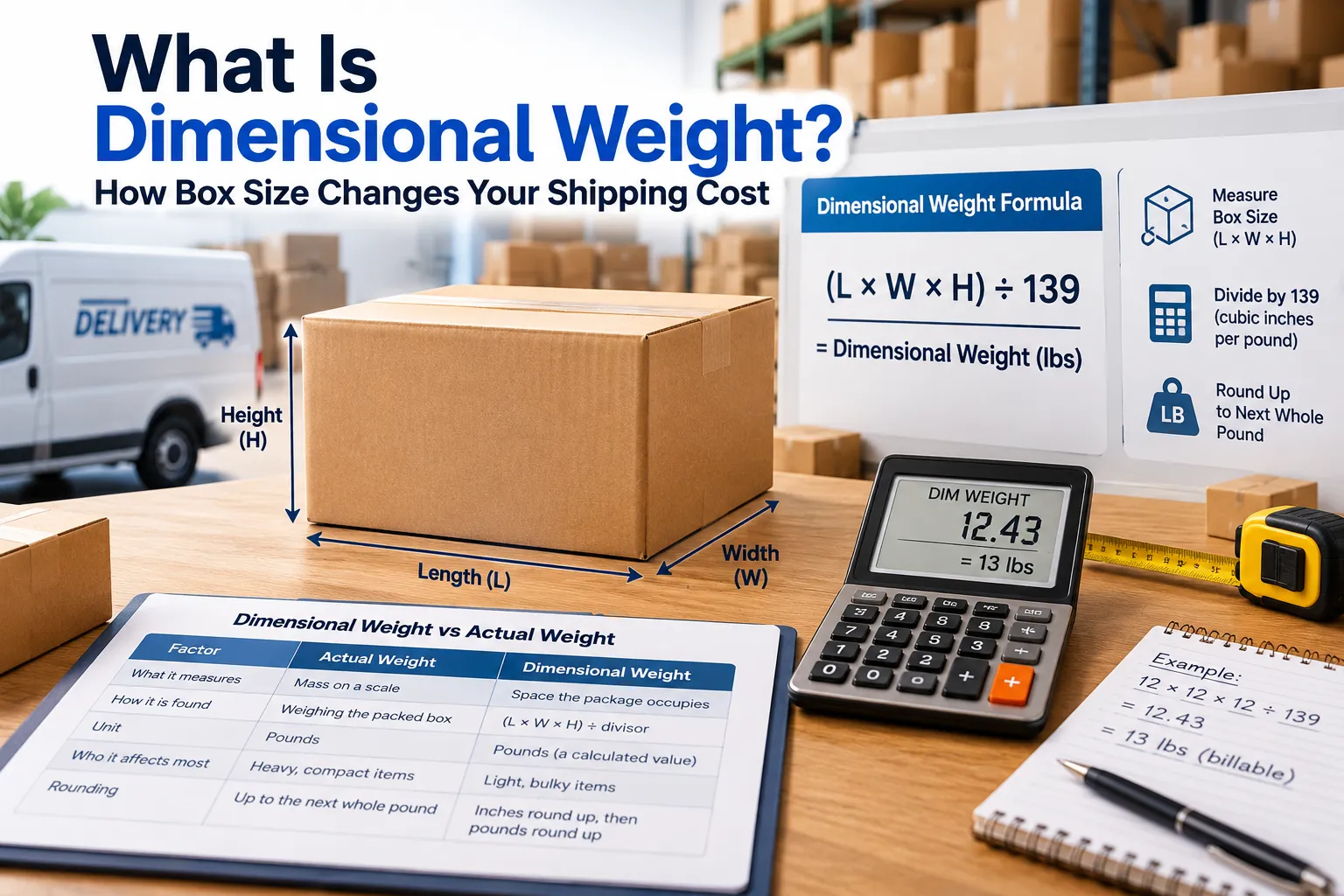
Dimensional weight is a billing weight that parcel carriers calculate from a package's length, width and height. You pay for whichever is higher, the dimensional weight or the actual scale weight. In 2026, most US parcel services divide cubic inches by 139, so an oversized, lightweight box can cost far more to ship than its contents suggest.
Key numbers at a glance (US, October 2026): Standard domestic divisor: 139 cubic inches per pound. Break-even density: about 12.4 lb per cubic foot. Postal parcels: dimensional weight applies only above 1,728 cubic inches (1 cubic foot). Rounding: every fractional inch rounds up to the next whole inch, and the result rounds up to the next whole pound.
Comprehensive Guide to Dimensional Weight, Formulas, and Shipping Cost Optimization
What Is Dimensional Weight?
Dimensional weight (often shortened to DIM weight) is an estimated weight based on how much space a package takes up inside a truck or aircraft. It is also called volumetric weight or cubed weight. The idea is simple: a carrier's capacity is limited by space as much as by weight, so a large, light box is priced as if it were heavier.
When people ask about the dim weight meaning in shipping, the practical answer is this: it is the minimum weight a carrier will bill for a box of a given size. If your product is dense enough, you pay for actual weight. If it is light for its size, you pay for space.
This is why the box you choose matters as much as the product inside it. A well-fitted custom shipping box can keep your billable weight close to the real weight of the order.
Why Carriers Price by Size, Not Just Weight
Delivery vehicles usually run out of room before they run out of weight capacity. A trailer loaded with bulky, light parcels "cubes out" long before it reaches its payload limit, and the carrier still pays for fuel, labor and the trip.
Dimensional pricing has been part of air freight for decades. Since 2015, the major national parcel carriers have applied it to ground packages of every size, not just large ones. That change moved dimensional weight from a niche freight concept to an everyday cost for any business that ships boxes.
Empty space is a big part of the problem. Logistics-industry research published in 2022 found that about 24 percent of the volume in an average e-commerce package is empty space. Under dimensional pricing, that empty space is billed like product.
Dimensional Weight vs Actual Weight
The difference between weight and dimensional weight comes down to what is being measured.
| Factor |
Actual Weight |
Dimensional Weight |
| What it measures |
Mass on a scale |
Space the package occupies |
| How it is found |
Weighing the packed box |
(L x W x H) / divisor |
| Unit |
Pounds |
Pounds (a calculated value) |
| Who it affects most |
Heavy, compact items |
Light, bulky items |
| Rounding |
Up to the next whole pound |
Inches round up, then pounds round up |
The carrier compares the two numbers and bills the higher one. That final number is called the billable weight.
A quick way to picture it: a 13 lb box of hardware in a 12 x 12 x 12 inch carton bills at its actual weight of 13 lb. A 3 lb box of throw pillows in the same carton also bills at 13 lb, because its dimensional weight is 12.43 lb, rounded up.
The Dimensional Weight Formula
The dimensional weight formula is the same everywhere. Only the divisor and the units change.
Formula in Inches and Pounds
Dimensional weight (lb) = (Length x Width x Height in inches) / divisor
For most US domestic parcel shipping in 2026, the divisor is 139. A lower divisor produces a higher dimensional weight, so the number matters a lot.
Formula in Centimeters and Kilograms
Volumetric weight (kg) = (Length x Width x Height in cm) / divisor
Metric divisors are usually 5,000 or 6,000 cubic centimeters per kilogram. A divisor of 5,000 is the metric equal of 139, and 6,000 is roughly equal to 166. For example, a 30 x 20 x 20 cm parcel has a volumetric weight of 2.4 kg at a divisor of 5,000.
How to Calculate Dimensional Weight Step by Step
Here is how to calculate dimensional weight in inches and convert it to a billable weight in pounds.
- Measure the outside length, width and height of the packed box in inches.
- Round each measurement up to the next whole inch (12.2 inches becomes 13).
- Multiply length x width x height to get cubic inches.
- Divide by the divisor that applies to your service (usually 139).
- Round the result up to the next whole pound. This is the dimensional weight.
- Weigh the box and round up to the next whole pound.
- Compare both numbers. The higher one is your billable weight.
Worked example: A box measures 16 x 12 x 8 inches and weighs 4 lb.
- 16 x 12 x 8 = 1,536 cubic inches
- 1,536 / 139 = 11.05, which rounds up to 12 lb
- Actual weight is 4 lb, so the billable weight is 12 lb
The shipper pays for 8 lb that do not exist on the scale.
How to Measure a Box Correctly
Accurate dimensions are the foundation of every dimensional weight calculation. Automated dimensioning systems in sorting hubs re-measure parcels, and if your declared size is wrong, the invoice gets adjusted afterward.
Follow these rules when measuring:
- Measure the outside, not the inside. Interior dimensions are what your product needs. Exterior dimensions are what the carrier bills. Board thickness adds to every side.
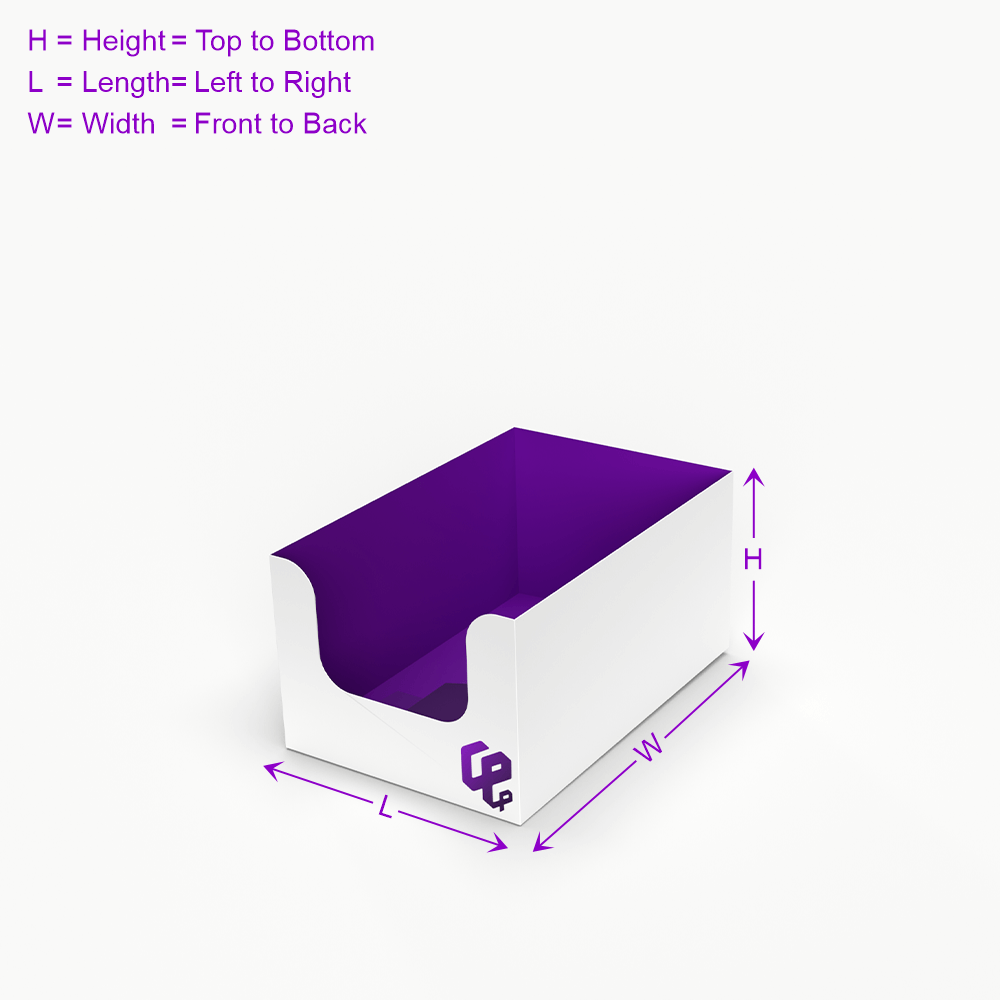
- Length is the longest side. Width is the next longest, and height is the shortest.
- Measure at the widest point. Bulging flaps, overstuffed cartons and protruding tape count toward the size.
- Treat irregular shapes as a box. Carriers measure the longest point on each axis, so a cylinder or odd-shaped item is billed as the rectangle that surrounds it.
- Measure after packing. A box can swell by a fraction of an inch once it is filled and sealed, and fractions now round up.
If the difference between interior and exterior sizing is new to you, this guide on length, width and height measurements explains the order and logic of box dimensions.
Dimensional Weight Divisors in 2026
The dimensional weight divisor (also called the DIM factor) is the number of cubic inches a carrier assigns to one pound. It represents the minimum density the carrier is willing to accept.
| Shipping Type |
Typical Divisor |
When It Applies |
| Domestic parcel, account (daily) rates |
139 |
All package sizes |
| Domestic parcel, some retail counter rates |
166 |
All package sizes, varies by carrier |
| National postal parcel services |
139 (was 166 until July 12, 2026) |
Only parcels over 1,728 cubic inches |
| International express |
139 in/lb or 5,000 cm³/kg |
Most international parcels |
| Some air cargo services |
166 in/lb or 6,000 cm³/kg |
Varies by service |
Two points are worth noting. First, high-volume shippers can sometimes negotiate a higher divisor in their contracts, which lowers their dimensional weight. Second, the postal rule is different from private carriers: parcels of 1 cubic foot or less are billed on actual weight only, which can make postal services cheaper for small, light boxes.
What Changed in 2025 and 2026
Dimensional weight rules tightened three times in the past 14 months, and many older guides have not caught up.
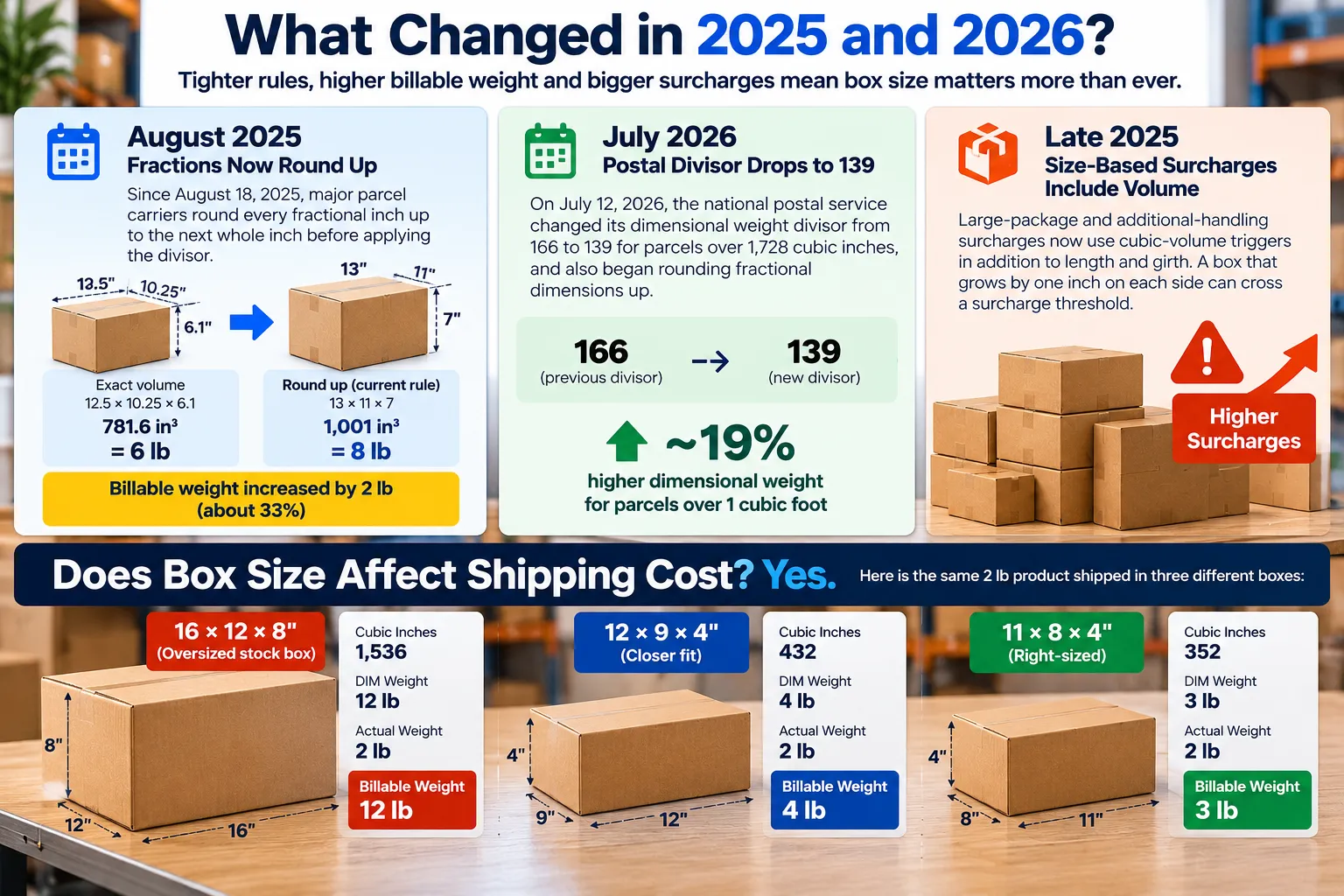
August 2025: Fractions Now Round Up
Since August 18, 2025, the major private parcel carriers round every fractional inch up to the next whole inch before applying the divisor. Before that date, a fraction under half an inch was often rounded down.
Here is what that does to a box measuring 12.5 x 10.25 x 6.1 inches:
| Method |
Billed Size |
Cubic Inches |
DIM Weight (/139) |
| Exact volume |
12.5 x 10.25 x 6.1 |
781.6 |
6 lb |
| Round up (current rule) |
13 x 11 x 7 |
1,001 |
8 lb |
The product did not change, yet the billable weight rose by 2 lb, an increase of about 33 percent.
July 2026: Postal Divisor Drops to 139
On July 12, 2026, the national postal service changed its dimensional weight divisor from 166 to 139 for its main package services, and also began rounding fractional dimensions up. Federal postal pricing standards published in the Federal Register in May 2026 state that if a parcel exceeds 1,728 cubic inches, its volume is divided by 139 and rounded up.
For a parcel over 1 cubic foot, the divisor change alone raises dimensional weight by roughly 19 percent (166 / 139 = 1.194).
Late 2025: Size-Based Surcharges Now Consider Volume
Large-package and additional-handling surcharges at major carriers now use cubic-volume triggers in addition to length and girth. A box that grows by one inch on each side can cross a surcharge threshold, which costs far more than the extra pounds of dimensional weight.
Does Box Size Affect Shipping Cost?
Yes. Box size often matters more than product weight, especially for items under 10 lb. Here is the same 2 lb product shipped in three different boxes:
| Box Size (inches) |
Cubic Inches |
DIM Weight |
Actual Weight |
Billable Weight |
| 16 x 12 x 8 (oversized stock box) |
1,536 |
12 lb |
2 lb |
12 lb |
| 12 x 9 x 4 (closer fit) |
432 |
4 lb |
2 lb |
4 lb |
| 11 x 8 x 4 (right-sized) |
352 |
3 lb |
2 lb |
3 lb |
Moving from the oversized box to the right-sized box cuts the billable weight from 12 lb to 3 lb, a 75 percent drop on every shipment. Multiply that across a month of orders and box size becomes one of the largest controllable costs in fulfillment.
For flat or low-profile items such as apparel, books and cosmetics sets, corrugated custom mailer boxes are often the easiest way to reduce height, which is usually the dimension with the most wasted space.
The Density Break-Even Point
There is a quick way to know whether dimensional weight will apply before you calculate anything. With a divisor of 139, one cubic foot (1,728 cubic inches) equals 12.43 lb of dimensional weight.
That means:
- If your packed box weighs more than about 12.4 lb per cubic foot, you will usually pay actual weight.
- If it weighs less than about 12.4 lb per cubic foot, you will pay dimensional weight.
Most consumer goods fall below that line once packaging and void fill are added. Candles, cosmetics, apparel, snacks, electronics accessories and gift sets are typically billed on size, not weight. Dense items such as metal parts, books and liquids in bulk are more likely to bill on actual weight.
Dimensional Weight Chart for Common Box Sizes
The chart below shows dimensional weight for popular box sizes, calculated with whole-inch exterior dimensions and rounded up to the next pound. Use it as a quick reference when choosing stock sizes.
| Box Size (L x W x H, inches) |
Cubic Inches |
DIM Weight at 139 |
DIM Weight at 166 |
Over 1 Cubic Foot? |
| 8 x 6 x 4 |
192 |
2 lb |
2 lb |
No |
| 10 x 8 x 4 |
320 |
3 lb |
2 lb |
No |
| 10 x 8 x 6 |
480 |
4 lb |
3 lb |
No |
| 12 x 9 x 4 |
432 |
4 lb |
3 lb |
No |
| 12 x 9 x 6 |
648 |
5 lb |
4 lb |
No |
| 12 x 10 x 8 |
960 |
7 lb |
6 lb |
No |
| 14 x 10 x 6 |
840 |
7 lb |
6 lb |
No |
| 16 x 12 x 8 |
1,536 |
12 lb |
10 lb |
No |
| 12 x 12 x 12 |
1,728 |
13 lb |
11 lb |
No (exactly 1 cu ft) |
| 16 x 12 x 12 |
2,304 |
17 lb |
14 lb |
Yes |
| 18 x 12 x 10 |
2,160 |
16 lb |
14 lb |
Yes |
| 20 x 14 x 10 |
2,800 |
21 lb |
17 lb |
Yes |
| 24 x 18 x 12 |
5,184 |
38 lb |
32 lb |
Yes |
| 18 x 18 x 18 |
5,832 |
42 lb |
36 lb |
Yes |
| 24 x 18 x 18 |
7,776 |
56 lb |
47 lb |
Yes |
| 24 x 24 x 24 |
13,824 |
100 lb |
84 lb |
Yes |
Note: For postal services, boxes marked "No" in the last column are billed on actual weight only.
Build Your Own Dimensional Weight Calculator
Online dimensional weight calculators are useful for one-off checks, but a simple spreadsheet formula works better for a full product catalog. Enter length in column A, width in B, height in C and actual weight in D, then use:
- DIM weight: =ROUNDUP(ROUNDUP(A2,0)*ROUNDUP(B2,0)*ROUNDUP(C2,0)/139,0)
- Billable weight: =MAX(ROUNDUP(D2,0), E2)
Change 139 to 166 if you need to compare an older or retail rate. For postal parcels, add a check so that boxes at or under 1,728 cubic inches use actual weight only. Running this across your top-selling products shows exactly which items are paying for air.
Which Products Are Hit Hardest by Dimensional Weight Pricing
Dimensional weight pricing does not affect every business equally. The products most exposed share three traits: they are light, they are bulky or awkwardly shaped, and they need protective space around them.
| Product Type |
Why DIM Weight Applies |
Packaging Fix |
| Apparel and soft goods |
Very light, often shipped in loose boxes |
Low-profile mailers, compression |
| Candles and glass jars |
Need cushioning, so boxes are oversized |
Fitted inserts instead of loose fill |
| Cosmetics and skincare sets |
Small items in large presentation boxes |
Snug inserts, smaller outer shipper |
| Electronics accessories |
Light products with retail boxes inside shippers |
Ship-in-own-container designs |
| Snacks and baked goods |
Bulky, low-density contents |
Right-sized cartons, stackable packs |
| Subscription boxes |
Mixed items packed in one standard size |
Two or three standard sizes instead of one |
If your products need protection, the goal is not the smallest possible box. It is the smallest box that still passes your damage tests. Custom inserts usually allow a smaller outer carton than loose void fill does.
How to Reduce Dimensional Weight Charges
These are the changes that reliably lower billable weight without raising damage rates.
- Right-size every product. Leave enough room for protection, but not a gap that needs to be filled with air pillows.
- Order custom box dimensions. Stock sizes come in fixed steps. A custom size that is one inch shorter on each side can save several billable pounds per box.
- Design to whole-inch exterior sizes. Because fractions now round up, a box measuring 12.1 inches is billed as 13. Specify exterior dimensions that land just under a whole inch.
- Replace loose void fill with inserts. Die-cut corrugated or paperboard inserts hold products in place with less empty space.
- Use mailers or poly mailers for non-fragile items. Flat items rarely need a tall carton.
- Standardize three to five box sizes. One box for every order guarantees wasted space on smaller orders. A small range of sizes covers most orders efficiently.
- Consolidate multi-item orders. Two right-sized boxes are sometimes cheaper than one oversized box, and sometimes the reverse. Run both through your formula.
- Audit invoices for adjustments. Compare declared dimensions against carrier-measured dimensions to catch packing errors early.
Right-sizing also reduces corrugated use and void fill, which supports sustainability goals. If that matters to your brand, explore eco-friendly boxes that combine recyclable materials with tighter sizing.
Dimensional Weight in Freight Shipping
Dimensional weight applies to parcels. Less-than-truckload (LTL) freight uses a related concept: density-based freight class.
On July 19, 2025, the National Motor Freight Classification moved most commodities to a density-based system with a 13-tier scale, measured in pounds per cubic foot. Higher density earns a lower freight class, which usually means a lower rate. Two new classes, 50 and 55, were added for very dense freight.
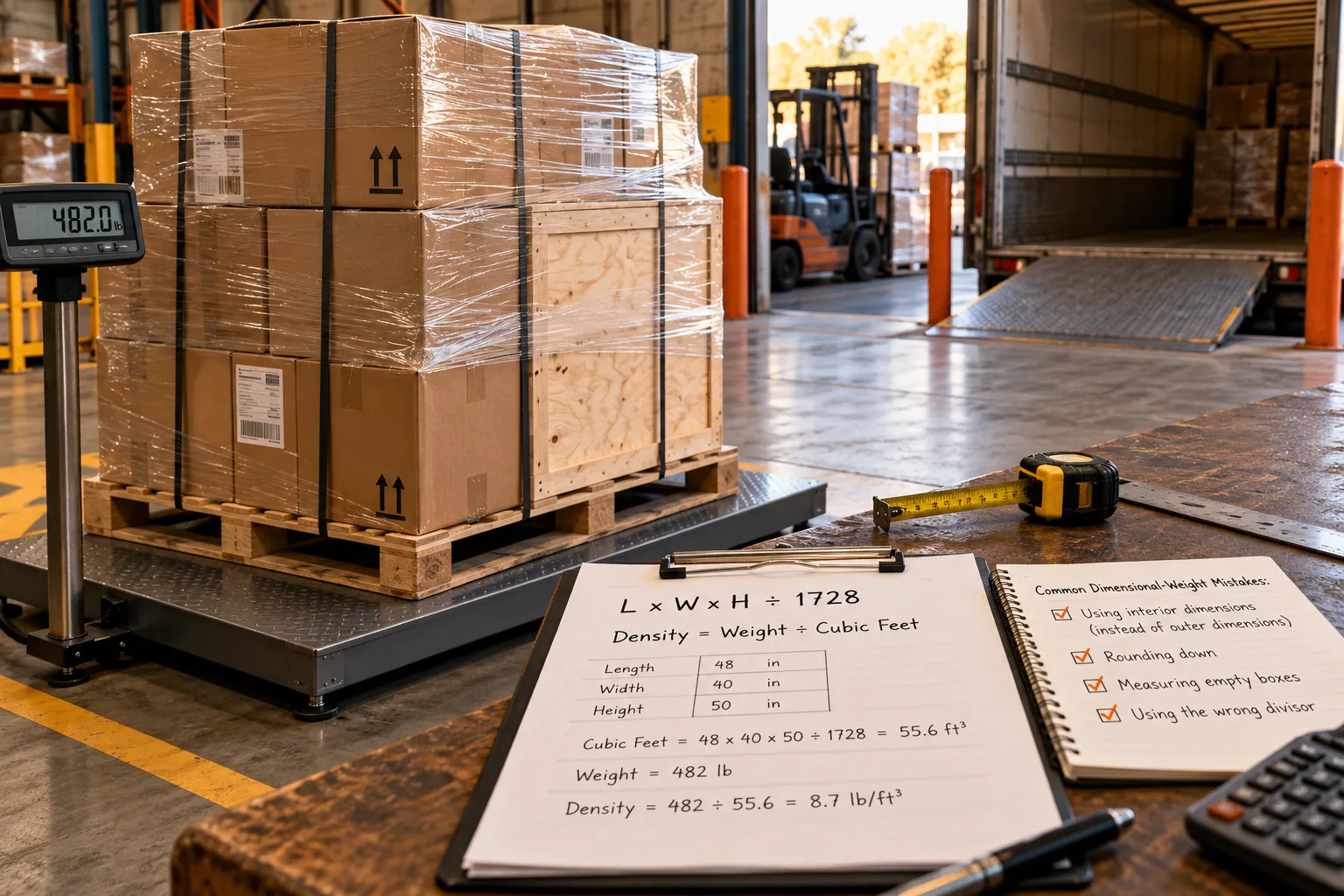
To calculate freight density, multiply the pallet or crate's length, width and height in inches, divide by 1,728 to get cubic feet, then divide total weight by cubic feet. The same packaging logic applies: tighter cartons and better pallet building raise density and lower cost.
Common Dimensional Weight Mistakes
- Using interior box dimensions instead of exterior dimensions
- Rounding measurements down or to the nearest inch instead of up
- Assuming small packages are exempt (only postal services exempt parcels under 1 cubic foot)
- Shipping every order in the same stock box
- Measuring empty boxes instead of packed, sealed boxes
- Ignoring the cubic-volume triggers on large-package surcharges
- Comparing services with the wrong divisor
Frequently Asked Questions
- What is dimensional weight in shipping?
Dimensional weight is a calculated weight based on a package's length, width and height. Carriers compare it with the actual weight and bill whichever is higher. It exists because large, light packages take up space in trucks and aircraft that could otherwise carry more freight.
- What is the dimensional weight divisor for 2026?
For most US domestic parcel shipping in 2026, the divisor is 139 cubic inches per pound. Some retail counter rates still use 166. The national postal service moved from 166 to 139 on July 12, 2026, for parcels over 1 cubic foot.
- How do you calculate dimensional weight in lbs?
Measure the box in inches, round each side up to the next whole inch, multiply length x width x height, then divide by 139. Round the result up to the next whole pound. For example, a 12 x 9 x 6 inch box has 648 cubic inches and a dimensional weight of 5 lb.
- Does box size matter when shipping?
Yes. For light products, box size usually decides the price. The same 2 lb item can bill at 3 lb in an 11 x 8 x 4 inch box or 12 lb in a 16 x 12 x 8 inch box. Reducing the box by a few inches on each side often lowers the billable weight more than any other change.
- Does dimensional weight apply to small packages?
With most private parcel carriers, yes. Dimensional weight applies to packages of every size. Postal parcel services are the exception, because they only apply dimensional weight to parcels larger than 1,728 cubic inches (1 cubic foot).
- What is the difference between dimensional weight and volumetric weight?
There is no difference. Dimensional weight, DIM weight, volumetric weight and cubed weight all describe the same calculation. "Volumetric weight" is more common in metric markets, where the formula uses centimeters and kilograms.
- Is dimensional weight rounded up?
Yes, twice. Each fractional inch is rounded up to the next whole inch before multiplying, and the resulting dimensional weight is rounded up to the next whole pound. This double rounding is why small measurement differences can raise costs.
- How can a business lower dimensional weight costs?
Use right-sized or custom boxes, replace loose void fill with fitted inserts, switch flat items to mailers, design boxes to whole-inch exterior sizes and keep a small range of standard sizes so every order has a close fit.
Choosing Packaging That Ships Efficiently
Dimensional weight turns packaging into a shipping decision. Every inch of empty space is billed, every fraction of an inch rounds up and, since July 2026, postal parcels over 1 cubic foot follow the same 139 divisor as private carriers.
The most dependable way to control the cost is to build the box around the product. Custom Packaging Pro produces custom shipping boxes, mailer boxes and fitted inserts in exact dimensions, with free design support to help you find the smallest size that still protects your product. Request a quote with your product dimensions and current box size to see how much space you can remove.

 Custom Boxes
 Mailer Boxes
 Shipping Boxes
 Display Boxes
 Product Boxes
 Retail Packaging
 Luxury Packaging
 Sustainable Packaging
 Mylar Bags
 Labels & Stickers
 Inserts & Dividers
 Acrylic Signs
 Mylar and Zipper Bags
 Cosmetic Boxes
 Custom Candle Packaging Boxes
 Food and Beverage
 Display Packaging
 Pharma Packaging
 Custom Blister Packaging
 Stand Up Displays
 Kraft Boxes
 Cereal Packaging Boxes
 Bakery Packaging Boxes
 Eco-Friendly Boxes
 Electronics Packaging Boxes
 Custom Vape Boxes & Packaging
 CBD Packaging Boxes
 Rigid & Luxury Packaging Boxes
 Gift Boxes
 Custom Soap Boxes & Packaging
 Metalized Boxes
 Retail Boxes
 Subscription Boxes
 Invitation Boxes
 Corrugated Shipping Boxes
 Matte Finish
 Gloss Finish
 Soft Touch
 Foil Stamping
 Spot UV
 Embossing
 Debossing
 Window Cutouts