By Rai Haider
November 04, 2026
ISTA Packaging Testing Explained: ISTA 1A, 2A, 3A and 6A for Shippers
Before a new product ships to a retailer, a marketplace, or straight to customers, someone usually asks the same question: will this package survive the trip? ISTA packaging testing answers it in a lab, before damaged orders, returns, and chargebacks answer it for you. The tests apply to the whole packaged product, from the corrugated shipping box to the inserts and the product itself.
Quick answer: ISTA (International Safe Transit Association) publishes standardized lab tests that put a packaged product through the drops, vibration, compression, and climate it will face in shipping. ISTA 1A is a basic integrity screen, ISTA 2A is a partial simulation that adds conditioning and compression, and ISTA 3A is a general simulation of parcel delivery for packages up to 150 lb. "6A" is not a current ISTA procedure name: ISTA's 6-Series holds member procedures written for specific large retailers and their supply chains. If a buyer names a test, run that exact test; if not, 3A is the usual choice for parcel shipping.
What Is ISTA?
ISTA stands for the International Safe Transit Association, a global association of shippers, carriers, packaging suppliers, testing laboratories, and universities focused on transport packaging. Its work centers on four things:
- Writing and publishing pre-shipment test procedures
- Certifying packaging test laboratories
- Certifying packaging professionals
- Reviewing test reports as a third party
Since 2014, ISTA has been an ANSI Accredited Standards Developer, so its procedures go through a formal consensus process.
"ISTA testing" means running a packaged product through one of these procedures. The product and package are always tested together, as the customer would receive them, not separately.
The ISTA Test Series at a Glance
ISTA groups its procedures into series. The higher series numbers don't mean "harder"; each series has a different purpose.
| Series |
Type |
Purpose |
Examples |
| 1 |
Non-simulation integrity |
Basic screening of package and product strength; not a simulation of real transport |
1A, 1B, 1C, 1G |
| 2 |
Partial simulation |
Series 1 elements plus at least one simulation element, such as atmospheric conditioning or random vibration |
2A, 2B, 2C |
| 3 |
General simulation |
Simulates the forces and sequences of a specific type of shipment; useful for predicting damage risk |
3A (parcel), 3B (LTL), 3E (truckload), 3F (DC to store), 3L (e-commerce fulfillment) |
| 4 |
Enhanced simulation |
Custom test plans tied to a defined distribution pattern |
4AB |
| 6 |
Member performance |
Procedures created with large retailers for their own supply chains |
Retailer-specific procedures |
| 7 |
Development |
Compares container designs or thermal performance; not for judging product protection |
7D, 7E |
Within the 1 and 2 series, the letter mostly signals weight: "A" procedures cover packaged products of 150 lb (68 kg) or less, and "B" procedures cover products over 150 lb.
Why Packaging Transit Testing Matters
Packages in parcel networks get dropped, shaken, stacked, and stored in hot or humid spaces. Transit testing reproduces those hazards in a lab, so problems show up before the product ships in volume.
- Retailer and marketplace requirements: Some buyers require proof of testing before they accept a new item, and some specify an exact procedure.
- Fewer damage claims and returns: Testing finds weak points such as crushed corners, broken inserts, and loose closures, and these can be fixed before launch.
- Right-sized packaging: Testing shows when a pack is overbuilt, so you can remove material with confidence instead of guessing.
- Fragile and high-value products: Glass, cosmetics, and electronics packaging boxes benefit most, because vibration and drops can damage products without visible damage to the box.
- A repeatable benchmark: The same test can be rerun whenever the product, package, or supplier changes, so you can compare results over time.
Testing is a tool for decisions, not a guarantee. A pass means the packaged product survived that test sequence at those levels; it doesn't promise zero damage in real shipping.
ISTA 1A: Basic Integrity Screening
Covers: individual packaged products weighing 150 lb (68 kg) or less.
ISTA 1A is the most basic ISTA procedure. It checks whether the product and package can withstand transport hazards, but it doesn't try to simulate any real shipping route. It is most useful early in design, to compare two package options, or as a consistent benchmark over time.
The test runs in a fixed sequence:
- Atmospheric preconditioning at ambient temperature and humidity
- Fixed displacement vibration at 1 inch (25 mm) peak-to-peak
- Shock by free-fall drops, with drop height based on package weight (incline or horizontal impact are allowed alternatives)
ISTA points users to related procedures for specific needs. 1G uses random vibration instead of fixed displacement, 1C adds a minimum compression test, 2A suits international distribution, and 3A suits small parcel delivery.
ISTA 2A: Partial Simulation
Covers: individual packaged products weighing 150 lb (68 kg) or less.
ISTA 2A combines basic Series 1 elements with test elements from Series 3. It is more thorough than 1A and is often used to refine a design, and ISTA suggests it for products going into international distribution. It is still not meant to predict real shipping performance.
The sequence:
- Atmospheric preconditioning (ambient)
- Atmospheric conditioning at a controlled temperature and humidity chosen from a chart
- Compression, using a calculated test force
- Vibration (fixed displacement or random)
- Shock (drops, or incline or horizontal impacts)
- A second vibration test
The compression step matters for anything warehoused. In 2A, a box failure that could cause a stack to collapse counts as a failed test if the product may be warehoused during distribution.
ISTA 3A: Parcel Delivery Simulation
Covers: individual packaged products up to 70 kg (150 lb) shipped through a parcel delivery system, by air or ground.
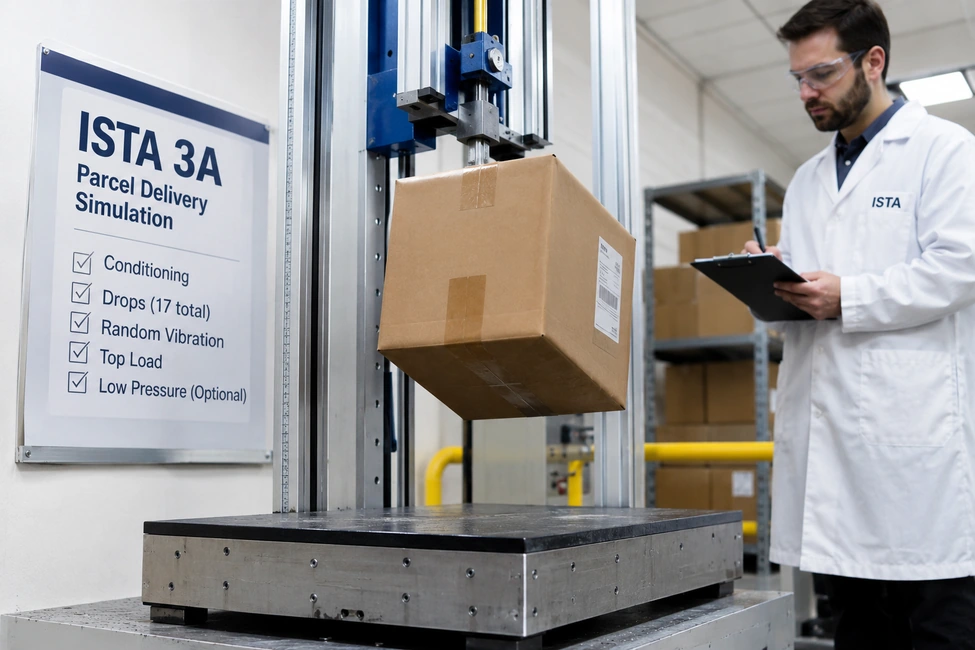
ISTA 3A is the most widely used ISTA procedure for e-commerce and direct-to-consumer shipping. It is a general simulation: the forces, order, and conditions are modeled on parcel networks, so results are more predictive than 1A or 2A.
The four package types
ISTA 3A first classifies the package, because each type is tested differently:
| Type |
Definition (summary) |
| Small |
Volume under 800 in³, longest side 14 in or less, weight 10 lb or less |
| Flat |
Shortest side 8 in or less, next side at least 4 times the shortest, volume 800 in³ or more |
| Elongated |
Long, narrow packages as defined in the procedure (packages that are both flat and elongated are tested as elongated) |
| Standard |
Anything that isn't small, flat, or elongated, including standard fiberboard cartons |
What a standard 3A test includes
- Atmospheric preconditioning, with optional controlled conditioning
- 9 drops, with height based on package weight
- Random vibration, with and without a top load
- Optional random vibration under low pressure (simulated high altitude), which checks whether closures and seals hold
- 8 more drops, including a drop onto a hazard
That makes 17 drops for a standard package. Flat and elongated packages get added rotational edge drops, rotational flat drops, and concentrated or bridge impact tests, and small packages follow their own sequence.
To pass 3A, the inside of the pack has to hold the product still through every drop. Fitted foam inserts are a common fix when a product shifts or breaks in early test rounds, because they keep the product at a fixed distance from every wall.
ISTA 6A and the 6-Series Member Procedures
Many shippers search for "ISTA 6A," but there is no current ISTA procedure by that name. Here is what the term usually refers to.
What the 6-Series is: ISTA's 6-Series holds member performance tests, written for large retailers or carriers whose supply chains are judged too specific for an industry-wide test. A 6-Series procedure carries the member's name rather than a plain letter.
Where "6A" came from: The label was widely used for a carrier's procedure for packages up to 150 lb. ISTA states that this procedure, and its companion for heavier freight, are no longer ISTA 6-Series tests.
What the 6-Series covers today: Current 6-Series procedures are written for specific retail supply chains. They include a test for products that ship to the customer in their own container, without being repacked; a test for products placed into an over-box at a fulfillment center; and a test for a warehouse club's pallet distribution system.
What to do if a buyer asks for "ISTA 6": Ask for the exact procedure name and version they require, and test to that document. For general e-commerce fulfillment through a retailer, ISTA also publishes Project 3L, a general simulation that isn't tied to one company.
ISTA 1A vs 2A vs 3A vs 6-Series Compared
| Metric |
ISTA 1A |
ISTA 2A |
ISTA 3A |
6-Series |
| Category |
Non-simulation integrity |
Partial simulation |
General simulation |
Member performance |
| Weight range |
150 lb (68 kg) or less |
150 lb (68 kg) or less |
70 kg (150 lb) or less |
Set by each procedure |
| Conditioning |
Ambient only |
Ambient plus controlled temperature and humidity |
Ambient, optional controlled |
Set by each procedure |
| Vibration |
Fixed displacement |
Fixed or random, run twice |
Random, with and without top load |
Set by each procedure |
| Compression |
No |
Yes |
Top load during vibration |
Set by each procedure |
| Drops |
Yes |
Yes |
17 drops for standard packages, including a hazard drop |
Set by each procedure |
| Predicts real shipping? |
No, screening only |
No, design refinement |
Yes, for parcel shipping |
Yes, for that member's supply chain |
| Best use |
Early design, quick comparisons |
Refining designs, international distribution |
Parcel and direct-to-consumer shipping |
Shipping into a specific retailer's system |
What is the difference between ISTA 2A and 3A?
ISTA 2A is a partial simulation: it adds conditioning and compression to basic integrity tests, but it isn't built to predict how a package will perform in a specific network. ISTA 3A is a general simulation of parcel delivery. Its drop heights, drop count, random vibration profiles, and package types are modeled on parcel shipping, so a 3A pass says much more about real parcel performance. If you ship parcels to consumers, 3A is usually the better choice. If you ship mixed or international distribution and need a compression check, 2A is a common step.
ISTA certified 3A or 6A: which do you need?
If a retailer or marketplace names a 6-Series procedure, that requirement wins, because it reflects their own supply chain. If no one has specified a test and you ship parcels, use 3A. For products fulfilled through a retailer's e-commerce network without a named requirement, ISTA's selection guidance also lists Project 3L.
The Test Methods Behind ISTA Procedures
Every ISTA procedure is built from a small set of test types, run in a fixed order. The equipment for each type follows ASTM apparatus standards.
| Test |
What it simulates |
Equipment standard named in ISTA overviews |
| Drop test |
Falls from conveyors, sorting, loading, and delivery |
Free-fall drop tester, ASTM D5276 |
| Vertical shock (alternative to drops) |
Impacts |
Shock test machine, ASTM D5487 |
| Incline and horizontal impact |
Impacts, as allowed alternatives to drops |
ASTM D880 and ASTM D4003 |
| Fixed displacement vibration |
Repetitive bounce in vehicles |
ASTM D999 |
| Random vibration |
Real truck and air vibration profiles |
ASTM D4728 |
| Compression |
Stacking in warehouses and trailers |
ASTM D642 |
| Atmospheric conditioning |
Heat, cold, and humidity during storage and transit |
Humidity recording per ASTM D4332 |
| Low-pressure vibration (optional in 3A) |
Air transport altitude |
Vacuum chamber with vibration |
Drop testing
Drop tests hit the package on faces, edges, and corners in a set order. Corners and edges are where cushioning is thinnest and where boxes split first, so a design that survives flat-face drops can still fail on a corner.
Vibration testing for packaging
Vibration doesn't usually crack a box. It loosens closures, wears through wraps, shifts products toward walls, and damages electronics from the inside. Random vibration, used in 3A, is closer to real truck motion than fixed displacement.
Compression testing
Compression checks whether the box can carry the load stacked on top of it. Box construction matters here: board grade, flute, and box size all affect stacking strength. A well-specified custom shipping box with the right board for the product's weight is the cheapest compression fix.
ISTA Certification, Certified Labs, and the Transit Tested Mark
"ISTA certified" gets used loosely. It can mean three different things:
| Term |
What it means |
| ISTA certified lab |
A testing laboratory that ISTA has certified to run its procedures. Lab certification must be renewed every two years. |
| ISTA certified packaged product |
A packaged product tested by a certified lab to the current ISTA procedure, with the test report submitted to ISTA for review. |
| ISTA Transit Tested mark |
A logo that can appear on packaging. It is available only to ISTA Shipper members with a signed manufacturer's license agreement, after passing a general simulation test with results reviewed by ISTA. |
Running an ISTA procedure in your own facility, or at a lab that isn't certified, can still be useful for design decisions. But for ISTA certification, the lab must hold a current ISTA certification.
How to get ISTA certified
- Confirm the exact procedure. Use the test your buyer names, or select one from ISTA's guidance for your distribution type.
- Choose an ISTA certified lab. ISTA's website has a lab directory.
- Define pass and fail criteria first. ISTA procedures require you to set the product damage tolerance and acceptable package condition before testing begins.
- Send production-representative samples. Use real products and real packages that haven't been tested or shipped unprotected.
- Test without opening. Opening the package partway through invalidates a certification test. Run separate investigation tests if you want to inspect along the way.
- Submit the report. The lab or shipper member submits the report to ISTA for review.
- Retest after changes. ISTA says tests must be repeated whenever the product, package, or process changes.
How to Choose the Right ISTA Test
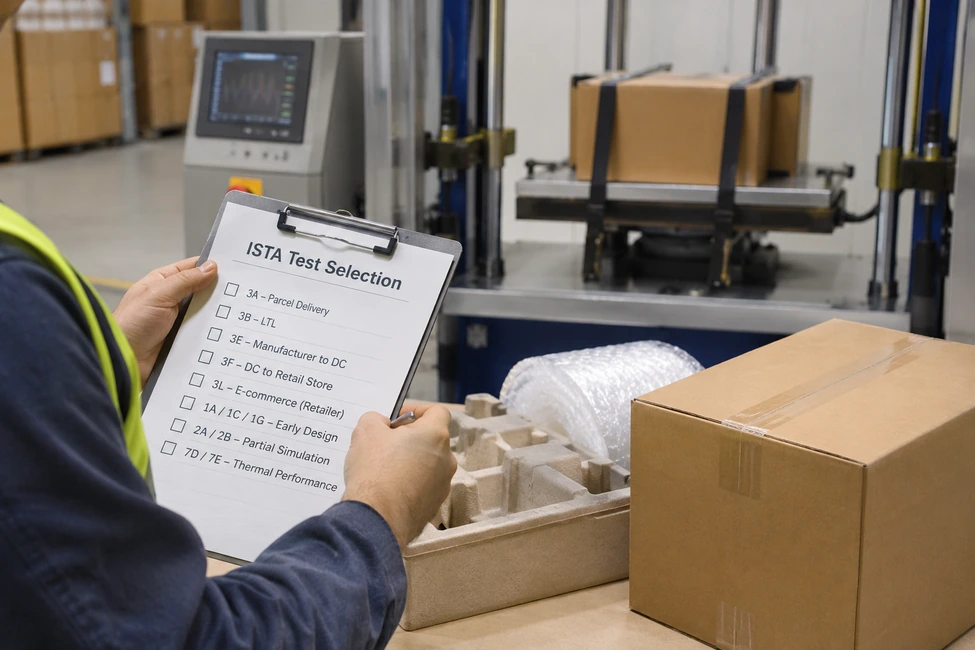
Start with how the product actually ships. ISTA's selection guidance maps distribution types to procedures:
| How the product ships |
Package 150 lb (68 kg) or less |
Over 150 lb |
Pallet load |
| Parcel delivery, North America |
3A |
Not applicable |
Not applicable |
| LTL (less-than-truckload) |
3B |
3B |
3B |
| Manufacturer to distribution center |
Not applicable |
Not applicable |
3E |
| Distribution center to retail store |
3F |
Not applicable |
Not applicable |
| E-commerce fulfilled by a retailer |
3L or that retailer's 6-Series procedure |
3L or that retailer's 6-Series procedure |
3L or that retailer's 6-Series procedure |
| E-commerce direct from manufacturer to consumer |
3A |
3B |
3B |
| Warehouse club stores |
That club's 6-Series procedure |
That club's 6-Series procedure |
That club's 6-Series procedure |
| Early design screening |
1A, 1C, 1G |
1B, 1D, 1H |
1E |
| Partial simulation |
2A |
2B |
Not applicable |
| Thermal performance |
7D, 7E |
7D, 7E |
Case by case |
Always use the current version of the procedure. ISTA updates its tests, and some buyers require a specific version.
Preparing Your Packaging Before Testing
Most failures come down to a few predictable issues. Check these before you send samples to a lab:
- Product movement: If the product can shift, it will hit a wall during drops. Use fitted inserts or enough cushioning to hold it still.
- Corner and edge protection: Corners take the hardest hits in drop sequences.
- Box strength: Match board grade to product weight and the stacking it will see.
- Closures: Seal with the H-tape method; open flaps are a common early failure.
- Liquids and powders: Use secondary seals and leak-proof bags, especially if the optional low-pressure test applies.
- Package type in 3A: Check whether your pack counts as standard, small, flat, or elongated, since the test sequence changes. Lightweight mailer shipping boxes often fall into the small or flat categories.
Custom Packaging Pro designs custom shipping boxes and inserts for US businesses, sized to the product and its distribution, with free design support. A pack designed with the test in mind is much more likely to pass on the first round.
Frequently Asked Questions
- What is ISTA packaging testing?
ISTA packaging testing is a set of standardized lab procedures that expose a packaged product to shipping hazards such as drops, vibration, compression, and temperature and humidity, then check whether the product and package survived within agreed limits.
- What does ISTA stand for in packaging?
ISTA stands for the International Safe Transit Association, an organization of shippers, carriers, suppliers, labs, and universities that publishes transport packaging test procedures and certifies testing labs.
- What are the ISTA testing procedures?
ISTA groups its procedures into series: 1-Series integrity screening (such as 1A), 2-Series partial simulation (such as 2A), 3-Series general simulation (such as 3A for parcel and 3B for LTL), 4AB enhanced simulation, 6-Series member procedures for specific retailers, and 7-Series development and thermal tests.
- Is ISTA testing required by law?
No. ISTA procedures are voluntary consensus standards. They become required when a buyer, retailer, marketplace, or your own company specification calls for them.
- Can you run ISTA tests in-house?
Yes, for design and development decisions. For ISTA certification of a packaged product, the test must be run by an ISTA certified lab and the report submitted to ISTA.
- What are the different types of packaging testing?
Transit performance tests (drop, shock, vibration, compression, atmospheric conditioning, and low pressure) check the packaged product as a system. Material tests check individual components, such as edge crush and burst tests for corrugated board.
- What are the ASTM standards for packaging testing?
ASTM D4169 is the main ASTM practice for performance testing of shipping containers and systems. ISTA procedures also reference ASTM apparatus standards, including D5276 (drop), D999 (vibration), D4728 (random vibration), D642 (compression), and D4332 (conditioning).

 Custom Boxes
 Mailer Boxes
 Shipping Boxes
 Display Boxes
 Product Boxes
 Retail Packaging
 Luxury Packaging
 Sustainable Packaging
 Mylar Bags
 Labels & Stickers
 Inserts & Dividers
 Acrylic Signs
 Mylar and Zipper Bags
 Cosmetic Boxes
 Custom Candle Packaging Boxes
 Food and Beverage
 Display Packaging
 Pharma Packaging
 Custom Blister Packaging
 Stand Up Displays
 Kraft Boxes
 Cereal Packaging Boxes
 Bakery Packaging Boxes
 Eco-Friendly Boxes
 Electronics Packaging Boxes
 Custom Vape Boxes & Packaging
 CBD Packaging Boxes
 Rigid & Luxury Packaging Boxes
 Gift Boxes
 Custom Soap Boxes & Packaging
 Metalized Boxes
 Retail Boxes
 Subscription Boxes
 Invitation Boxes
 Corrugated Shipping Boxes
 Custom Apparel Boxes