By Rai Haider
October 14, 2026
Edge Crush Test (ECT) Explained: 32 ECT vs 44 ECT vs 200# Burst Test
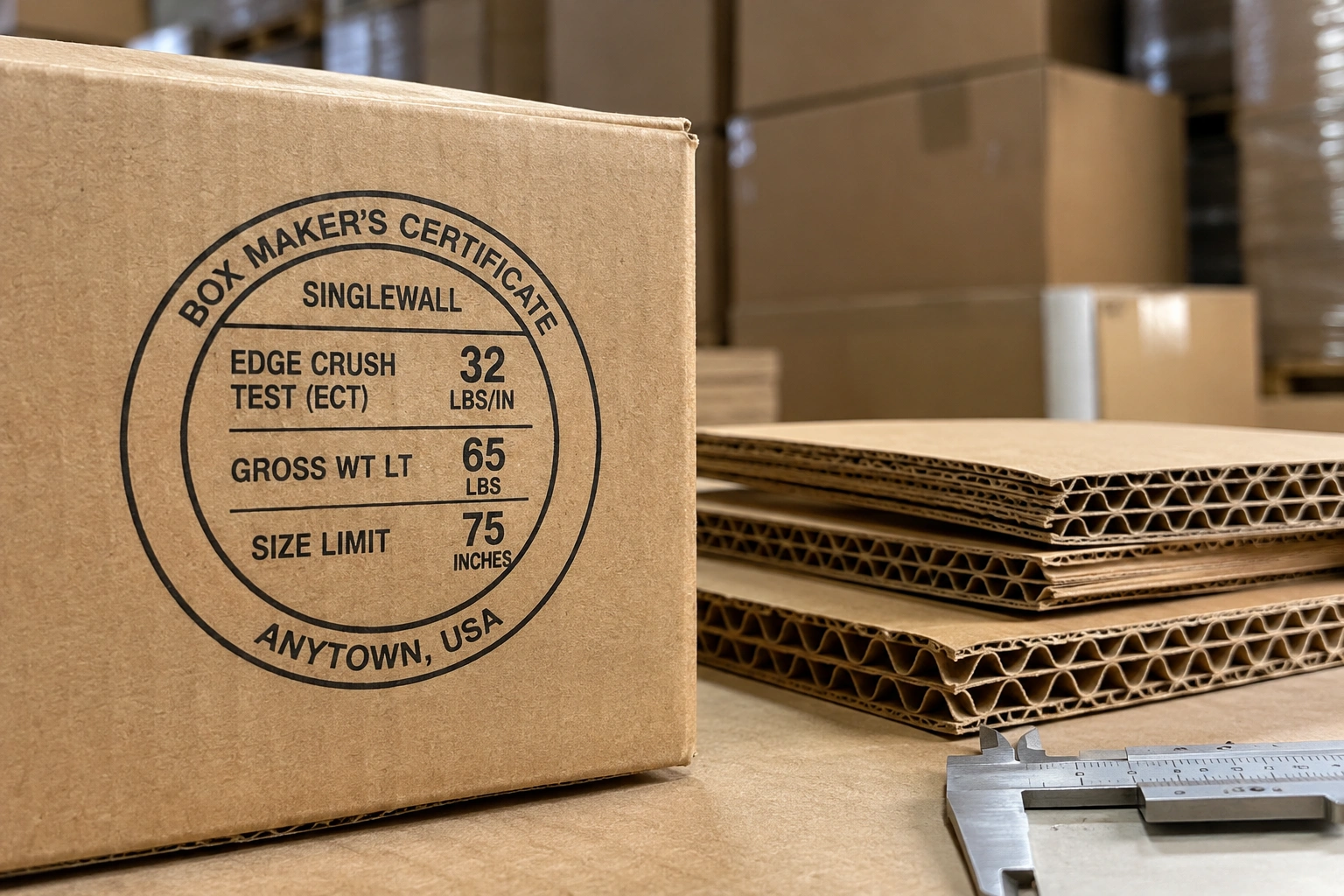
Every corrugated shipping box has a strength rating, usually printed in a small round stamp on a bottom flap. The most common rating today comes from the edge crush test (ECT). If you have seen "32 ECT" or "200 lb test" on a box and wondered what it means, or which one your products need, this guide explains it.
Quick answer: The edge crush test measures how much force a strip of corrugated board can take on its edge before it crushes. A 32 ECT rating means the board held at least 32 pounds of force per linear inch of edge. ECT predicts stacking strength. The older 200# burst (Mullen) test measures how much pressure the board's face can take before it ruptures, which relates to puncture and rough-handling resistance.
The two ratings answer different questions and are not interchangeable.
What Is the Edge Crush Test?
The edge crush test is a lab test that measures the edgewise compressive strength of combined corrugated board. A small sample is cut from the board, stood on its edge with the flutes running vertically, and pressed between two flat platens until it fails. The peak load is recorded.
The result is expressed in pounds per linear inch of edge (lb/in). In metric, ISO 3037 reports the same property in kilonewtons per meter (kN/m). For reference, 32 ECT is about 5.6 kN/m and 44 ECT is about 7.7 kN/m.
ECT matters because a box's side walls work like columns. When boxes are stacked on a pallet or in a warehouse, the vertical panels and corners carry the load from above. Board that resists crushing on its edge makes a box that resists collapsing in a stack.
Official Test Methods
In the US, edge crush testing follows standards from TAPPI (Technical Association of the Pulp and Paper Industry).
| Standard |
What it covers |
| TAPPI T 811 |
Edgewise compressive strength of corrugated fiberboard (short column test). The reference method, with wax-reinforced edges. |
| TAPPI T 839 |
Clamp method, often used for routine quality control |
| TAPPI T 838 |
Neckdown method, also used for routine control |
| ISO 3037 |
International method for edgewise crush resistance |
Burst strength uses a different method, TAPPI T 810. Whole-box compression is tested to TAPPI T 804 or ASTM D642.
What Does 32 ECT Mean?
"32 ECT" means the combined board tested at a minimum of 32 lb of force per inch of edge width before crushing. It is the most common rating for single-wall shipping boxes in the US.
One mistake shows up in a lot of online explanations: ECT is not measured in pounds per square inch. Burst strength is measured per square inch. ECT is measured per linear inch. That difference is part of why the two numbers can't be converted directly.
A 32 ECT rating also does not mean a box can hold 32 pounds, or that it can carry 32 pounds stacked on top. The weight a box can carry depends on its size, the board thickness, how long it is loaded, humidity, and how it is stacked.
Where to Find the Rating on a Box
Look for the Box Maker's Certificate (BMC), a circular stamp usually printed on a bottom flap. An ECT-certified box lists:
- Edge crush test value (for example, 32 ECT)
- Gross weight limit (the maximum weight of box plus contents)
- Size limit (length + width + depth, in inches)
- Box maker's name and location
A burst-certified box shows "Bursting Test" with a value such as 200 lb per square inch, plus a minimum combined weight of facings. A box carries one certification type or the other.
How the Edge Crush Test Is Performed
- Condition the samples: Board is held in a controlled lab atmosphere (TAPPI T 402 conditions) so moisture content is consistent. Paper fibers absorb moisture, and wet board tests weaker.
- Cut the specimens: Small rectangular samples are cut with clean, parallel edges exactly perpendicular to the faces. TAPPI's guidance stresses that poor cutting gives unreliable results.
- Prepare the edges: For the reference method (T 811), the loading edges are dipped in paraffin so they don't fail early.
- Load the sample: The specimen stands on edge with flutes vertical, and a compression tester presses down at a controlled rate.
- Record the peak load: The maximum force is divided by the specimen width to give lb/in. Several specimens are averaged.
Edge Crush Test vs Burst Test (Mullen)
For decades, the Mullen burst test was the standard. A rubber diaphragm pushes against the face of the board until it ruptures, and the result is reported in pounds per square inch (for example, 200#).
In 1990, US corrugated industry trade associations proposed changes to the freight classification rules (NMFC Item 222 and UFC Rule 41) so that ECT could be used as an alternative to burst strength. Today, either rating can certify a box.
| Feature |
Edge Crush Test (ECT) |
Burst Test (Mullen) |
| What it measures |
Edgewise compression of the board |
Pressure needed to rupture the board face |
| Unit |
lb per linear inch |
lb per square inch |
| Example rating |
32 ECT, 44 ECT |
200#, 275# |
| Predicts |
Stacking and compression strength |
Puncture and rough-handling resistance |
| Material rule |
No minimum liner basis weight |
Requires a minimum combined weight of facings |
| Best fit |
Palletized loads, warehouse stacking, retail distribution |
Heavy or sharp contents, rough handling, contents pressing outward |
| Test method |
TAPPI T 811 / T 839 / T 838 |
TAPPI T 810 |
The material rule is the practical difference. Burst-certified board must meet a minimum liner weight. ECT-certified board only has to meet the performance number. That allows manufacturers to use lighter or more recycled board that still reaches the required stacking strength, often giving a lighter box with the same compression performance.
The trade-off is that a lighter ECT board can have lower burst and puncture resistance than an equivalent burst-rated board. If your products are dense, have sharp corners, or go through rough single-parcel networks, that matters.
ECT to Mullen Equivalency Chart
The freight classification rules (NMFC Item 222 and UFC Rule 41) list burst and ECT grades side by side for the same maximum weight and size limits. This is where most "32 ECT equals 200#" charts come from.
| Wall |
Max weight of box + contents (lb) |
Max size, L+W+D (in) |
Burst test |
ECT |
| Single |
65 |
75 |
200# |
32 |
| Single |
80 |
85 |
250# |
40 |
| Single |
95 |
95 |
275# |
44 |
| Single |
120 |
105 |
350# |
55 |
| Double |
80 |
85 |
200# |
42 |
| Double |
100 |
95 |
275# |
48 |
| Double |
120 |
105 |
350# |
51 |
| Double |
140 |
110 |
400# |
61 |
| Double |
160 |
115 |
500# |
71 |
| Double |
180 |
120 |
600# |
82 |
| Triple |
240 |
110 |
700# |
67 |
| Triple |
260 |
115 |
900# |
80 |
| Triple |
280 |
120 |
1100# |
90 |
| Triple |
300 |
125 |
1300# |
112 |
How to read this chart: each row is a pair of alternative certifications for the same weight and size class. It does not mean the boards perform identically in every test. A 200# board and a 32 ECT board qualify for the same freight class, but one may stack better while the other resists puncture better.
32 ECT vs 44 ECT vs 200# Burst: Which One Do You Need?
| Feature |
32 ECT |
44 ECT |
200# Burst |
| Construction |
Usually single wall |
Usually single wall with heavier or stronger liners |
Single wall |
| Freight class limit (Item 222 / Rule 41) |
65 lb, 75 in |
95 lb, 95 in |
65 lb, 75 in |
| UPS single-wall parcel guideline |
Up to 30 lb, 75 in |
Check current UPS chart |
Up to 40 lb, 75 in |
| Main strength |
Stacking |
Stacking (about 38% higher ECT than 32) |
Burst and puncture resistance |
| Common uses |
General e-commerce, retail cartons, light to medium products |
Heavier products, taller pallet stacks, longer warehouse storage |
Rough handling, dense or sharp items |
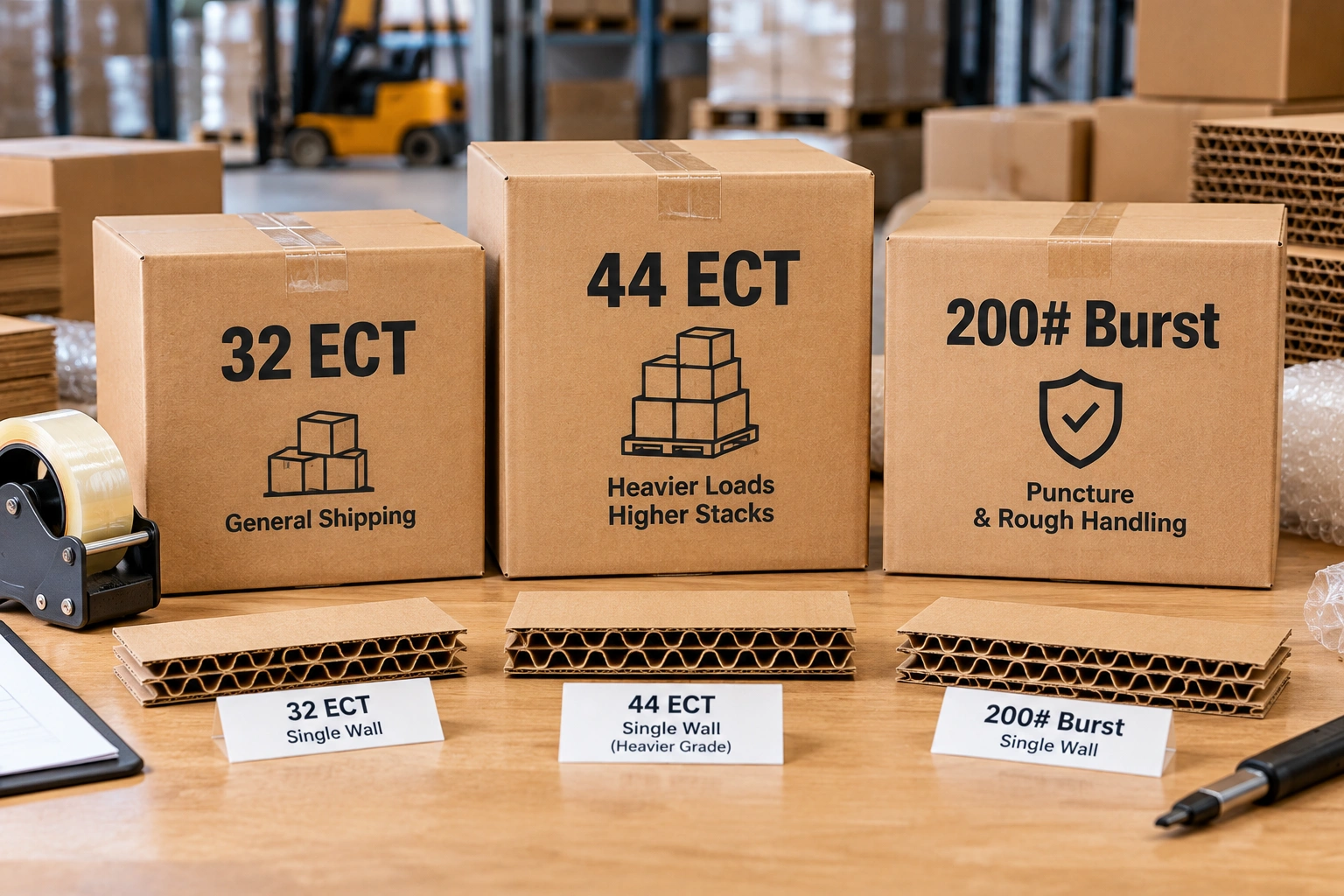
- Choose 32 ECT for most standard shipping boxes holding light to medium products, especially when boxes are palletized or stacked moderately.
- Choose 44 ECT when boxes will be stacked high, stored for weeks or months, kept in humid spaces, or carry heavier products. Moving from 32 to 44 ECT is often enough to avoid going to double wall.
- Choose 200# burst when the main risk is puncture or rough handling rather than stacking, for example heavy, compact items shipped one at a time through parcel networks.
If both stacking and rough handling are concerns, double-wall board (such as 48 ECT or 275# double wall) is usually the next step.
32 ECT Box Weight Limit: Two Different Answers
Searches for "32 ECT box weight limit" turn up two different numbers, and both are correct in their own context.
- Freight classification (palletized LTL and rail): NMFC Item 222 and UFC Rule 41 allow a 32 ECT single-wall box up to 65 lb gross weight and 75 united inches (L + W + D). This is the number printed on the BMC.
- UPS small-parcel guidelines: UPS publishes its own Box Strength Guidelines for single-package shipping. These list 32 ECT single-wall boxes for up to 30 lb within 75 united inches, and 200# burst for up to 40 lb. UPS states that BMC weight limits are meant for palletized freight, not small-parcel networks, where boxes get dropped, tossed, and sorted on conveyors.
If you ship individual parcels, the lower carrier guideline is the safer limit. Carrier guidance changes, so check the current UPS packaging guidelines (ups.com/packaging) and your FedEx or USPS account rules before you finalize a spec. UPS also recommends testing packaged products to ISTA procedures (such as ISTA 3A) rather than relying on board grade alone.
The freight rules include a size provision: if the gross weight is below the table maximum, the maximum outside dimensions may be increased by half the percentage that the actual weight is below the limit. This applies only to the freight classification, not to parcel carrier guidelines.
Some large retailers also set their own corrugated specs. Walmart's supply chain standards, for example, require a BMC on corrugated cases with a minimum rating of 200 lb per square inch, matched to product weight.
Box Compression Test (BCT) and Stacking Strength
ECT tests the board. The box compression test (BCT) tests the finished box. An empty box is placed in a compression tester and loaded top to bottom until it buckles. BCT is the most direct measure of how much load a box can carry, but it requires sample boxes and lab equipment.
Estimating BCT from ECT: The McKee Formula
In 1963, R.C. McKee published a formula for estimating box compression strength. The simplified version, still widely used in the corrugated industry, is:
$$\text{BCT} = 5.87 \times \text{ECT} \times \sqrt{\text{caliper} \times \text{perimeter}}$$
- BCT = estimated top-to-bottom compression strength (lb)
- ECT = edge crush value (lb/in)
- Caliper = board thickness (in)
- Perimeter = 2 × (length + width) of the box (in)
The formula works best for empty single-wall regular slotted containers (RSC). It is less reliable for other box styles, filled boxes, and very short or very tall boxes, so treat it as an estimate, not a guarantee.
You can also run it in reverse to find the ECT you need:
$$\text{Required ECT} = \frac{\text{Target BCT}}{5.87 \times \sqrt{\text{caliper} \times \text{perimeter}}}$$
Worked Example
Take a 12 × 10 × 8 in RSC made from C-flute board about 0.159 in thick (typical caliper for 200#-class C-flute). The perimeter is 2 × (12 + 10) = 44 in, and $\sqrt{0.159 \times 44} \approx 2.645$.
| Board |
Estimated BCT (lb) |
| 32 ECT |
$5.87 \times 32 \times 2.645 \approx 497$ |
| 44 ECT |
$5.87 \times 44 \times 2.645 \approx 683$ |
This example holds caliper constant to isolate the effect of ECT; real 44 ECT board may have a slightly different caliper. Either way, 497 lb is a lab number for one new, empty box under ideal conditions. Warehouses are not ideal.
Why Real Stacking Strength Is Lower Than BCT
The Fibre Box Association (FBA) publishes environmental factors that reduce compression strength in real distribution. The commonly cited factors from the Fibre Box Handbook include:
| Condition |
Approximate compression loss |
| Storage under load, 10 days |
37% |
| Storage under load, 30 days |
40% |
| Storage under load, 90 days |
45% |
| Storage under load, 180 days |
50% |
| Relative humidity 60% |
10% |
| Relative humidity 70% |
20% |
| Relative humidity 80% |
32% |
| Relative humidity 90% |
52% |
| Columnar stacking, misaligned |
10-15% |
| Interlocked stacking |
40-60% |
| Pallet overhang |
20-40% |
| Pallet deckboard gaps |
10-25% |
| Excessive handling |
10-40% |
More recent FBA research has refined some of these. A study with Rochester Institute of Technology on 32 ECT and 44 ECT boxes found 12-20% loss even for columnar aligned stacks, higher than the handbook's original estimate, and 49-54% loss for interlocked stacks. FBA work with Virginia Tech found pallet overhang losses can range from 0% to 40% depending on board type, box perimeter, and overhang amount.
Applying It to the Example
Say the boxes sit in a warehouse for 90 days (×0.55) at 70% humidity (×0.8), stacked in aligned columns (×0.85):
- 32 ECT: $497 \times 0.55 \times 0.8 \times 0.85 \approx 186$ lb of safe load on the bottom box
- 44 ECT: $683 \times 0.55 \times 0.8 \times 0.85 \approx 256$ lb
If each filled box weighs 25 lb, the bottom 32 ECT box can support about 7 boxes on top (8 high). The 44 ECT version supports about 10 on top (11 high). This assumes the product inside carries no load. Products that support the box walls add strength, while loose or soft products don't.
Interlocking pallet patterns are popular because they make loads more stable, but they can cut box compression strength roughly in half. If boxes are failing at the bottom of a pallet, stacking pattern is one of the first things to check.
Does Flute Type Change the Rating?
ECT is a property of the board, so a 32 ECT E-flute board and a 32 ECT C-flute board both meet the same edge crush minimum. They won't make equally strong boxes, though. The McKee formula includes caliper, so thicker board (C or A flute) gives higher box compression at the same ECT. Thinner flutes (E and F) print better and suit mailer shipping boxes and retail cartons, but they give up some stacking strength.
| Flute |
Approx. thickness (in) |
Typical use |
| F |
1/32 |
Small retail packaging, fine printing |
| E |
1/16 |
Mailers, retail boxes, custom printed cartons |
| B |
1/8 |
Retail, displays, smaller shippers |
| C |
11/64 |
Standard shipping cartons (most common) |
| A |
1/4 |
Maximum cushioning and stacking |
Wall construction matters too. Single wall has one fluted medium between two liners. Double wall has two mediums and three liners. Triple wall has three mediums and four liners, for heavy industrial or bulk loads.
How to Choose the Right Box Strength
- Weigh the packed box: Include the product, inserts, void fill, and the box itself.
- Measure united inches: Add outside length, width, and depth.
- Identify the shipping mode: Small parcel (UPS, FedEx, USPS) or palletized freight. Use carrier guidelines for parcels and Item 222 / Rule 41 for freight.
- Decide what the main risk is: Stacking and storage point to ECT. Puncture and rough handling point to burst strength.
- Estimate the stack load: Multiply the weight of one filled box by the number of boxes stacked on top.
- Apply environmental factors: Account for storage time, humidity, pallet pattern, and overhang.
- Work back to the ECT you need: Use the reverse McKee formula, then choose the next standard grade up.
- Test before scaling: Run box compression or ISTA tests on samples, especially for high-value or heavy products.
Specifying Strength for Custom Shipping Boxes
When you order custom shipping boxes, board grade should be part of the spec alongside size and print. Include:
- Packed weight per box
- Inside dimensions
- Shipping mode (parcel, LTL, or both)
- Expected stack height and storage time
- Storage conditions (climate-controlled or humid)
- Required ECT or burst grade, if you already know it
- Flute and wall preference (single, double, or triple)
Custom Packaging Pro produces corrugated shipping boxes, custom printed corrugated boxes, and kraft corrugated boxes for US businesses, with free design support. If you're not sure which grade fits your product, share your weights and shipping details when you request a quote and the team can help match the board to the job.

Frequently Asked Questions
- What does ECT stand for on a box?
ECT stands for Edge Crush Test. The number after it, such as 32 or 44, is the minimum edgewise compression strength of the board in pounds per linear inch.
- Is 32 ECT the same as 200 lb test?
No. They qualify for the same freight weight and size class (65 lb, 75 united inches) under NMFC Item 222 and UFC Rule 41, but they measure different properties. 32 ECT measures stacking strength. 200# measures burst strength. UPS's parcel guidelines also give them different weight limits.
- What is 32 ECT equal to in Mullen?
On the freight classification charts, 32 ECT single wall sits in the same row as 200# burst. Similarly, 44 ECT sits with 275#, and 40 ECT with 250#. These are alternative certifications, not direct conversions.
- How much weight can a 32 ECT box hold?
For palletized freight, the certified gross weight limit is 65 lb within 75 united inches. For UPS small-parcel shipping, the guideline is 30 lb. Stacking capacity is a separate question and depends on box size, board caliper, humidity, storage time, and stacking pattern.
- Is 44 ECT double wall?
Not usually. 44 ECT is typically a heavier single-wall board. Double-wall grades start at around 42 ECT and go up to 82 ECT and beyond.
- What is the difference between ECT and BCT?
ECT tests a small sample of the board on its edge. BCT tests a whole finished box from top to bottom. ECT is used to estimate BCT through the McKee formula, but only a BCT test shows how a specific box design performs.
- Is ECT or burst strength better?
Neither is better overall. ECT is a better predictor of stacking and compression performance, which matters most for palletized and warehoused goods. Burst strength is a better indicator of puncture and rough-handling resistance. Choose based on how your boxes fail.
- Why are ECT-rated boxes often lighter?
Burst certification requires a minimum liner basis weight. ECT certification only requires the board to reach a performance number, so manufacturers can use lighter or higher-recycled-content board and still meet the stacking requirement.

 Custom Boxes
 Mailer Boxes
 Shipping Boxes
 Display Boxes
 Product Boxes
 Retail Packaging
 Luxury Packaging
 Sustainable Packaging
 Mylar Bags
 Labels & Stickers
 Inserts & Dividers
 Acrylic Signs
 Mylar and Zipper Bags
 Cosmetic Boxes
 Custom Candle Packaging Boxes
 Food and Beverage
 Display Packaging
 Pharma Packaging
 Custom Blister Packaging
 Stand Up Displays
 Kraft Boxes
 Cereal Packaging Boxes
 Bakery Packaging Boxes
 Eco-Friendly Boxes
 Electronics Packaging Boxes
 Custom Vape Boxes & Packaging
 CBD Packaging Boxes
 Rigid & Luxury Packaging Boxes
 Gift Boxes
 Custom Soap Boxes & Packaging
 Metalized Boxes
 Retail Boxes
 Subscription Boxes
 Invitation Boxes
 Corrugated Shipping Boxes
 Matte Finish
 Gloss Finish
 Soft Touch
 Foil Stamping
 Spot UV
 Embossing
 Debossing
 Window Cutouts